
What matters most: You don't have to invent a workbook. You package the client work you already do. Find the smallest useful piece, turn its steps into prompts, and write it the way you talk on a call. Then tidy it until it's clear and easy to use, not perfect, and you've got a product you can sell.
A new client books with you, and you attach the same intake sheet to your welcome email, the way you've done for years. You hit send without a second look. It's a small, ordinary moment, and yet that sheet may be the best product you own.
So much of your best work stays locked inside your two-on-one calls. There's the method that changes a client's week, the question that cracks a problem open and the template three clients asked to keep. It all lives in a folder, waiting for a free week that never seems to come.
We'd love to help you turn your coaching method into a step-by-step workbook. You'll use the client work you already do. You won't need to invent anything new, because you'll package what already works.
We spent decades inside busy, high-pressure companies, working with data, strategy and sales. The method underneath our work is one Coach Shayla created in 2011 and still coaches from today. Coach Carlton built systems that turned big ideas into real results.
Now we build our own schools and products every day. We know how it feels when a big idea stalls, and we know how good it feels when a small product ships.
The workbook you need is already in your client files, and we'll help you find it.
If you've been stuck, please know it isn't because you don't know enough. It's a size problem. You picture the biggest possible version of the thing, and then your calendar takes the blame.
A workbook doesn't need twelve modules. It needs one clear path, one outcome and a reader who can finish it. We'll show you how to get there without waiting for an empty week.
Key takeaways
- Your best product is already in your client files, and real clients have already tested it.
- Find the smallest piece of your method that gives a full result on its own.
- Outline your steps by putting your client work in the order a client would follow it.
- Write your workbook in plain, warm words, as if you're talking to one person.
- Cut anything that doesn't move the reader toward the workbook's one outcome.
- Get it ready to sell by making it clear and easy to use, not perfect.
Why Your Best Product Is Already Done
In 2026, the most valuable thing a coach can sell is rarely a brand-new idea. It's a clear, ordered version of help you already give two-on-one, week after week, without even thinking about it. Your product is done, and it simply hasn't been packaged yet.
It's easy to spend months trying to invent something original. You might sketch formats and outlines, or ask the internet what coaches should sell. Meanwhile, the answer sits quietly in a client folder.
It's the intake sheet you've rebuilt for every new client, or the check-in template three people asked to keep.
It's the question you answer in under a minute because you've explained it a hundred times. That isn't rough material. It's a finished product that's been wearing a different name.
The story below is an illustration, not a client case.
Meet Scott Renner, a coach in his mid forties. For years, he's been shaping an intake sheet that new clients find helpful before their first two-on-one call. Priya Shah, one of his clients, told him it calmed her down before they ever spoke.
Scott never saw that sheet as a product, because to him it was only paperwork.
But the sheet already does what a good workbook does. It walks a person down a clear path, asks useful questions and leaves them better prepared than before. Scott didn't need to create anything new. He only needed to see what he'd already made.
Worth sharingThis is the shift that matters. Most coaches think the job is creating a product. The more useful way to see it is packaging one.
Your client work has already been tested in the real world. Real people have used it, gained from it and sometimes asked to keep it.
That's stronger proof than any idea you could dream up on a blank page. Coach Shayla spent decades in people analytics, turning messy data into clear answers for senior leaders. The best dashboards were never the ones built from scratch on a hunch.
They were the ones that showed what the data already said, cleanly and in order. A workbook works the same way.
The trap is believing that bigger is better. A coach with a full calendar pictures a twelve-module course, and its size becomes the reason it never ships. But a small, specific piece of client work can stand on its own.
A template can sell, and so can a checklist.
A twenty-page workbook can sell, too. So the real question isn't whether you've got enough content. It's which piece of what you already do deserves to go first.
That's worth sitting with for a moment. Your best product isn't waiting for a free week or a burst of inspiration. It's already in your files, already tested and already useful. Your next step is to find the smallest piece of it and give it a shape.
Find Your Workbook's Smallest Useful Piece
Scott keeps a one-page intake sheet in a folder on his desktop. He sends it to every new client before their first two-on-one session. When Priya filled it out last month, she told him it made her name a goal she'd been circling for weeks.
That sheet isn't a workbook yet. It's the smallest useful piece of one, and it already does a whole job. It helps a client get clear on what they want before the real work begins.
So here's the simple answer: find the smallest part of your coaching method that still gives a full result on its own. That might be one intake sheet, a check-in template or a five-question reflection exercise. If a client would pay for that piece by itself, or if it changes how they show up to a session, it counts. Size isn't the test. The test is whether the piece ends somewhere useful without you standing next to it.
Trying to fit in too much is what quietly stops most workbooks. It's tempting to open a blank page and pour your whole method into it. Then it grows into a half-finished project that never ships.
A kinder way is to break your method into its separate steps and tools. Then ask which one a client could use alone. The questions clients ask you most are a great place to look.
So are the exercises you repeat with every client, the ones you could run in your sleep.
The Weekend-Sized Test
We call this a weekend-sized product. If you can't finish a clean, usable version between Saturday morning and Sunday evening, it's still too big, so cut it down again.
A template can sell, and so can a checklist or a short workbook.
What matters is that your first version fits inside a real weekend. It shouldn't wait for a free week that may never arrive.
This is how we'd sort Scott's options:
- The intake sheet: It's already written and already used, and it solves one clear problem. It's weekend-sized.
- The goal-setting exercise from session three: It's strong, but it needs what clients learn in sessions one and two. It's too big for now.
- The mid-program check-in template: It works on its own, but it feels less pressing to a client than the intake sheet. It's a close second.
Scott's intake sheet wins because it's the first thing a new client touches. It doesn't need an introduction or a backstory.
It needs a title, a few short instructions and a little polish. That's a Saturday's work, not a season's.

We'd pick the intake sheet every time. It isn't the most impressive choice, but it's finished. The impressive version can come later, once your first small product shows that your method holds up without you on the call.
If you're not sure which piece of your work should go first, that's the exact job of our Client-Work-to-Product Finder. You list the client work you've already delivered in one simple table, and it points you to the smallest piece worth selling. By the end of the afternoon, you've picked one row and given it a real Saturday.
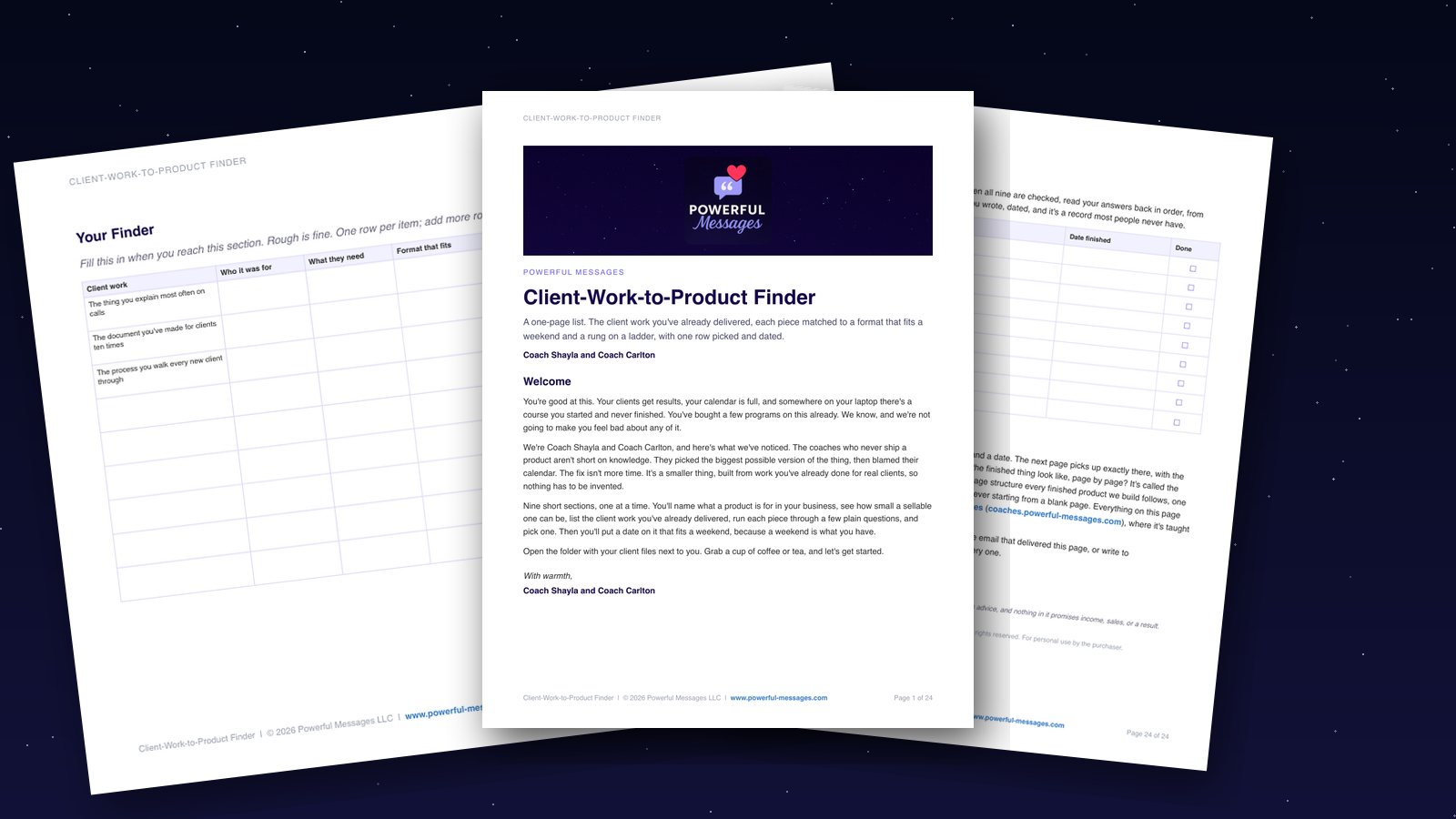
Client-Work-to-Product Finder
helps you turn an answer you give clients into a product you can sell.
Get the Client-Work-to-Product FinderOutline Your Coaching Method's Steps
An outline isn't a creative task. It's really a sorting task. You take the piece of client work you picked and put its parts in the order a client really moves through them. Then your outline answers three simple questions: what happens first, what happens next and what the reader knows by the end.
Marcus Bell, Scott's accountability partner, gave him a simple idea. He told Scott to list every question from the intake sheet and turn each one into its own prompt for the workbook.
That one move turns a form Scott already uses into a natural, step-by-step flow, and it doesn't need any new content.
The questions he asks in the first ten minutes of a paid session become the first ten pages of a product.
We like this approach because it takes away the hardest part of outlining, which is deciding what belongs. The intake sheet already has an order. It starts broad, narrows down to details and ends with a promise the client makes to themselves.
That's a structure already. Many coaches fight the blank page because they believe an outline has to be clever.
It doesn't need to be clever, because it only needs to feel familiar.
One Clear Outcome Per Step
Each step in your outline should carry one outcome instead of a topic. A topic is "goals." An outcome is "the reader names the goal they have been avoiding." That difference matters. When a step has an outcome, you know what the prompt should ask. When it only has a topic, you end up writing long explanations instead of an exercise.
Scott's intake sheet asks what the client has tried before. As a workbook step, that becomes a prompt: write down the last three things you tried and why each one stalled. The reader does the work. Scott's method stays whole, but now the client can move through it without him on the call.
We'd rather see five steps with sharp outcomes than twelve steps with fuzzy ones. Feel free to cut anything that doesn't move the reader toward the one result your workbook promises.
Turn Steps Into Prompts
Worth sharingA workbook outline isn't a table of contents. It's a chain of prompts. Each step ends with an instruction the reader can follow in a few minutes.
The Client-Work-to-Product Finder guides coaches toward this same idea, with one piece of client work, one format and one rung. Your outline is where that idea becomes easy to see.
Scott's outline now has a steady rhythm. There's a question, then a prompt, then space to write, and then it starts again.
The reader never wonders what to do next. That rhythm is what makes a workbook feel doable, and it's the same rhythm Scott uses on a call.
If you'd like a guide while you build, Digital Products Academy for Coaches, our self-paced school, has a full module on the workbook. It covers when a workbook is the right format, how to map your process into pages and how to write prompts that really work. You build yours as you go, at your own pace.
Scott's product isn't a new method. It's his method, written down in the order he already shares it.

Write Workbook Content for Your Reader
Writing a workbook is more like translating than writing. You take the words you already say on calls and put them on the page, so a stranger can follow them alone. Your reader can't see your face, hear your tone or ask a question. So every sentence has to carry its own warmth and its own clarity.
We write at a 5th to 6th grade reading level. That isn't dumbing anything down. It's clearing the path between your reader and their next step, and plain writing reaches more people. In 2023, 28% of U.S. adults scored at the lowest literacy levels (National Center for Education Statistics, PIAAC, 2024).
So use short sentences and everyday words, with one idea on each line.
When Scott sat down to write his workbook's introduction, he remembered how Priya struggled to get clear in their early calls. She didn't need more information.
She needed a calm voice saying, "Start here, and we'll take the next step together." So he wrote that first section like a talk across a table. He used the same words he'd use in a two-on-one call. That's really the whole trick.
Jargon is the fastest way to lose a beginner. A phrase like "cognitive reframing protocol" means something to you. But it means nothing to the person holding your workbook at the kitchen table. Instead, say "notice the thought, then name what is actually true." If a word wouldn't come out of your mouth on a call, leave it off the page.
A workbook that sounds like a textbook makes readers stall by page three. They aren't confused by your method.
They're confused by your words. An Ohio State University study of 650 adults found jargon made readers lose interest. Defining the terms didn't help (Shulman and others, Journal of Language and Social Psychology, 2020).
Clear instructions do the heavy lifting. Each prompt should tell the reader exactly what to do, what to write and when to stop. A prompt like "reflect on your patterns" is vague, and it's a little tiring to read.
Instead, try "Write down the last time you felt this. What happened right before it?" A person can answer that in two minutes.
The best workbook pages aren't meant to impress anyone. They're meant to be used.
Examples your reader can relate to matter more than perfect ones. You don't need made-up testimonials or fake client stories. You need small, ordinary moments your reader will recognize.
A coach who helps people with morning dread might write, "Maybe you check your phone before your eyes are fully open. Write what you reach for first." That isn't a case study.
It's a mirror. Scott does this by using the questions Priya asked him, instead of making up a success story about her. The reader feels seen, and nobody is misled.
We keep this short list in front of us when we write workbook pages:
- Give one instruction per step, never two.
- Use the word "you" like you're sitting across from them.
- Cut any sentence longer than fifteen words.
- Swap jargon for the phrase you'd say out loud.
- Give a tiny example, then ask the reader to write their own.
Worth sharingThat last point is where most workbooks go soft. They explain, but they don't invite. A workbook isn't a lecture.
It's a set of small invitations, and each one says, "Your turn." Your reader should finish a page with ink on it. A warm feeling from reading something nice isn't enough.
We'd rather see ten plain prompts that get answered than fifty fancy ones that get skimmed. Skimming is normal, too. Nielsen Norman Group found people read only about 20% of the words on an average web page (Nielsen, 2008). The plain version ships, while the fancy version sits in a folder.
A workbook that gets answered is also the one a reader tells a friend about. That's the quiet engine behind it all, because useful things spread while polish only sits there.
Refine and Prepare Your Workbook to Sell
The Small Enough to Finish check turns a finished draft into a product you can sell. It's a simple list of boxes, one for each section, and it tells you when to stop editing. Your workbook is ready when each section is clear, complete and useful, even if it isn't perfect.
Scott used this check on his workbook before Elena Rossi, his first buyer, ever saw it. He didn't rewrite every sentence, and instead he asked three questions about each section. Can a beginner follow it?
Does it give one result? Is anything missing that would stop someone from finishing?
Each time he could tick a box, he closed that section and moved on.
- Read each section once, out loud, and mark any sentence that confuses you.
- Check that every prompt has a clear place to write an answer.
- Make sure the format works in both Notion and PDF before you send it.
- Run the good-enough check, and stop when every box is ticked.
Four checks before your workbook ships
- Read each section once, out loud, and mark any sentence that confuses you.
- Check that every prompt has a clear place to write an answer.
- Confirm the format works in both Notion and PDF before you send it.
- Run the good-enough check and stop when every box is ticked.
Layout can surprise you. A workbook that looks clean in Notion can break when you save it as a PDF. Tables shift, spacing collapses, and a page that was easy to scan turns into a wall of text.
So pick one format first and make it solid. Then save the other version and fix only what breaks. Scott chose PDF as his main format, because Elena asked for something she could print and write in by hand.
Your format is worth choosing on purpose. If you're not sure a workbook is right for you, our Pick-Your-Format Guide can help. It matches what you know to a format that fits the hours you really have. You end with one row picked and dated, so you can stop wondering and start building.
Being clear will always beat being polished. A workbook with a few rough edges and a clear path from start to finish will sell. One that's been edited until it feels stiff usually won't. Your goal is a product that feels like a talk with you, not a textbook.

The Client-Work-to-Product Finder includes this same good-enough check as a bonus, and there's a good reason for it. It keeps your work moving toward a buyer instead of circling through endless edits. Scott's workbook shipped on a Saturday afternoon. Elena got it that evening, and the first thing she said was that it felt like sitting across from him.
Conclusion
The product you've been waiting to build isn't waiting for a free week. It's already in your client files, already tested and already paid for in hours you've worked. The smallest useful piece of your method is the one you've explained so often that you can answer it in under a minute.
Picture someone you've never met printing your workbook on a quiet Sunday night. She fills in the first page, and it feels like you're sitting right there with her. That's your workbook, and that's your product.
The only thing it's missing is a date next to it.
We've walked the whole path together, and each step builds on the one before it:
- Your best product is already done. It lives in the intake sheets, check-in templates and answers you repeat on every two-on-one call.
- The smallest useful piece wins. A template, a checklist or a twenty-page workbook can each sell, and you don't need twelve modules to start.
- Outline from what you already say. The steps of your method are the order you follow when a client sits across from you.
- Write for one reader with one problem. Use the words you use on calls, not the words you think a course creator should use.
- Edit by cutting, not adding. If a section doesn't move the reader toward the outcome, it doesn't belong in the first version.
Open your client folder today, and pick the one piece of work you've shared most often. Write down the steps you already follow, in the order you follow them.
Then give that piece a format and a Saturday. If you'd like help making that first pick without guessing, use the Client-Work-to-Product Finder. In one afternoon, it helps you turn your client work into a clear product choice with a date beside it.
Your first product was already there, waiting for you. Now it finally gets a date.
Where to start this week
Before your next welcome email goes out, open the Client-Work-to-Product Finder and pick your first piece. Still torn between a workbook and another format? You can add the Pick-Your-Format Guide. When you're ready to build, price and sell the workbook, join Digital Products Academy for Coaches. And if you'd like a second pair of eyes first, book a Discovery call with Coach Shayla and Coach Carlton. In 30 minutes, we'll look at your method together and help you choose which piece to package first.
 Scott RennerA coach building his first productMeet Scott →
Frequently asked questions
Can I turn my coaching method into a step-by-step workbook if I don't have an audience?
Yes, you can. Your first product should come from the client work you already do, not from a new audience. Start with the twenty people who already know your work and would gain from a small, focused product based on what you teach them.
How small can a digital product be for coaches?
It can be very small. Think of a template, a checklist or a short workbook that solves one problem your clients often ask about. The goal is to keep it small enough to finish in a weekend, which shows that your knowledge can stand on its own.
What if I've already started a larger course and it's unfinished?
Bring your unfinished course with you. Often, the smallest useful piece of that bigger idea is already inside what you've made. Pull a weekend-sized template or checklist from it, and you'll have your first product to sell.
Do I need special software to create a coaching workbook?
No, you don't need special software. Many coaches start with a simple printable PDF or a Notion page. The Client-Work-to-Product Finder, for example, comes as a Notion page you can copy with one click, or as a printable PDF.
How long does it take to pick my first workbook topic?
It takes about one afternoon. The Client-Work-to-Product Finder has nine short sections with one thing to write in each, about two hours in all.
Where can I learn to build, price and sell the workbook?
Digital Products Academy for Coaches is our self-paced school for coaches who already have clients. You ship one product at a time, with modules on the workbook, pricing and the sales page.
Can someone help me choose which method to turn into a workbook?
Yes, we'd be glad to help. Book a Discovery call and talk it through with both of us. It starts with a small deposit that is credited toward your next call or the 5-Day Challenge.
Sources
- National Center for Education Statistics, Highlights of the 2023 U.S. PIAAC Results (NCES 2024-202), December 2024
- Ohio State University news release on Shulman, H. C. and others, Journal of Language and Social Psychology, February 12, 2020
- Jakob Nielsen, How Little Do Users Read?, Nielsen Norman Group, May 5, 2008
Recommended for you
Client-Work-to-Product Finder
helps you turn an answer you give clients into a product you can sell.
Get the Client-Work-to-Product Finder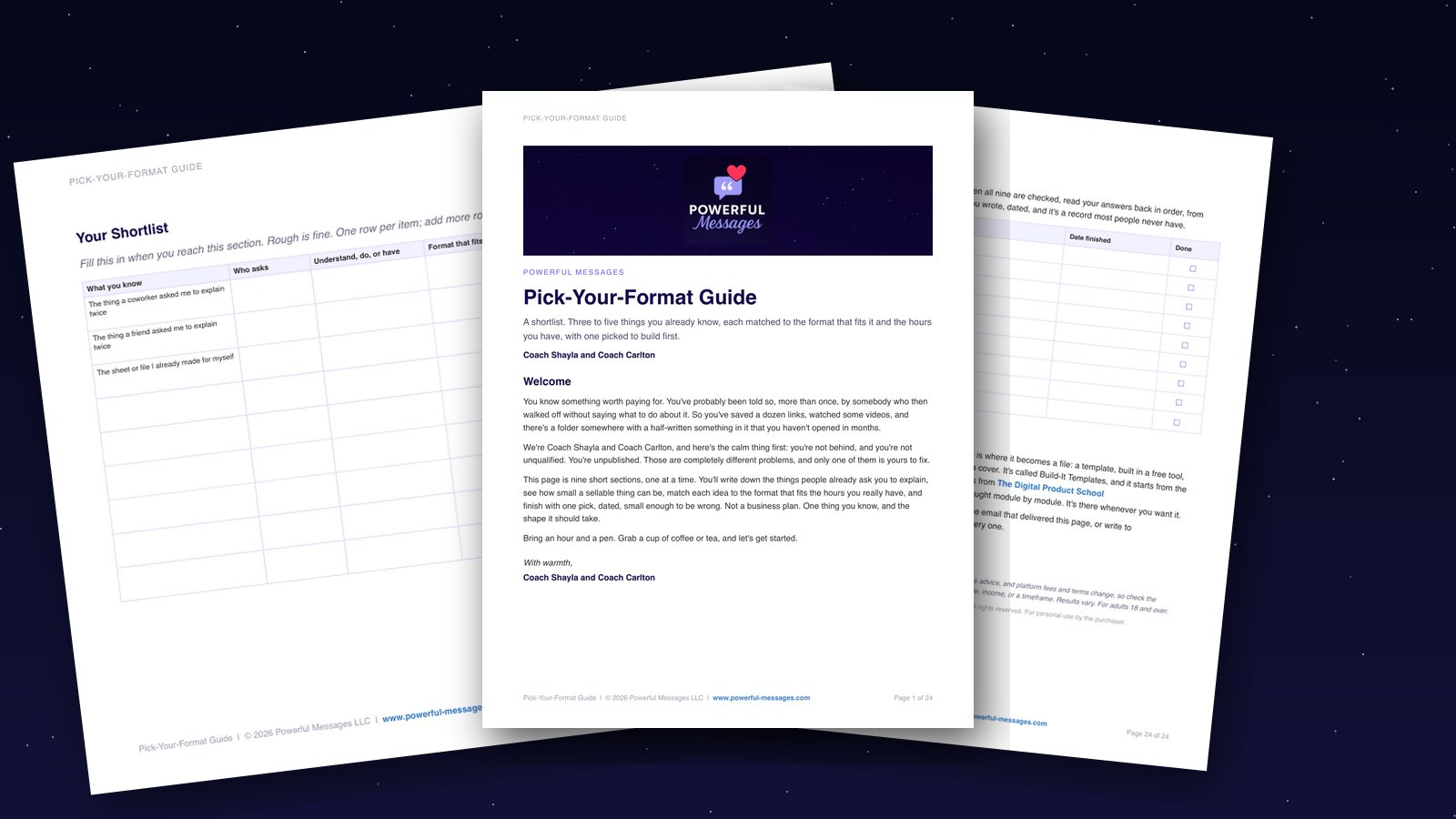
Pick-Your-Format Guide
helps you choose a simple shape for your idea, so you can start making it.
Get the Pick-Your-Format GuideDigital Products Academy for Coaches
Sell your expertise as products
Explore the school