
The big idea: Your first digital product is already hiding in your client sessions. Find the advice you give again and again, and pick one small idea. Outline it, choose a simple format and build it. Then put it on a platform that takes care of payment and delivery, so it can help people while you rest.
Your last call of the day ends, and as the video window closes, you realize something. You walked three different people through the same three steps today, in almost the same words, and each time it worked. Then the hour ended, and all of that wisdom went right back into your head to wait for the next call.
The story below is an illustration, not a client case.
That's a quiet kind of tired, and it's not about loving the work any less. It's the feeling that your week has a ceiling, because every good thing you know only reaches one person at a time. You trade an hour for a fee, then another hour for another fee. Your clients are happy, and still the ceiling doesn't move.
We want you to know that it doesn't have to stay that way. Find the patterns in your sessions and write them down once. Then what you know can serve many people, not only the one in front of you.
We're Coach Shayla and Coach Carlton. We spent decades inside busy, high-pressure companies. One of us turned people data into reports for boards, and the other sold software to executive teams. Today we build our own schools and products with the same method we teach. We know the jump from service to product can feel big, but it starts with work you've already done.
Your client work holds more than you think. In this guide, we'll show you how to find it, one gentle step at a time.
Key takeaways
- Your client sessions are raw material for a product, so start noticing the advice you give again and again.
- Write down the common threads in your sessions, like the problem, the steps you give and the tools you use.
- Pick one focused idea that clients ask for, that you enjoy teaching and that you can outline in one sitting.
- Make a clear outline, because it gives your buyer a path they can follow.
- Choose a format, like a workbook or a video, that fits the moment your buyer will use it.
- Build in small, finished passes, and care more about clear than perfect.
See Your Client Work Through New Eyes
Your client sessions already hold the raw material for a digital product, and it's been sitting in plain sight. To see it, you shift from giving advice to noticing the advice you give. The patterns are already there, and we only have to look for them.
Coach Shayla spent decades leading people analytics at large global companies. Her job was to find patterns in huge piles of data. She ran surveys of workers around the world, built dashboards and gave talks to top leaders. That work taught her a truth that fits coaching well: repeatable patterns are the most valuable thing you own.
Coach Carlton saw the same truth from the sales side, where he sold software to senior leaders and executive teams. The best salespeople didn't invent a new pitch for every call. They kept shaping one strategy that worked, until it worked almost every time.
Now think about your own practice for a moment. You likely give the same advice to many clients and ask many of the same questions. You may even walk people through the same framework without noticing.
That isn't a flaw in your coaching, and it isn't a sign that you're stuck in a rut. It's one of the most useful things you own.
Meet Scott Renner, a coach in his mid forties who works from home. He's friendly and kind, but lately he feels worn down. He's traded hours for income for years. He's far from alone, too. The International Coaching Federation counted a record 122,974 coach practitioners around the world in 2025, up 15% since 2023 (ICF Global Coaching Study, 2025).
Scott loves the work, but he's starting to feel the ceiling pressing down on his week.
One Tuesday afternoon, Scott is on a call with Priya Shah, a client in her early forties. Priya is talking about how hard it feels to set limits at work. Her boss keeps adding tasks, and she keeps saying yes.
Scott listens, and then he gives her the same advice he's given many times before.
He tells her to name the boundary, say it calmly and hold the line. He asks what she's afraid will happen if she says no, and then he helps her write out what she'll say.
Priya's face lights up, and Scott feels good about the call, but then he pauses.
He's said these exact words to other clients in other sessions, and he knows the advice works. Yet he's never once written it down as a process someone could follow without him.
After each session, jot a short note about the problem that came up, the advice you gave and the framework you used. After ten sessions, you'll start to see the patterns clearly.
Scott mentions this to Marcus Bell, his accountability partner and a fellow coach. Marcus is in his early fifties, and he's been gently nudging Scott to package what he knows. "You keep giving away the same gold," Marcus tells him. "You should write it down once."
Worth sharingThat's the shift. Your client work isn't only a service. It's also research.
Every session shows you what people struggle with and what truly helps them. So the raw material for your first product is already living inside the practice you have today.
If you'd like help seeing those patterns on paper, that's the exact job of our Client-Work-to-Product Finder. In one afternoon, you put the client work you've already done into one table. Then the smallest piece you could sell rises to the top. You finish with one row picked and a real Saturday next to it.
You only have to learn how to see it.
Find the Common Threads in Your Sessions
Writing down what you already repeat is the fastest way to see your product. Many coaches give the same help for years and never put it on paper. So the advice lives only in their voice, tied to the clock. Spoken advice fades, too, and it fades fast. Memory research going back to Hermann Ebbinghaus shows we forget much of what we learn within a day unless we review it. A 2015 study repeated his test and found the same curve (Murre and Dros, PLOS ONE, 2015).
Scott sat down with Marcus to look back over a month of session notes. Marcus asked one question that changed the whole talk: "What do you say so often that you could say it in your sleep?"
Scott laughed, and then he answered without much thought, because the answer was time management.
Nearly every client came to him with the same struggle, which was feeling behind before the day even started. They had no way to decide what mattered most, and Scott always gave them the same first three steps.
Marcus pointed at the notebook on the table. "Write those three steps down right now," he said.
That's the method in a nutshell. Writing down your patterns means you note the problem that keeps coming up. You also note the advice you keep giving and the tools you keep using. You don't need notes on every session, only on the ones that repeat.
We like a simple page with three columns for this. One column holds the problem clients bring, one holds the answer you give and the last holds the tool or exercise that goes with it.
After about two weeks of filling it in, the patterns get very hard to miss.
Worth sharingMost coaches give the same core advice to client after client. That isn't a flaw. It's inventory.
A partner like Marcus helps because he can hear your patterns without feeling attached to them. He could see what Scott couldn't see from inside the work. To Scott, the repeating felt ordinary, but to Marcus, it looked like a system that was waiting for a name.
If you'd like to try this, these are the things we suggest you track:
- The problem a client names in their first or second session
- The exact steps you give them, in order
- The exercise, worksheet or question that moves them forward
- How often that same mix shows up with different clients
Scott's time management thread showed up in eleven of his last fourteen sessions. The first three steps were the same every single time, and yet he'd never written them out in order.

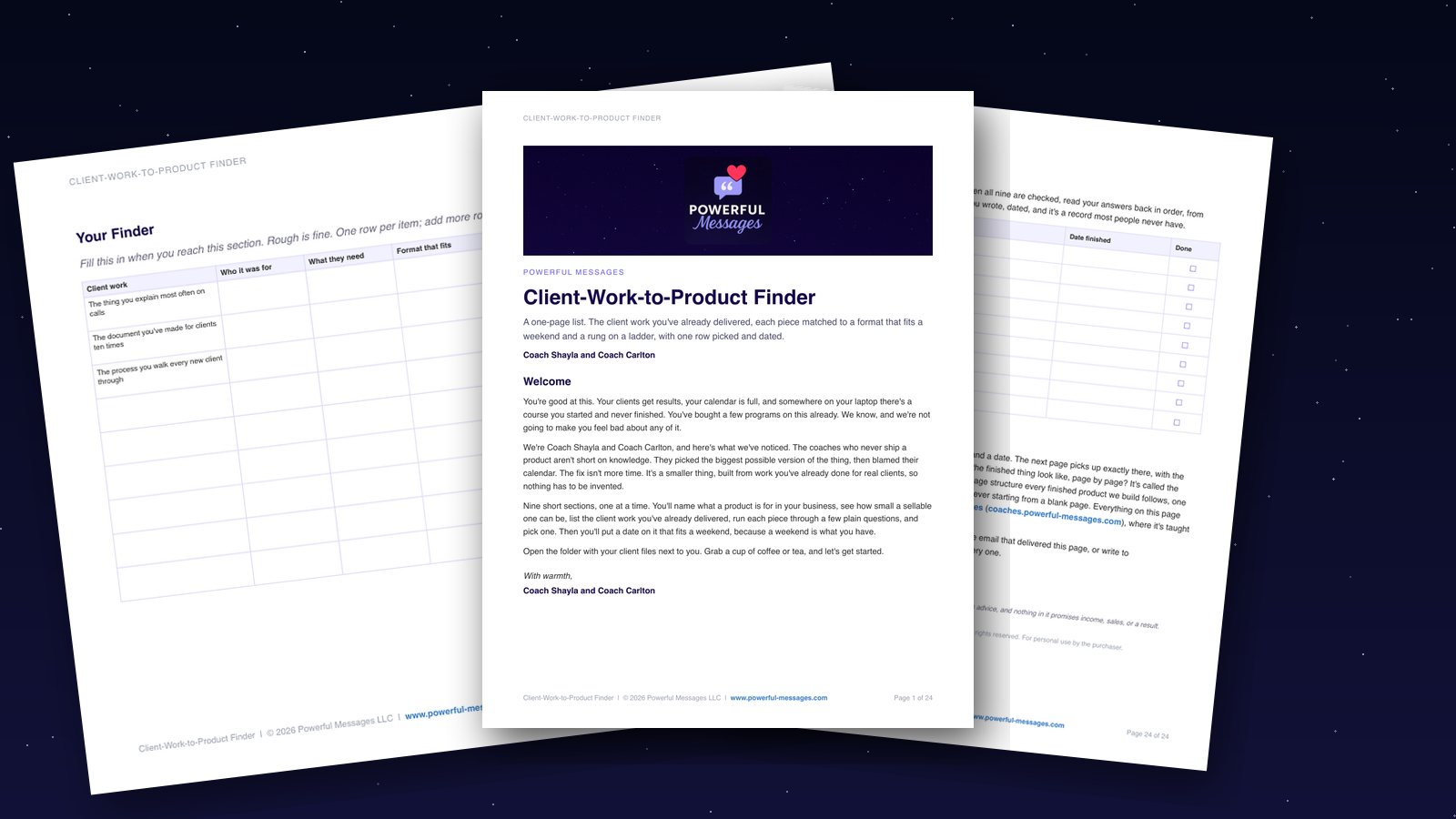
Client-Work-to-Product Finder
helps you turn an answer you give clients into a product you can sell.
Get the Client-Work-to-Product FinderThat list of steps is the foundation. It isn't a product yet, but it's the first shape of one, pulled straight from work he was already doing. The next question was which thread deserved his full attention first.
Choosing one idea from your client work turns a fuzzy dream into something you can actually build. The simple answer is to pick the single, most focused thing you already teach and package that one thing first. When you're new to this, a short guide will serve you far better than a big course.
It's easy to stall by trying to fit in everything you know, and that's so human. But everything you know is a library, not a product. A library has no clear start, no clear buyer and no finish line.
Scott faced this exact moment. His notes held a dozen themes, from handing off tasks to running better meetings. But one thread had the most energy. It was his three steps to better time management.
Clients asked for it by name, and he could explain it in under ten minutes.
So Scott made a choice. He'd turn those three steps into a short guide instead of a full course. A guide felt small enough to finish, and that was the whole point.
How to Pick the Right Idea
We use three simple filters to choose a first product idea. Demand means clients already ask for it. Passion means you enjoy teaching it. Ease of creation means you can outline it in one sitting.
Scott's time management idea scored high on all three, while each of his other ideas missed at least one. That made his choice feel clear and calm instead of hard.
One focused idea also eases the overwhelm that stops so many new product makers. A single guide has a beginning, a middle and an end. You can see its whole shape before you build.
What This Looks Like in Practice
Scott didn't need to design a whole program. He only had to write down the three steps he already taught. Then he added examples from his sessions and put them in order. That's a product draft, and it's much lighter than a research project.
We saw the same thing in the companies we worked in. The most useful tools there were never the giant systems. People reached for the one-page checklists and short guides instead.
Your first product can feel that way too. It can be small enough to finish and clear enough to help one person solve one problem. The outline comes next, and it gets much easier once your idea is this clear.
Outline Your Product's Core Content
A clear outline is the bridge between a good coaching insight and a product someone can actually finish. It's the part that turns your client work into something a buyer can follow. Without it, even your clearest idea tends to stay stuck in your head.
Scott learned this the hard way. He had his time management guide in mind. But every time he sat down to build it, the project grew bigger. So he tried something simple and wrote a table of contents on a single page.
His outline had three parts:
- Understanding Your Time: Help the buyer see where their hours really go before they try to change anything.
- Identifying Time Wasters: Name the habits and interruptions that steal focus, with examples from real sessions.
- Implementing New Habits: Give one small practice the buyer can start the same day, instead of a whole new system.
That short list did more than sort his thoughts. It made him decide what belonged in the product and what could wait for later. Think of a buyer like Elena Rossi, who's in her mid thirties and buying her first digital product. She needs that kind of clarity, because she wants to see the path before she says yes.
Skipping the outline is one of the most common ways a product stalls. People start recording videos or writing pages without one. Then they wonder why the project won't move. Your outline isn't busywork. It's the skeleton of your product.
Each section should answer one question your buyer is already asking. Each lesson inside it should move them one step closer to a result. If a piece of content doesn't do that, you can let it go.
Our own schools work this way. They're self-paced, so learners move through them at their own speed. That only works when the path is clear from the very first page.
A confused learner usually quits, but a clear outline keeps them moving.
Scott's three-part table of contents took him twenty minutes to write. It saved him weeks of building the wrong thing. He chose a format next, and the outline made that choice easy.

The wrong format can bury good content under hassle, while the right one makes it feel easy to use. A format isn't decoration. It decides whether your buyer will actually use what you made. A workbook that should have been a video feels like homework.
A video that should have been a checklist feels slow, so we match the format to how the buyer will use it in real life.
Scott looked at his outline and asked one question. Where would Priya be when she used it? She'd be at her desk on a Tuesday morning, trying to plan her week before her first meeting. She'd need something to write in, not something to watch. That pointed him straight to a downloadable PDF workbook.
Each format has a trade-off. Templates are fast to use but teach very little, while workbooks guide real practice but take some effort.
Video lessons can show small details but are hard to skim, and audio guides fit a commute but lose the visual layout.
Online courses hold everything in one place but take much longer to build. So don't ask which format is best in general. Ask which format makes life easiest for one buyer.
We think about two things before we choose. First, we ask how much guidance the content needs, because a simple checklist needs no explaining.
A framework for hard conversations, on the other hand, needs someone to show how it works. Second, we ask where the buyer will use it.
A busy leader won't sit through a forty-minute video, and someone on a train won't fill out a workbook.
Match the format to the moment your buyer will use it, not to what's easiest for you to make.
Being easy to open matters more than looking polished. A PDF that opens on any device beats a pretty course site that needs a login and fast internet. Every extra click gives a busy buyer a reason to give up.
The best format almost disappears, so the buyer feels like the help is simply there when they need it.
Scott's workbook choice also shaped what he'd build next. A PDF with spaces to fill in meant he could make it in one afternoon with tools he already had. He didn't need video editing, a course site or audio. That's the quiet gift of a simple format, because it actually gets finished.
It's easy to overthink this step and dream about a big video course before you've sold one template. We'd gently suggest the smallest format that still gives your buyer the result.
You can always grow it later, because a workbook can become a course and a template can become a toolkit.
Going the other way, from a giant course down to something small, is much harder.
If you feel torn between formats, our Pick-Your-Format Guide helps you match what you know to a format that fits the hours you really have. You walk away with a short list and one row picked and dated. Then the back and forth can finally stop.
Scott's guide will live as a PDF, because that's where his buyer already is. The format fits the moment, the content and the person, and that's the whole decision.
Build Out Your First Product
A finished first product will always help more people than a perfect idea that never ships. Building it takes steady work more than genius. Now you take your outline and turn it into something a buyer can use.
We build our own schools, products and apps with AI tools every day. That's taught us that the tools matter far less than the choice to finish. A simple document editor is enough to get you started.
Scott opens a blank page and writes his workbook one section at a time. He follows the outline he already made. Each part answers a question Priya asked in their sessions. He adds a few of the exercises that helped her plan her week.
That's really the whole method, and it doesn't need fancy software or the perfect template.
Work in Small, Complete Passes
We treat each section of the outline as its own small project. You write the lesson, add one example and then add one exercise.
This keeps the work from growing out of control. A workbook that tries to cover everything turns into a book nobody finishes. A workbook that covers one clear result gets used.
Clear matters more than polished here. A buyer like Elena wants to know what to do next, and she isn't there to admire your design choices.
Follow a Simple Build Sequence
- Draft the core content: Write each section in plain words and short sentences. If a sentence confuses you, it'll confuse your buyer too.
- Add the exercises: Pull in the prompts and activities you already use with clients. They're the real value of your product, because they turn reading into doing.
- Check the flow: Read the whole thing once from start to finish, and cut anything that doesn't move the buyer toward the result.
- Export and save: Save the file in the format you chose earlier, and give it a clear name so a buyer knows what it is.
Four steps to build your first product
- Draft the core content in plain words
- Add the exercises you already use
- Check the flow from start to finish
- Export and save the file
Worth sharingWe don't aim for perfect on a first product. We aim for done. A finished workbook can get better after real buyers use it, but an unfinished one can't help anyone.
Scott's workbook isn't beautiful, but it's clear, useful and finished. That's exactly what makes it ready for the next step, which is getting it ready for a first sale.
Prepare for Your First Sale
Picture two coaches who finish the same workbook on the same day. One posts it on a random file-sharing link, and the other puts it on a platform built for selling.
The second coach is the one who gets the sale. Getting ready for a first sale isn't about making your product fancier. It's about making it easy to find, easy to understand and easy to buy.
It's sad how often a coach pours weeks into a product and then treats the sale as an afterthought. The sale is where your product finally gets to do its job. A clear description and a simple way to buy matter as much as the content.
Scott learned this the week he finished his time management workbook. He had a finished product. But he didn't yet have a way for someone like Priya to find it, understand it and pay for it with ease.
Three Decisions Before the First Sale
Scott made three choices in one afternoon, and each one took away a reason for a buyer to walk away.
- Pick a platform that handles the boring parts. Payments, file delivery and receipts should all happen on their own. Many platforms make selling digital products simple, and Scott chose one that didn't ask him to build anything technical.
- Write a short sales page that names the problem. Scott described his workbook as a way for overwhelmed professionals to take back control of their day. He didn't list features. He described how Priya felt on a Tuesday morning and the relief the workbook could bring.
- Set up payment before you tell anyone. Scott connected his account, tested the checkout with a small purchase and made sure the file arrived. He wanted his first real buyer to have no surprises at all.
A clear description is what draws in buyers like Elena. She doesn't know Scott, and she found his page through a search. So the page had to answer three questions in seconds. What's this, who's it for and what will it do for me? Nielsen Norman Group found people often leave a web page in 10 to 20 seconds unless its value is clear (Nielsen Norman Group, 2011).
Scott's sales page did that with plain words. It skipped the jargon and the long story, and it simply showed the problem, the answer and an easy button to click.

We'd skip the urge to write a long, clever page. People buying a first product want clear words more than clever ones. A short page that respects their time will do better than a polished page that buries the point.
Which platform you choose matters less than making buying feel normal and easy. A buyer should be able to go from curious to paid in under a minute. Every extra step is a place where people slip away.
Scott's first sale came from a stranger instead of a friend, and that's the real test. When a product sells to someone who doesn't know you, it can keep selling while you're off the clock.
Writing a clear sales page is a skill you can learn, and you don't have to figure it out alone. Inside Digital Products Academy for Coaches, our self-paced school, you build one product at a time from your client work. You also write a sales page for each one in your own voice, without hiring a copywriter.
The thrill of that first sale is real, and it's also proof. The product left Scott's hands and still worked. That's the moment client work becomes something that lasts.
Conclusion
Your client work already holds the product you've been looking for. The patterns you see again and again in your sessions aren't only coaching moments. They're the raw material for something that can keep helping people after the call ends.
We've walked through the whole path together. First, you learned to see your client work with fresh eyes. Then you found the threads that show up with many clients.
You picked one idea, outlined it and chose a format that fits how your buyer will use it. Finally, you built the first version and got it ready for its first sale.
These are the four things we hope you'll carry with you:
- Patterns are products: the question you answer every week is a product that's waiting to be packaged.
- Start small: begin with one idea, one format and one finished draft, because you don't need a full library on day one.
- Done beats perfect: a simple workbook that exists helps more people than a perfect course that doesn't.
- Your time isn't the only thing you can sell: a digital product lets you help people without being on the call.
Imagine Scott after his first workbook sale. On a Tuesday afternoon, while he was out walking his dog, his workbook helped someone he's never met. That's how it feels to stop trading only time for money. You start building something that serves many people.
So here's a small first step you can take today. Open your notes from your last five client sessions. Circle the question or exercise that came up most often.
That's your starting point, and once you've found it, you can write a one-page outline for it today.
This article is the first in a five-part series. The next piece shows you how to turn that outline into a finished product, step by step. You already have what you need to begin, and we're cheering you on.
Where to start this week
This afternoon, open the Client-Work-to-Product Finder and pick your first product from work you've already done. If the format is the part you keep going back and forth on, add the Pick-Your-Format Guide so you can settle it in one sitting. When you're ready to build the product, price it and write its sales page, join Digital Products Academy for Coaches and work through it at your own pace. And if you'd rather talk it over first, book a Discovery call with Coach Shayla and Coach Carlton. It's a warm 30 minutes about which client work should go first.
 Scott RennerA coach building his first productMeet Scott →
Frequently asked questions
What's a digital product for coaches?
A digital product is anything you can sell again and again without trading an hour of your time for it. It might be a template, a guide, a video series or an online course. It packs what you've learned from client work into a form many people can buy and use at their own pace.
How does client work become a digital product?
It starts when you notice the patterns in the advice you give and the problems you solve. Maybe you keep teaching the same steps or giving the same answers to many clients. If so, you can shape that process into a product. It's really about seeing the needs your clients have in common.
Can any coach create a digital product?
Yes, any coach who has worked with clients can create one. Look back over your two-on-one sessions for the themes, tools and frameworks you already use. The way you help clients solve their problems is valuable, and it deserves to reach more people.
What are the benefits of selling digital products?
Digital products let you help more people than your calendar could ever hold. They add income that doesn't depend on your hours, which gives you more breathing room. They also show people what you know, so your reach can grow with your work.
Is there a quick way to pick my first product?
Yes, and it fits in one afternoon. The Client-Work-to-Product Finder walks you through nine short sections, about two hours in all. It comes as a Notion page you copy, plus a printable PDF.
Where can I learn to build and sell the product, start to finish?
Digital Products Academy for Coaches is our self-paced school for coaches who already have clients. You ship one product at a time, from a quick-win product to a workbook or mini course, and each one gets its own sales page.
Can someone help me choose which client work to start with?
Yes, and we'd love to. Book a Discovery call and talk it through with both of us. It starts with a small deposit that is credited toward your next call or the 5-Day Challenge.
Sources
- International Coaching Federation, 2025 ICF Global Coaching Study (news release, September 16, 2025)
- Murre, J. M. J. and Dros, J., Replication and Analysis of Ebbinghaus' Forgetting Curve, PLOS ONE, 2015
- Jakob Nielsen, How Long Do Users Stay on Web Pages?, Nielsen Norman Group, September 11, 2011
Recommended for you
Client-Work-to-Product Finder
helps you turn an answer you give clients into a product you can sell.
Get the Client-Work-to-Product Finder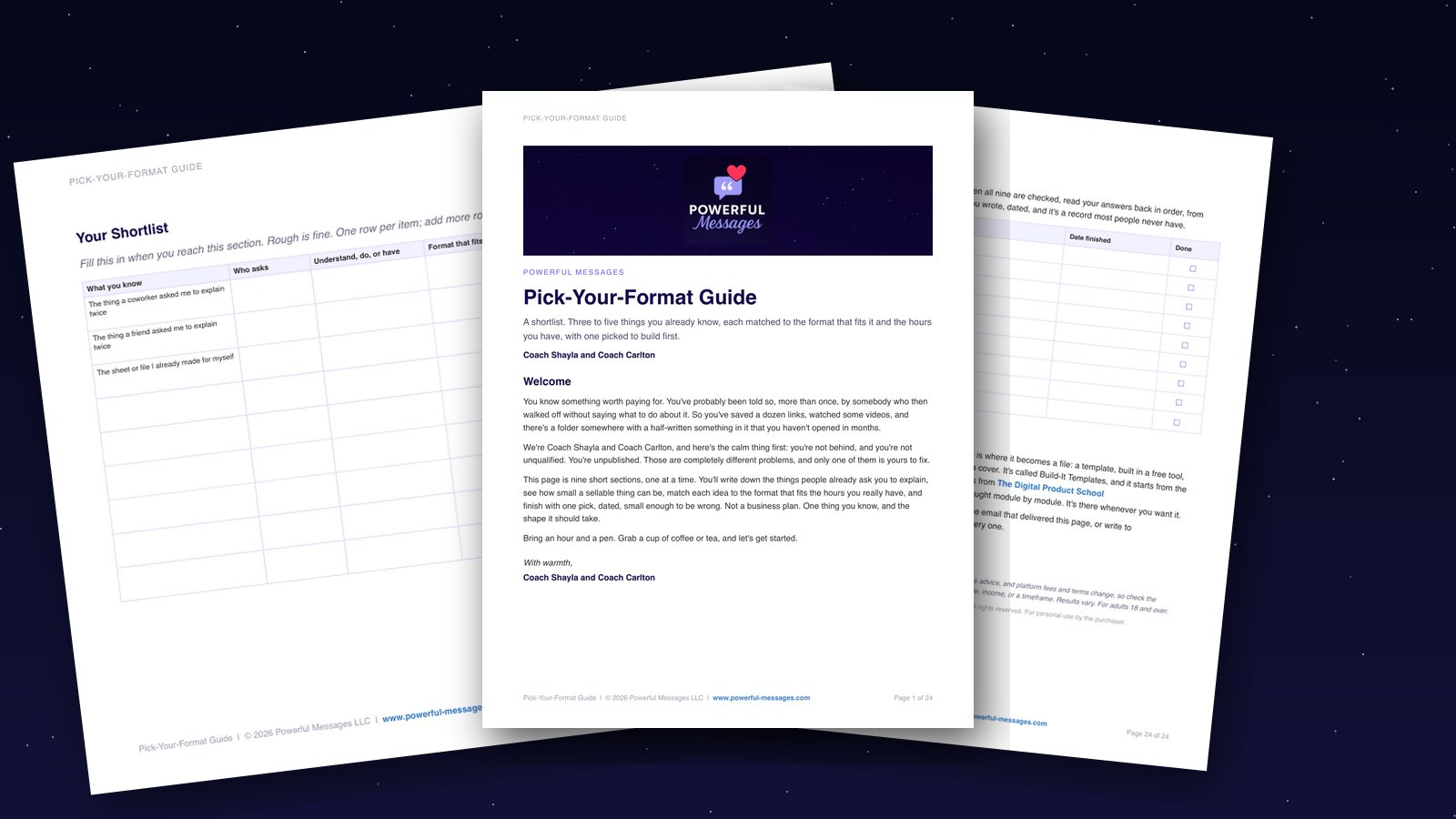
Pick-Your-Format Guide
helps you choose a simple shape for your idea, so you can start making it.
Get the Pick-Your-Format GuideDigital Products Academy for Coaches
Sell your expertise as products
Explore the school