
The big idea: Yes, a small launch can help you sell your first digital product. You offer one small, clear product to a few people who already trust you. The risk stays low, and the feedback comes fast. It turns a vague idea into a real offer and builds your confidence before you share it widely.
There's a sticky note on the edge of your screen, and it holds one word in your own handwriting. It says "Product?" and it's been there so long that the corners have curled. Today, in the quiet minutes between two client calls, you read it again. You feel that familiar little sink in your stomach.
You know you have something worth selling, because you've spent years helping clients with the same problems. But the idea feels too big, and the tech feels too heavy. The thought of hearing nothing after you hit publish feels too loud. So you keep trading hours for dollars and tell yourself you'll get to it later.
If that sounds like you, you're not behind, and nothing is wrong with you. You've been picturing the hardest kind of launch, and we'd love to show you a smaller one.
A small launch works because it shrinks the risk to a size a busy coach can hold. You don't need a huge audience, a fancy website or a polished brand to make your first sale. You need one clear offer and a short list of people who already trust you. Then you add a date that gives them a reason to say yes.
Everything else can wait until after you've learned what your buyers really want.
We built our own schools and products this way. We saw the same pattern in the companies where we spent our corporate years. The people who ship something small learn faster than the people who wait for perfect. A small launch turns your first product from a far-off dream into a skill you can repeat. It also helps you listen to buyers instead of guessing what they want.
This is the path we'd give any coach who's ready to stop renting out their time. You already have the raw material in your client work. A small launch is how you shape it into something people can buy.
Key takeaways
- A small launch keeps the risk low while you sell your first digital product.
- Your first buyers are often the clients who already know and trust you.
- Your first product can solve a problem you already help clients with every week.
- Aim for a product that's clear and narrow, not one that's perfect.
- A short, personal email to a small group is enough to find your first buyers.
- Feedback from early buyers shows you what to fix before you share it more widely.
Why Coaches Struggle to Sell Their First Digital Product
It's 2026, and the tools to build a digital product are everywhere. Yet so many coaches still hold back. Most believe a launch needs a big audience, a polished brand and a marketing budget they don't have. That belief stops them before they've made a single file.
The real barrier isn't technical skill. It's the heavy feeling of picturing a launch as a big, public event where everyone is watching you.
The story below is an illustration, not a client case.
Meet Scott Renner, a coach in his mid forties who works with clients from his home office. He has years of client talks stored in his head, and he can name the patterns in seconds. He repeats some advice so often that he could say it in his sleep. But when he thinks about turning all of that into something people can buy, he freezes.
He pictures a big marketing budget, a fancy sales page and an audience of thousands. None of it matches his quiet business, where he works with one client at a time. Yet businesses like his are the norm, and the U.S. Census Bureau counted 29.8 million businesses with no paid employees in 2022.
So he keeps trading hours for dollars and tells himself the product idea can wait.
We saw this same loop in the companies where we worked. A capable person looks at something new and assumes the hardest version is the only version. Selling a service feels familiar. The client shows up, you talk together, and the value is clear right then.
Selling a product feels different, because there's no one nodding across the table from you. You have to trust that a simple guide or template can carry the same value without your voice in the room.
The Mental Barriers That Keep Coaches Stuck
Self-doubt does most of the damage before any real obstacle shows up. Maybe you've told yourself that you need a bigger audience first, as if that were a rule printed on the box. It isn't, and we want you to hear that clearly.
Maybe you've also thought that launching sounds overwhelming. The word launch carries the weight of a rocket leaving the pad. We think that word is part of the problem, because it makes a simple offer feel like a big show.
The difference between selling time and selling a product comes down to repetition. A service is sold once and delivered once, but a product is made once and sold many times.
That shift sounds simple, but it changes how you see your own work. Scott told his accountability partner, Marcus Bell, that it felt like starting a second business. He didn't feel like he was growing the one he already had. That feeling is common, and it's also misleading.
Scott didn't need a bigger audience or a marketing team. What he really needed was a smaller way in. A simpler idea kept coming up in their talks, a way to test the product without a grand opening. That matters, because the fear of needing a huge audience is the exact problem a small launch eases.
Worth sharingWe'd tell any coach in Scott's place the same thing. Your product doesn't need to impress everyone, because it only needs to help one person clearly enough that they'd pay for it. That's a much lower bar, and it's the only bar that matters at the start.
How a Small Launch Helps Coaches Sell Their First Digital Product
Scott sat down with a short guide he'd written for three of his coaching clients. It wasn't a polished course with a big sales page and a webinar. That one choice changed what the word launch meant to him. A small launch shrinks the risk of selling your first digital product. It turns your first sale into a chance to learn, not a public test.
Your audience is already there, and your product is already useful. The only missing piece is the courage to offer it. That courage grows once the offer feels small enough to hold.

Many coaches treat a launch like a stage show. They wait for the right brand, the right email list and the right moment. A small launch takes all of that waiting away.
It starts with people you already know, the ones who've paid for your coaching and already trust your voice. Scott offered his guide to his current clients first, so he didn't have to win over strangers. He only had to say, "I made something for the problem we keep talking about." That's a conversation, not a campaign.
Quick feedback is the quiet gift of a small launch. A big launch hides mistakes behind a crowd, but a small one shows them early. Research on testing shows how few people you really need. Jakob Nielsen found that five testers uncover about 85% of the problems (Nielsen Norman Group, 2000).
Scott's clients told him which parts felt clear and which ones dragged. He fixed the guide that same week. You can't get that kind of direct, honest help when you're shouting into a big crowd. It's the difference between guessing and knowing.
Early wins build a kind of momentum that no pep talk can replace. Your first sale from a small launch feels real because it came from a real relationship. It tells you the product works and the price makes sense. It also tells you the next buyer will be easier to find.
Confidence follows proof, not the other way around. It's a pattern that shows up whenever someone stops planning and starts offering.
What to sell, and to whom, gets clearer after your first small launch, not before it. Scott's guide started as one answer to one problem his clients kept bringing up. Their feedback showed him which problem deserved a bigger product later.
A small launch isn't settling for less. It's the most direct way to learn what people will pay for.
Scott kept his format small on purpose. If you're not sure which format fits the hours you really have, our Pick-Your-Format Guide helps you decide. You list what you already know and match each row to a format that fits your week. Then you pick one row and put a date beside it.
Finding Your First Digital Product From Client Work
Your best product idea isn't hiding in a brainstorming session. It's already sitting in your client notes. So many coaches miss it for years, simply because the answer feels too plain. Very often, your first product is the answer to a problem you solve for clients again and again.
Think about the questions you answer over and over. The same confusion shows up in different voices, in different weeks, from different clients. Scott noticed this when several clients, including Priya Shah, kept asking the same thing. They wanted to set clear boundaries without feeling guilty.
He'd walked through that talk so many times that he could almost script it. That repetition isn't a burden. It's a signal pointing straight at your first product.
When you look through your client work for product ideas, watch for these three patterns:
- The questions that keep coming back. What do clients ask in almost every session, no matter their field or background?
- The mistakes you fix again and again. Which ones do you gently correct over and over, often in the first few weeks of working together?
- The things every client needs first. What do clients need to understand before your deeper coaching can even begin?
Each of those patterns points to an answer you already give out loud. A digital product simply packages that answer so a client can use it without you on the call. In many teams, the most useful training isn't the advanced strategy. It's the simple framework that answers the same basic questions for every new person.
That framework is often the product hiding in plain sight.
Simple formats work best for a first product. A checklist walks a client through a process step by step. A template gives them a starting shape they can fill in.
A short guide explains one clear answer in plain words. None of these needs design skills or a big budget. They only need clarity, and you already have that from explaining your topic dozens of times.
We'd much rather see you share a five-page guide on boundaries than build a course nobody asked for. The guide answers one real problem, while the course answers a problem you've only imagined. That difference matters more than it first seems.
Scott's boundary guide didn't need to cover every possible situation. It only needed the core advice he gave Priya and others like her. The moment he wrote it down, he had a product. Getting it ready for buyers came next, but the idea was proven before he wrote a word.
Preparing Your Digital Product for Its First Buyers
Getting ready isn't about making the product perfect. It's about making it clear. A good first product tells a buyer what problem it solves and how it solves it. It also tells them what they'll be able to do afterward. That clarity is what turns a curious reader into your first buyer.
We build our own schools, products and apps with AI every day, and the pattern is always the same. The products that sell make their promise obvious right away. People often leave a web page in 10 to 20 seconds unless its value is clear (Nielsen Norman Group, 2011). The products that stall make the buyer work hard to understand what they're getting.
Your first product doesn't need more features. What it really needs is a sharper explanation.
Scott learned this while drafting his boundary guide. With help from Marcus, he shrank the guide down to three clear steps his clients could use right away. That limit did the real work.
Three steps made him name the exact outcome and cut the extra advice. He wrote steps a tired client could follow on a Tuesday afternoon. Before long, his simple outline had become the product.
Worth sharingYour product should solve one clear problem for your buyer. That sounds obvious, but many first products miss it, because they try to solve a whole group of problems, or a problem the coach finds interesting, or one the buyer hasn't admitted yet.
We'd rather see a narrow product that solves one named problem than a broad one that waves at several. A narrow product is easier to plan, easier to write and easier for a first buyer to say yes to.
Clear writing means short sections, plain words and one step at a time. A simple sales page outline follows the same rule. You state the problem and the answer, list what the buyer gets, and say who it's for. That outline isn't marketing copy yet.
It's a promise you can keep. Reaching out to buyers comes next, but your product needs to keep its promise first.
If you'd like help picking that first product from your client files, that's the job of our Client-Work-to-Product Finder. In one afternoon, you choose one piece of client work you've already delivered. You give it a format and put a real Saturday next to it.
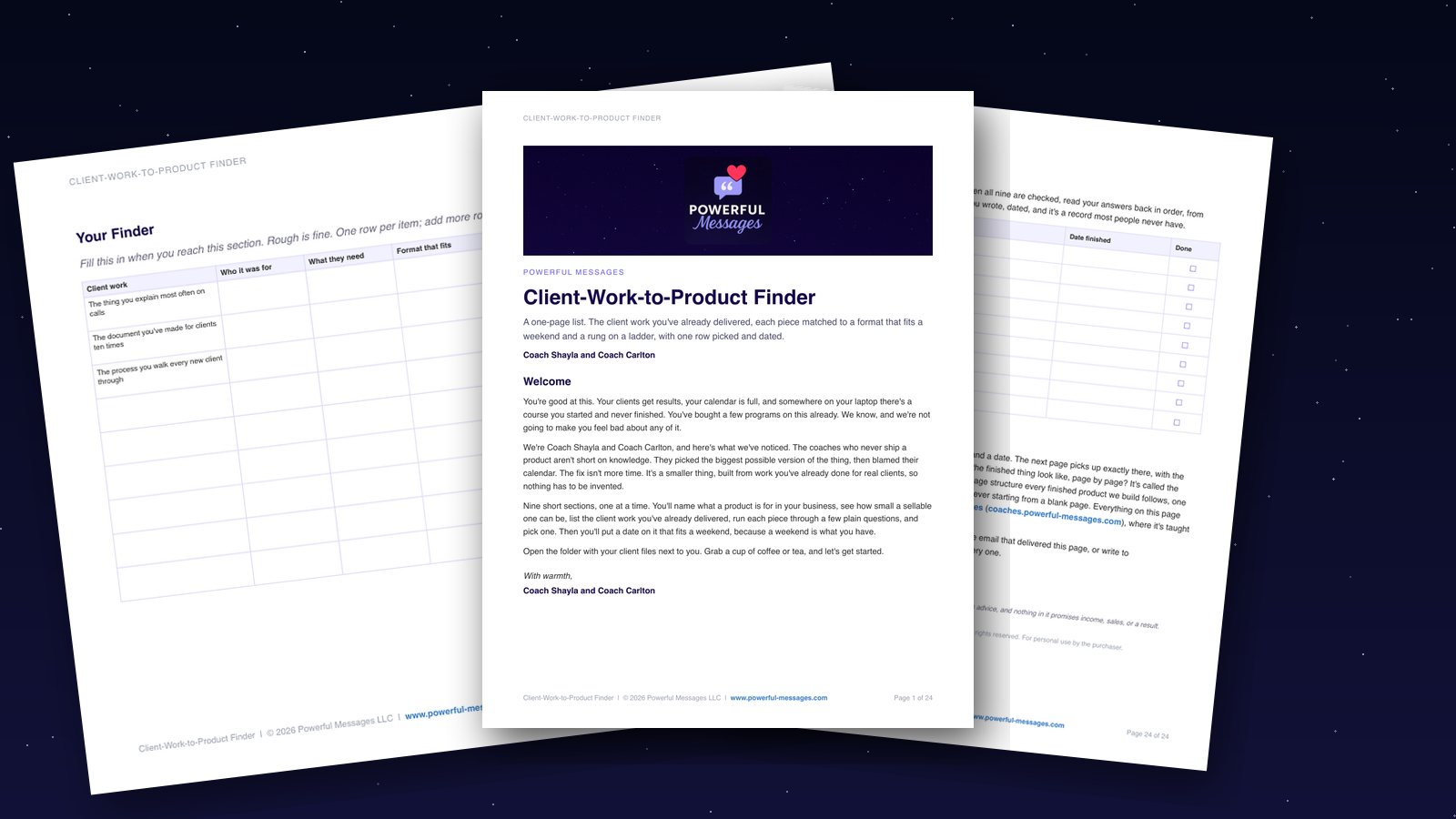
Client-Work-to-Product Finder
helps you turn an answer you give clients into a product you can sell.
Get the Client-Work-to-Product FinderReaching Your First Buyers With a Small Launch
A short, personal email to a few past clients and colleagues is the quickest way to reach your first buyers. You don't need a website, a big social following or an ad budget. You only need a list of people who already trust your work and a warm invitation to try something new.
That's really the whole launch. So yes, a small launch can help you sell your first digital product. The launch is simply a conversation with people who already know you.
Coach Carlton spent years selling software to senior leaders and executive teams. In that world, reaching out to a few well-chosen people is a familiar habit. We bring that same habit to product launches.
Big marketing asks you to turn into a marketer almost over a weekend. A small launch asks you to do what you already do well. You talk to one person about a problem you can solve.
Who Belongs on Your First Buyer List
Your best first buyers aren't random followers. They're people who've already paid you for advice, sent someone your way, or asked a question your product answers. Scott wrote a short, personal email to a few past clients and colleagues, including Elena Rossi. He invited them to be the first to try his boundary guide.
He didn't post it in public, and he didn't run ads. He wrote to people who had already told him, in one way or another, that boundaries were hard for them.

We'd rather see you send ten personal emails than one hundred general ones. A personal email names the person, mentions a real conversation, and explains why the product exists. It also keeps the ask small, with something like, "Would you try this guide and tell me what confuses you?"
That's an invitation, not a sales push, and it works because the relationship already exists.
What to Say and How to Deliver
Keep the invitation short, because three or four sentences are plenty. Name the problem, name the product, and ask for honest feedback.
Scott's email didn't tell a long story about his coaching journey. It simply said that he'd made something for the boundary talks they kept having. Then it asked if they'd read it and tell him what to fix. That kind of message feels like a favor between colleagues, and that's exactly what it is.
Worth sharingDelivery can be as simple as a PDF attached to an email or a link to a file. The system matters less than the follow-through, so when someone says yes, send the product that same day.
Then ask one gentle question: what was the clearest part, and what was the muddiest? That feedback is the real point of a small launch. It turns early buyers into partners in making the product better. It also gives you the words to reach the next group.
Many coaches skip this next step, so please hold on to it. Write down every question your first buyers ask. Those questions become the FAQ on your sales page and the subject lines for future emails. Best of all, they become proof that your product solves a real problem.
A small launch isn't a one-time event. It's the first round of a conversation you'll keep having for years.
Some coaches try to skip this step and go straight to a public offer, and it rarely works. A public offer needs proof, and proof comes from these private conversations.
It's lovely that a digital product can sell while you're busy with other things. Still, your first sales will usually happen while you're wide awake, writing to one person at a time. That's the launch working the way it should.
What Comes After Your First Small Product Launch
Your first small launch can feel like a finish line, but it's really more like a starting line. The real question isn't whether the product sold. It's what your first buyers taught you that you didn't know before.
After Scott's first outreach, he gathered notes from Elena and others who had worked through his guide. Their notes weren't praise at all. They were something better, which was clear instructions for what to fix.
You can treat that feedback as raw material for three simple moves:
- Find the parts buyers skipped or misread, and rewrite them in their words.
- Collect the questions buyers asked after they bought. Those can become your next product or your next email subject line.
- Notice which promise drew each buyer in, and shape your sales page around that promise alone.
Three moves after your first launch
- Find the parts buyers skipped or misread, and rewrite them in their words.
- Collect the questions buyers asked after they bought. Those can become your next product or your next email subject line.
- Notice which promise drew each buyer in, and shape your sales page around that promise alone.
Coach Carlton often says, "Vision without a system is just a wish." The system here is simple. Every buyer talk becomes a note, every note becomes a fix, and every fix makes the next launch easier. You don't need a large audience for that loop, only a small group willing to tell you the truth.

Plan a wider release after that loop has run at least once. A wider release without changes only spreads the same rough edges to more people. A product that worked for ten trusted buyers may still confuse a stranger.
That isn't a flaw in you or in the product. It's simply a question of order.
Coach Shayla's motto, "Be thankful for today. Don't wait for tomorrow," fits here in a very practical way. Your first launch gives you today's proof. Your next version depends on what you do with it this week, not on some future audience.
One product is the start, not the whole plan. In the Digital Products Academy for Coaches, you build one product at a time from client work you've already done. You keep going at your own pace until you have a full ladder of offers, each with its own sales page.
Conclusion
Your first digital product feels heavy because you can't see it yet. So many capable coaches sit on years of client wins, sure they have nothing to sell. The work was there all along. It simply never had a shape, and a small launch gives it one.
Once you see how it works, the question of whether a small launch can help almost answers itself. A small launch shrinks the risk, and it turns a vague idea into a real offer with a real buyer.
It gives you early feedback while the stakes are still low. It also builds a kind of confidence that no course or template can hand you.
Here's what we covered, in plain words:
- Your client work already holds your product, because the problems you solve every week are the product.
- A small launch means a small group, a short window and a clear promise, and that's enough to start.
- Early buyers show you what to fix, and their questions show you what to explain more clearly.
- Your first sale matters more than your first big number, because it proves the whole thing works.
- After the launch, you improve what you have instead of starting over from scratch.
So here's your next step. Open your notes from your last five client sessions and look for the problem that keeps showing up.
That problem is your product. If you'd like help naming it and shaping it, try the Client-Work-to-Product Finder, which is an easy, low-risk first step.
You already have everything you need inside your client work. Now give it a small door to walk through. You might be surprised by who's waiting on the other side.
Where to start this week
Begin with the Client-Work-to-Product Finder and pick your first product from work you've already delivered. If choosing a format is where you get stuck, the Pick-Your-Format Guide helps you match it to the hours you really have. When you're ready for a full set of products, join the Digital Products Academy for Coaches and build at your own pace. If you'd rather talk first, book a 30-minute Discovery call with Coach Shayla and Coach Carlton. We can all look at your idea together. It starts with a small deposit that's credited toward your next call or the 5-Day Challenge.
 Scott RennerA coach building his first productMeet Scott →
Frequently asked questions
What is a 'small launch' for a digital product?
A small launch means offering a new product to a small group, often your current clients, with very little marketing. It puts learning and feedback ahead of big sales, so the process feels much less overwhelming the first time. It also helps you improve your offer before you share it more widely.
How can I find my first digital product idea from client work?
Look for patterns in your client sessions. Which questions do clients ask again and again, and which problems do many of them share? Your own answers to those problems can become a template, guide or short course. That's your first digital product, your know-how in a form people can buy.
Do I need a large audience to launch my first digital product?
No, you don't need a large audience for your first launch. Starting with your current clients or a small part of your network often works better. These people already trust you. They're more likely to support your new offer, and they'll give you early sales and honest feedback.
How do I pick my first digital product?
Start with the work you already do with clients. The Client-Work-to-Product Finder walks you through nine short sections, about two hours in all. It comes as a Notion page you copy, plus a printable PDF.
Where can I learn to build more than one product?
The Digital Products Academy for Coaches is our self-paced school for coaches and consultants who already have clients. You build one product at a time, then the full ladder, then the checkout, all at your own pace.
Can someone look at my product idea with me?
Yes, and we'd love to. Book a 30-minute Discovery call and talk it through with both of us. It starts with a small deposit that's credited toward your next call or the 5-Day Challenge.
Sources
- U.S. Census Bureau, 2022 Nonemployer Statistics (America Counts story, May 2025; data released December 12, 2024)
- Jakob Nielsen, How Long Do Users Stay on Web Pages?, Nielsen Norman Group, September 11, 2011
- Jakob Nielsen, Why You Only Need to Test with 5 Users, Nielsen Norman Group, March 18, 2000
Recommended for you
Client-Work-to-Product Finder
helps you turn an answer you give clients into a product you can sell.
Get the Client-Work-to-Product Finder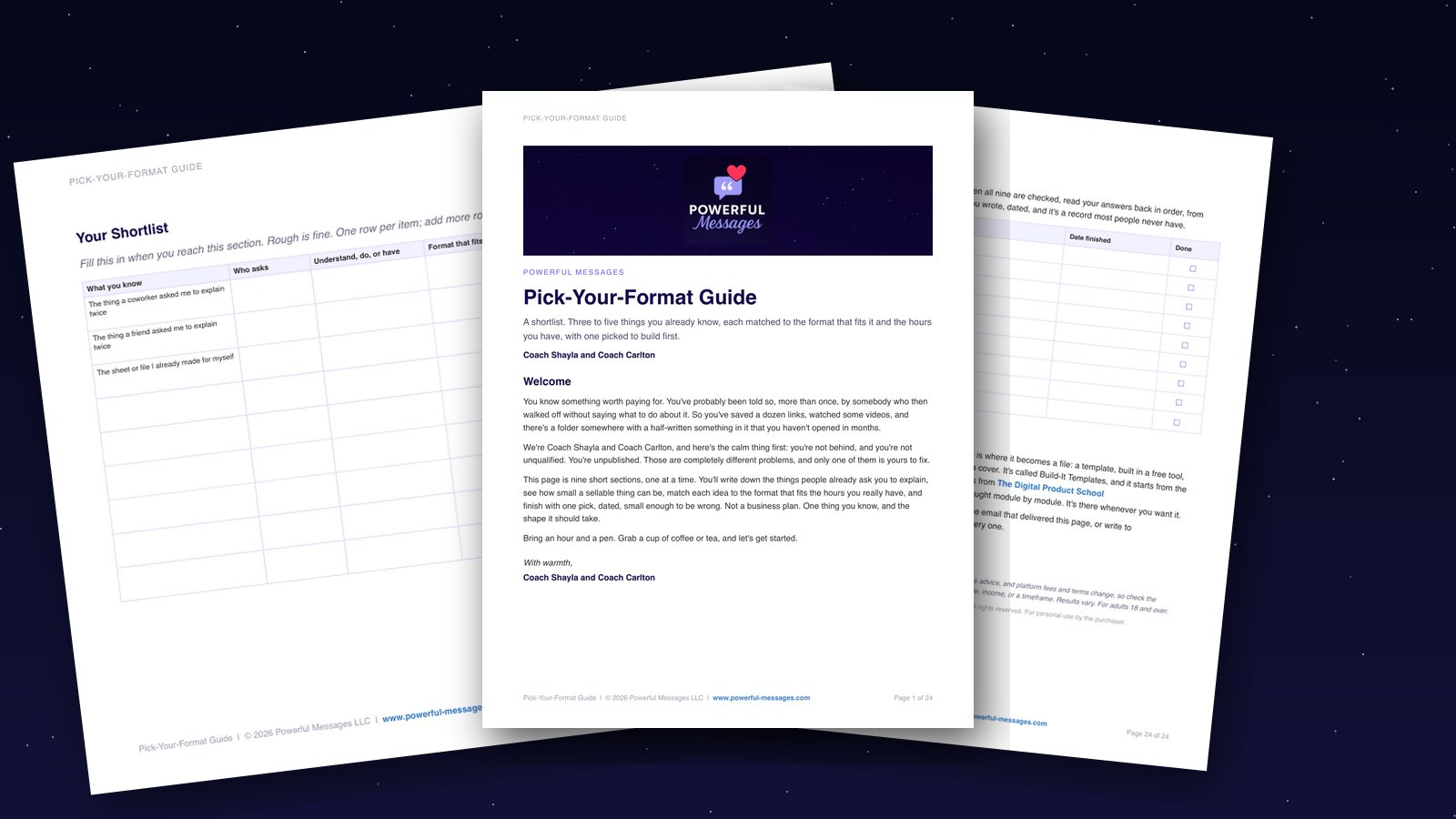
Pick-Your-Format Guide
helps you choose a simple shape for your idea, so you can start making it.
Get the Pick-Your-Format GuideDigital Products Academy for Coaches
Sell your expertise as products
Explore the school