
The big idea: Your first digital product should promise one clear, urgent result that you already help clients reach in your paid work. Choose a problem clients bring up again and again. It should cost them something they can feel, and you should be able to solve it in a simple way.
It's your lunch break, and half a sandwich sits next to your keyboard. You're typing the same three steps into an email for the fourth client this month. Somewhere around step two, a quiet thought slips in, and you tell yourself you should put this somewhere people can buy it. Then the next session starts, and the thought gets filed away with all the others.
Scott Renner knows that moment well. He coaches clients in private sessions, and he's very good at it. Still, every hour he works is an hour he has to be there, awake and present. He'd love a digital product that sells while he sleeps, and one question keeps him stuck: what promise should your first digital product make?
The story below is an illustration, not a client case.
The answer is kinder and simpler than it feels. Your first digital product should promise one clear, urgent result that you already help clients reach. That promise becomes the ground every future sale stands on.
We're Coach Shayla and Coach Carlton. We spent decades in high-pressure corporate roles, building dashboards, selling software and learning what makes people say yes. Now we help coaches turn what they already know into products they can sell again and again.
Scott isn't alone in this, and you aren't either. His friend Marcus Bell, a fellow coach, keeps telling him to record a workshop. Meanwhile, his client Priya Shah keeps asking for a way to work with him between sessions.
Scott already has the knowledge. What he's missing is a promise clear enough to make a stranger click buy.
This is part two of our five-part series on moving from client work to a product you can sell. The first step is the promise, and once you get that right, everything after it gets easier.
Key takeaways
- Look for the urgent problems you already solve for clients.
- Promise one clear, specific result instead of a long list of benefits.
- Use active words that paint the "after," the moment the problem is gone.
- Keep the promise believable by rooting it in work you've already proven.
- Test your promise with real people so you get honest feedback.
- Build from the client work you already do, not from brand-new inventions.
Look for Urgent Problems You Already Solve
Your client work already holds the urgent problems your first digital product should solve. It's so easy to miss. Many coaches go hunting for fresh ideas when the answer is sitting right there in their own session notes.
Scott noticed something during a Tuesday afternoon call. Priya Shah, one of his coaching clients, kept losing track of her own client notes. They were spread across three different apps and a paper notebook. Every session started with her hunting for what she wrote the week before.
Scott had helped other clients with this same mess, and he had a simple system he taught them. He'd never thought of it as a product, though, because it was simply something he did.
That's the moment we want you to catch. The problem you solve without even thinking is often the one most worth packaging.
How to Spot the Problems That Keep Coming Back
There are three signals to look for in your own client work. When a problem is urgent enough to build around, these show up again and again.
- Clients bring it up on their own. They say things like "I keep struggling with this" or "I know I should have this handled by now."
- You keep giving the same advice. You hear yourself walk different people through the same steps in different weeks.
- The problem costs them something. It wastes time, causes stress or blocks progress, so it's much more than a small annoyance.
Scott saw all three with Priya. She brought it up herself, and he'd given the same organizing steps to several clients. The cost was real, too, because she spent the first ten minutes of every session digging through notes instead of being coached.
Worth sharingThat last part matters most. An urgent problem has a cost you can see, and a mild preference doesn't.
Filter for Urgency and Simplicity
Not every problem that keeps coming back deserves a product. We'd filter for two things. First, does the problem feel urgent to the client? Second, can you solve it with a simple promise?
Scott's note-sorting problem passed both tests. Priya felt the frustration every single week, and the answer was narrow enough to explain in one sentence: a single place to capture and find client notes.

You're not looking for the biggest problem you solve. You're looking for the one clients feel most sharply and the one you can solve most directly. That mix is what makes a first promise believable.
Your private sessions are the richest source of these problems. The next step is turning one of them into a clear result.
Maybe your days look a lot like Scott's, with a full calendar and income that still depends on every hour. If so, our Coach's Path was built with you in mind. It's five self-paced schools, taken in order with one login. Step by step, they take you from a clear position to an offer a stranger can buy. Then you build a product that shares your thinking without needing you there every time.
Promise One Clear Outcome, Not Many
A first digital product should promise one specific result, not a bundle of improvements. In 2026, buyers scroll past fuzzy offers every day, and they stop for a promise they can picture. So the answer to what promise your first digital product should make is simple. Name the one result your buyer wants most.
Corporate dashboards teach the same lesson. A dashboard that tracks twelve numbers can impress a room full of executives and still change nothing. The one that tracks a single number, like how long it takes to fill a role, is the one people check every morning.
That same rule applies to your product. One result beats ten benefits because the brain can hold it. Memory research backs this up. Working memory holds only about 3 to 5 meaningful items at once (Cowan, Current Directions in Psychological Science, 2010). With one clear result, a buyer can repeat it to a colleague and picture finishing it.
Narrow the Problem Until It Fits in One Sentence
Scott's first instinct was to promise "organization," but that's a feature, not a result. So he asked himself a better question: what does organized look like at 5 p.m. on a Friday?
His answer to that question changed everything. He could stop promising to organize a client's whole business. Instead, his product could promise, "Sort your client onboarding documents in under an hour." That promise is clear, you can measure it and it names one result.
Piling on features quietly sinks a lot of first products. A coach adds a workbook, then a video library, then a community and then a bonus call. Each extra piece waters down the promise until the buyer can't tell what they're buying.
Write your promise on a sticky note. If it needs two sentences, keep trimming until it fits on one line.
One Outcome Makes a Clearer Sale
Coach Carlton often says, "Vision without a system is just a wish." A single result works like that system. It tells the buyer exactly what changes after they finish.
Coach Shayla adds a different lens: "Emotions are not problems. They are messages." When a buyer feels confused by your offer, that confusion is a message. It's telling you the promise is too broad.
Worth sharingWe'd rather sell a product that does one thing well than ten things halfway. That isn't settling for less. It's a smart, careful plan.
Next comes the wording for that single result. First, though, the result itself has to be narrow enough to say in one breath.
This is the same order we teach inside Digital Products Academy for Coaches, our self-paced school for coaches who already have clients. It's built for coaches whose calendars are full and can't hold one more session. You look through your sessions for the problems people already pay you to solve. Then you build one product at a time from client work you've already delivered, so you're never starting from a blank page.
Scott sits with a promise that's almost right, but the wording still feels heavy. He knows the result he wants for someone like Priya. He hasn't yet found the sentence that lets a buyer feel it before they buy.
Framing your promise isn't decoration. It's the difference between a fuzzy offer and a future the buyer can see. The strongest promises use simple, active words to show that future.
Lead with the after, not the effort
Most coaches describe what the product contains, like a workbook, a video or a checklist.
Buyers don't really buy what's inside, though.
They buy the moment after the problem is gone.
Scott tries one version: "A system to organize your client notes." That describes the tool. Then he flips it: "Stop searching for client notes and start every session prepared." The second version names the relief instead of the method.
Software buyers tend to work the same way. They rarely ask about features first, and they usually want to know what life looks like after the switch. Good sellers learn to answer that question before anyone asks it.
Action words carry the weight here. Stop and start do more than describe what happens. They move the buyer from one state to another, and that movement is the promise.
Jargon tends to work against you. Words like framework, optimize or streamline make the buyer stop and translate, and every bit of translating slows the sale.
It also helps to avoid stacking results. Keep it to one sentence and one shift, because if Scott adds "and grow your practice" to the end, the promise splits in two.
Then the buyer has to hold two futures at once, and one of them always gets dropped.
Here's a useful test you can try. Read the promise out loud and ask yourself whether the buyer can picture the "after" without asking what it means. If they can't, the wording still needs some work.
Scott's sentence passes that test. Priya can picture herself opening a session with her notes in hand instead of digging through apps, and that picture is the product.

Making it believable comes later. First, the promise has to be clear enough to feel possible.
Build Trust with a Believable Promise
A believable promise comes from what you've already proven, not from what you hope will happen. This is a very common mistake. A coach writes a promise that sounds amazing but has no roots in their real work. The buyer feels the gap and walks away.
Scott almost did this. He wanted his first product to promise a total transformation, and then he thought about Priya Shah, the client he coaches every week.
Her changes never happen all at once, since she makes small, steady progress.
One week she sorts her notes, and the next week she uses them in a real conversation. That's the truth of how Scott helps people.
So his product promise should match that truth. He won't promise to reinvent someone's whole coaching practice. Instead, he might promise, "Get one system you can repeat working for you this week." That promise is believable because it matches what he really does.
We've lived this tension ourselves. Coach Shayla spent years looking the part while underneath she was running on racing thoughts and morning dread. Coach Carlton knows what it's like to wake up with a heavy feeling in your gut.
Neither of us promises anyone a life with no stress. What we offer is a way to move through it with more calm and more control.
That's a promise we know we can keep.
Your know-how is the proof. When you promise something you've done hundreds of times with clients, your voice changes, and you sound sure.
Buyers can hear that, even on a sales page or in a short video. Hype sounds shaky because it really is shaky.
Write the promise you could deliver for a client tomorrow, not the one you hope to deliver someday.
Honest expectations also protect you after the sale. A buyer who expects a small, steady win will feel happy when it happens, and a buyer who expects a miracle will ask for a refund. We'd always rather promise a little less and deliver a little more.
Being real isn't a soft skill here. It's the beam that holds the whole promise up. When your promise matches what you've already proven, you don't have to convince anyone. You simply describe what you already do.
If you'd like to find that proven piece of work this week, start with our Client-Work-to-Product Finder. In one afternoon, you pick one piece of client work you've already delivered, choose a format and set a real Saturday next to it. You walk away with your first product picked and on the calendar, not only imagined.
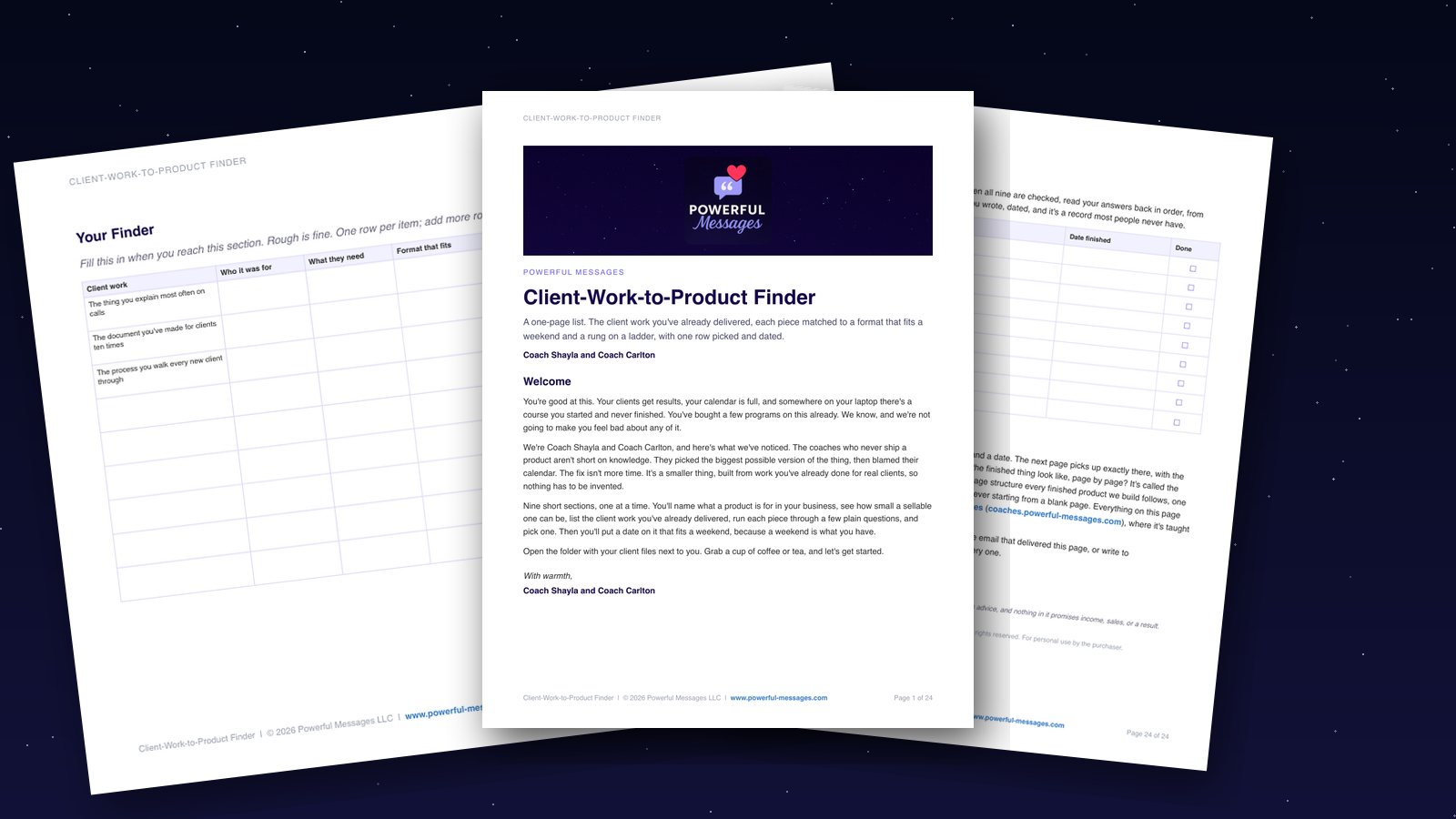
Client-Work-to-Product Finder
Helps you turn an answer you give clients over and over into a product you can sell.
Get the Client-Work-to-Product FinderThis is also why testing the promise with real people matters so much. You can feel sure about a promise and still be wrong about how it lands, and that's what the next step is for.
Scott's promise won't sound flashy, but it will sound true. For a buyer who has been burned by hype before, true is the whole point.
Test Your Product Promise with Real People
A promise on paper is only a guess until real buyers react to it. The best test is to say the promise out loud to people who fit your audience. Their faces, their pauses and their follow-up questions will tell you more than reading it over by yourself ever could.
Scott has a clear promise now, but he hasn't heard it leave his mouth in front of someone who might actually buy. That's the gap between feeling ready and being ready.
He asks Marcus Bell, his accountability partner, to listen. Then he reaches out to a few past clients he trusts, not to sell them anything, but to watch what happens when the promise lands.
What to Listen For
Try not to ask, "Do you like this?" That question invites polite answers. Instead, ask questions that show whether the promise matches a real problem.
- Does this sound like something you would pay to solve?
- What would you expect to get from a product that promises this?
- Where does the wording confuse you or slow you down?
- What would you call this problem in your own words?
Four questions to test your promise
- Does this sound like something you would pay to solve?
- What would you expect to get from a product that promises this?
- Where does the wording confuse you or slow you down?
- What would you call this problem in your own words?
The last question matters most. Buyers describe problems in their own words, and those words are often different from ours. When a past client says the promise back in their own way, you hear the words that would have worked better from the start.
Scott listens closely for any hesitation. A pause before "that sounds good" isn't agreement. It's doubt wearing a polite mask. So Marcus nudges him to ask a follow-up: "What part feels off?"
One past client says the promise sounds right but too broad. Another says she'd want to know how long it takes. Neither comment is a rejection, and both are clear directions for tightening the words.
Change the promise based on patterns, not on one person's opinion. If one person trips on a word, make a note of it, and if three people ask the same question, rewrite the promise so it answers that question before anyone asks.
This isn't a formal focus group. It's a handful of honest talks with people who already trust you enough to tell the truth, and that's enough to catch the biggest problems before you launch. Usability research agrees with this, too. Jakob Nielsen found that testing with just five people uncovers about 85% of the problems (Nielsen Norman Group, 2000).
Worth sharingTesting the promise this way builds real confidence. You stop wondering whether the words work, and you start knowing which ones to keep and which to cut.
Scott leaves those conversations with a shorter promise and a clearer sense of who it speaks to. The product itself hasn't changed at all, but the way he describes it has.
If you'd like to say your promise out loud to two people who will tell you the truth kindly, book a Discovery call with us. It's a 30-minute conversation with Coach Shayla and Coach Carlton about where you feel stuck and what to do next. It starts with a small deposit that is credited toward your next call or the 5-Day Challenge.

From Client Work to a Promise You Can Sell
A simple review turns scattered client notes into one clear product promise. Many coaches sit on years of useful client work and still wonder what to sell. The answer isn't more ideas. It's a simple way to sort what you already know, one you can use again and again.
Scott sits down with his notes from Marcus and Priya one more time. He isn't looking for new problems. He's looking for the one problem that keeps showing up in different words.
That's the step most people skip. They jump from client work straight to a product idea without a bridge, and that bridge is a short review built on three questions.
The Three-Question Review
First, ask which problem made a client lean forward. You're not looking for the polite problem. You're looking for the one that made them say, "Wait, can we stay on this?"
Second, ask what result they described in their own words. Don't clean it up yet, and write it down exactly as they said it.
Third, ask what you already know how to fix without a long back-and-forth. If the answer needs you there live every single time, it isn't a product yet.
Scott runs Priya's scattered notes through this filter, and the big "organization" idea falls away. What's left is a promise about finding the one next action in under ten minutes.
That promise came from her words, not his guess. It came from a problem she kept repeating across three different apps and a paper notebook.
Marcus pushes back a little during their call and asks Scott to say the promise out loud without explaining it. Scott stumbles once, and then he lands on a single sentence.
That sentence is the part people will buy. It isn't the workbook or the video, but the sentence itself.
This works because it makes you choose. A product promise isn't a list of everything you can help with. It's the one thing you'll be known for first.
As we often say, "You're not broken. You're not behind. You're just ready to stop repeating an old story."
The old story says that client work and product work are separate, and they aren't. When you look at your client work through a clear filter, one feeds the other.
Scott closes his notebook, and the promise is shorter than when he started. That's exactly the point.
Bringing It Together
A strong first product promise is specific and doable, and it grows out of the urgent needs you already meet for clients. That's the heart of it. You don't need a clever tagline or a long list of features. What you need is a clear answer to one pressing problem.
So many coaches sit on years of client work and still wonder what to sell. The answer is usually waiting in their session notes. The promise is the result they already deliver, packaged so it can sell while they sleep.
Here's what we hope you'll remember:
- Start with what feels urgent. Pick the problem your clients bring up first, the one that costs them sleep or money.
- Make your promise about one result. One clear result beats a whole menu of possibilities every time.
- Make it believable. Your promise should sound like something you've already done, because you've done it.
- Test it with real people. Say the promise out loud to a few people you trust and watch how they react.
- Build from your client work. Your first product isn't a new invention. It's a version of what already works, shaped so people can buy it.
So what promise should your first digital product make? It should make the promise your clients already trust you to keep. Write that promise down today, and then take an easy first step with the Client-Work-to-Product Finder, which helps you turn your client work into a product idea you can test.
Clarity comes first, and confidence follows it. When you get the promise right, the rest of the product has a clear place to grow from.
Where to start this week
On your next free evening, open the Client-Work-to-Product Finder. It takes about two hours and ends with your first product picked and dated. When you're ready to build it and the products that come after it, join Digital Products Academy for Coaches and work through it at your own pace. If you'd like your position, your offer and your products built in order, The Coach's Path walks you through five schools one after another. And if you'd feel better talking it through first, book a Discovery call with Coach Shayla and Coach Carlton, and bring the promise you're working on.
 Scott RennerA coach building his first productMeet Scott →
Frequently asked questions
How do I find a promise my audience cares about?
Start by listening to your current clients. Notice which problems they bring to you again and again, and which quick wins you already help them reach. Your best product promise solves one of those urgent problems, so it feels like a natural next step from the work you already do.
What makes a digital product promise strong?
A strong promise is specific and simple, and it solves one urgent problem. It clearly names the result the buyer will reach, without jargon or grand claims. It builds trust by focusing on something real they can see, and it shows them a clear path to get there.
Should my first digital product promise a big transformation?
No, your first product should promise a small, clear win. Big changes usually need more support than a simple digital product can give. Focus on one narrow problem, like "Organize your client files in 30 minutes" instead of "Transform your entire business workflow," and you'll build confidence for both you and your buyers.
How can I avoid making promises I can't keep?
Base your promise directly on the work you already do with clients. Think about the results you help them reach again and again, and build your promise around those. Try not to invent new claims or take on problems you haven't already solved many times in your private sessions, and keep it specific and honest.
Is there a simple way to pick my first product from my client work?
Yes, there's a tool made for exactly that. The Client-Work-to-Product Finder walks you through nine short sections, with one thing to write in each, and it takes about two hours in all. It comes as a Notion page you copy, plus a printable PDF.
Where can I learn to build and sell the product once I pick it?
Digital Products Academy for Coaches is our self-paced school for coaches and consultants who already have clients. You build one product at a time until you've got a full set that leads from one to the next, with a sales page for every one.
Can someone help me test my promise?
Yes, and we'd love to. Book a Discovery call and talk it through with both of us for 30 minutes. It starts with a small deposit that is credited toward your next call or the 5-Day Challenge.
Sources
- Nelson Cowan, The Magical Mystery Four: How Is Working Memory Capacity Limited, and Why?, Current Directions in Psychological Science, 2010
- Jakob Nielsen, Why You Only Need to Test with 5 Users, Nielsen Norman Group, March 18, 2000
Recommended for you
Client-Work-to-Product Finder
helps you turn an answer you give clients into a product you can sell.
Get the Client-Work-to-Product Finder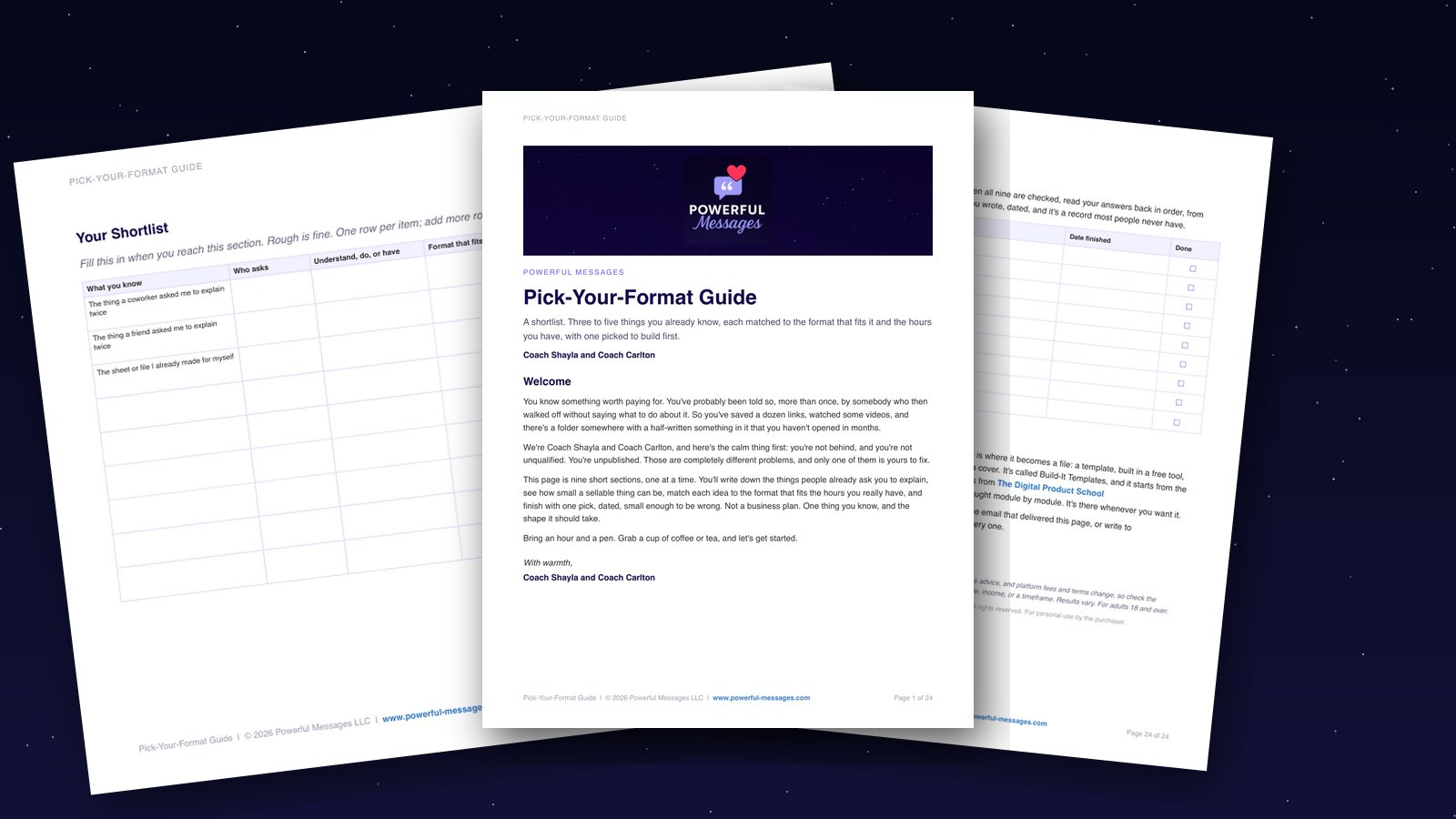
Pick-Your-Format Guide
helps you choose a simple shape for your idea, so you can start making it.
Get the Pick-Your-Format GuideDigital Products Academy for Coaches
Sell your expertise as products
Explore the school