
What matters most: A good sales page for coaches starts with your client's problem and the outcome they want. Then it makes the next step clear. Write it the way you'd run a discovery call. Lead with the client's story and show how your method works. Then close with a call to action that feels helpful. Your know-how is already a product, and the page gives it a shape people can buy.
You're standing in the hallway between two sessions, refilling your water, when a text comes in from someone on your waitlist. She asks if there's anything she can start with while she waits for a spot. You stare at the screen, because you've got nothing to send her. Your calendar is full and your clients are doing great work. Still, no one can get your help without an hour of your time.
That quiet moment is where a sales page starts to matter more than almost anything else in your business. It's the page that lets someone say yes to your help, even when you can't add another hour.
So how do you write a sales page for coaches? You write it the way you run a discovery call. You start with the problem your client already brought to you. Then you show them the outcome they want and make the next step feel easy.
A strong sales page doesn't have to talk anyone into anything. It writes down the talk you've already had dozens of times, in your own voice. Then it keeps helping people while you're with clients or fast asleep.
We spent decades inside Fortune 100, Fortune 500 and Fortune Global 500 companies and small and midsize private firms. Then we built our own schools and products. Coach Shayla created her coaching method in 2011 and still coaches from it today. Coach Carlton was twice named Best Rookie in enterprise sales.
Along the way, we learned that the best sales pages aren't clever. They're clear, and they're built on real client work.
In this article, we'll walk with you through each part of a sales page that connects. You'll see how to turn what you already teach into a product and how to open with your client's story. You'll learn to build trust without a pile of reviews and to ask for the sale in a kind way. We'll also show you where one page fits on a product ladder. That way, each page leads to the next one instead of standing alone.
By the end, you'll know the parts of a strong sales page, and we hope you'll feel ready to start yours. You don't need a copywriter or a big audience to do this well. All you need is the work you already do, written down in a way that helps the right person say yes.
Key takeaways
- Your coaching know-how is already a product, waiting inside your client sessions.
- Open your sales page with your client's inner struggle and the outcome they want, not your credentials.
- Build trust by showing how your product works and answering common worries out loud.
- Write a clear call to action that names the next step, what the client gets and why now makes sense.
- Treat each sales page as one rung on a product ladder, where every offer leads gently to the next.
Your Coaching Expertise Is Already a Product
Maybe you've decided to stop trading every dollar for another hour on the calendar. When that happens, the first urge is to invent something brand new. We understand that urge, but you don't need to follow it. The product you need is already sitting inside the client sessions you led this week.
It lives in the advice you repeat and the framework you sketch on the whiteboard. It's in the questions you ask right before a client has a big aha. All that's missing is a way to package it, so people can buy it even when you aren't in the room.
It's easy to brush off your own material as too obvious. You may have caught yourself thinking that you tell everyone the same five things. That isn't a weakness at all. Those five things are the start of a course.
What feels obvious to you is exactly what clients pay to stop guessing about. The ease you feel with this material is the product.
When a client hears your advice and says, "That makes so much sense," they aren't only praising how you said it. They're telling you that your know-how has value of its own, even apart from your calendar.
The story below is an illustration, not a client case. Meet Scott Renner, a coach in his mid-forties who works from home and sees clients back to back. Scott kept giving the same advice about boundaries to one client after another. One Tuesday afternoon, his accountability partner, Marcus Bell, noticed that Scott had walked through the same three-step process five times that month.
Scott had never written that process down, because to him it was simply part of the conversation.
Marcus could see a mini-course in it. The material was already there, tested in dozens of sessions. Real questions and real pushback had shaped it, so Scott didn't need to invent a thing.
What he needed was to notice what he was already doing.
Worth sharingThis is the shift that matters most. Many coaches think a digital product starts with a blank page and a big idea, but it really starts with a look back at your own client work.
Look for the problem that shows up again and again, and for the process you repeat until it feels automatic.
Listen for the moment in a session when you say, "I always tell my clients this," without even thinking. That repeat is a sign that people truly want it. Clients keep paying you to solve that problem. That tells you the problem is real and your way of solving it works.
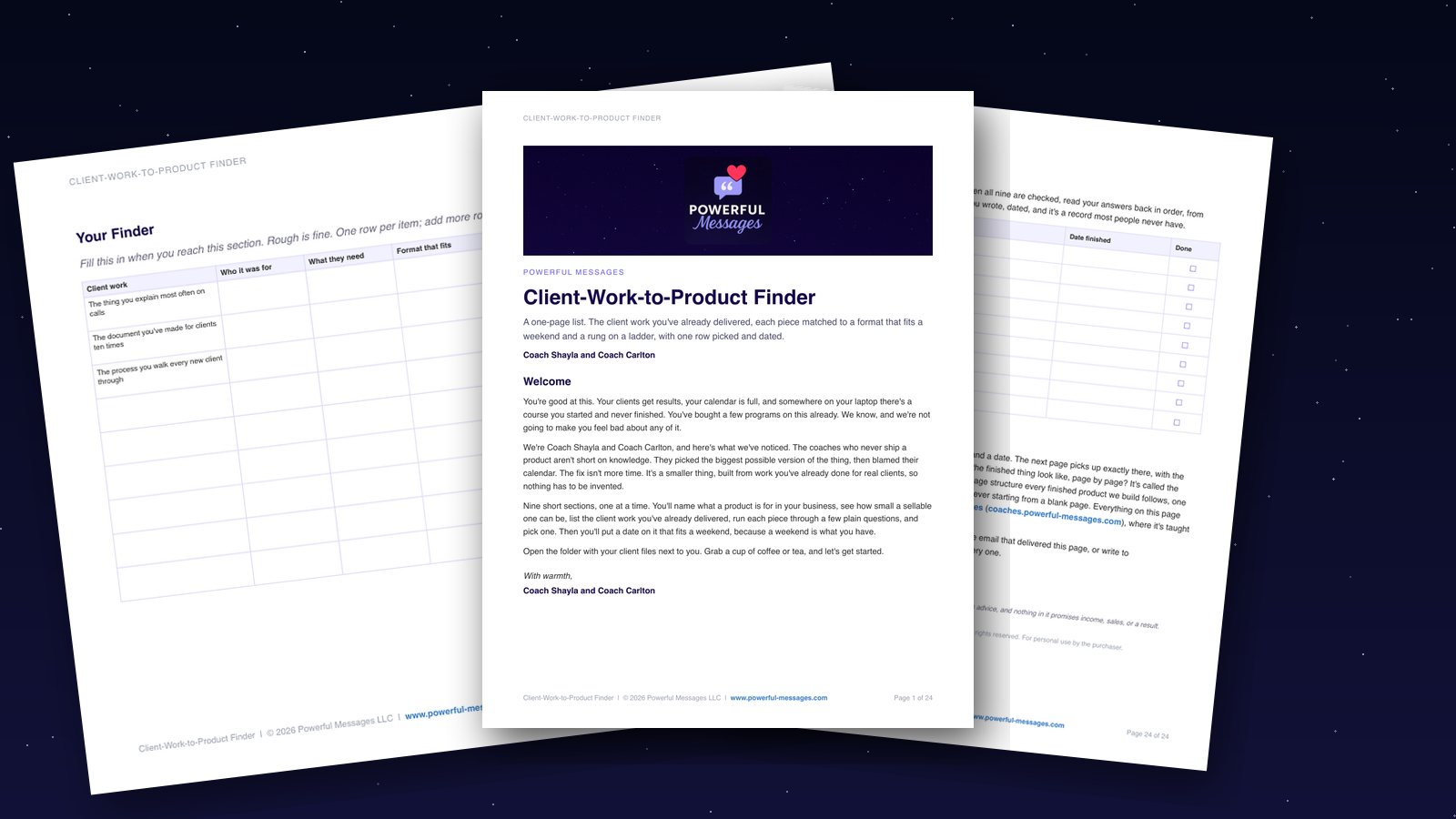
We built the Client-Work-to-Product Finder for exactly this moment. It's a Notion page and a printable PDF with nine short sections, and you write one thing in each. It takes about two hours, and the goal isn't to outline a whole course.
Instead, you pick one piece of client work and match it to a format. Then you put a real Saturday on the calendar next to it. Nothing in it asks you to invent anything new.
The Finder treats your client files as what they already are, which is the raw material for your first product.
Here's what to look for as you go back through your own sessions:
- The advice you give most often, because that repeat tells you people want it
- The process you could run in your sleep, because that can become a workbook or template
- The question clients ask right before a breakthrough, because that can become a guide or mini-course
- The moment a client says "I wish I had known this sooner," because that's your opening line
Scott's boundary process became a small product he could actually finish. It wasn't a ten-module flagship course, but a mini-course sized to fit into one weekend.
That first product had been there all along, and now it has a date on the calendar.
Once a product exists, the next question isn't how to build more. It's how to describe what the product does for the person reading on the other side of the screen. That description is where your sales page begins, and it starts with your client's story, not your features.
Starting Your Sales Page With the Client's Story
A sales page that works opens with your client's inner struggle, not with your credentials or a list of features. The first lines should echo the exact words a client uses to describe the problem that keeps them up at night. When readers see their own worry reflected back, they stop scrolling and start to trust that you understand.
Good sales talks have always worked this way. The ones that move forward fastest rarely start with what a product can do. They start when someone says the buyer's problem back in the buyer's own words. Then they show the outcome the buyer wants.
A sales page works the same way. It's a written version of that first talk, so it needs to begin right where your client already is.
Think about Priya Shah, one of Scott's coaching clients. Most mornings she wakes up with a tight chest before her feet even touch the floor. Her calendar is full, her team leans on her, and she can't remember the last time she felt ahead of anything.
A page that opens with a headline about "proven coaching frameworks" loses her in seconds. Nielsen Norman Group found that people often leave a web page within 10 to 20 seconds unless its value is clear (Nielsen Norman Group, 2011). Now picture a page that opens with the feeling of morning dread and racing thoughts before email. When it names the tiredness behind her polished smile, she feels seen.
She keeps reading because someone has finally named what she's been carrying alone.
To find that opening, we go back to the same place the product came from. We look for the phrases clients use in sessions and the pictures they keep coming back to. We listen for the worries they only share once they trust you. Those are the words that belong on your page.
We don't turn them into corporate language or smooth them into something generic. We keep them honest and easy to recognize.
Those words are already waiting in your client files. Our Client-Work-to-Product Finder helps you go back through them and choose one piece of work you've already delivered. You leave with your first product picked, along with a format, a rung and a real Saturday. After that, the opening of your page gets much easier to write.

- Write down the exact sentence a client said the first time they described their problem.
- Name the feeling under the problem, not only the situation around it.
- Describe the future they want in their words, not yours.
- Put that before-and-after picture in the first two paragraphs of your page.
Four steps for your sales page opening
- Write down the exact sentence a client said when they first described their problem.
- Name the feeling under the problem, not only the situation.
- Describe the future they want in their own words, not yours.
- Put that before-and-after picture in the first two paragraphs of your page.
Leading with the outcome means you show readers where they want to land before you explain how they'll get there. Our Digital Products Academy for Coaches teaches this in its sales page module. The idea holds for every kind of product. A coach selling a workbook on making decisions doesn't open with the page count or the exercises inside. She opens with the relief of making a hard choice and not second-guessing it for a week.
Worth sharingThis isn't manipulation. It's accuracy. Your client's story is the truest reason the product exists, and starting there keeps the whole page honest.
When the opening matches what the reader is living, the rest of the page is allowed to be simple. The structure that follows can do its job without having to talk anyone into anything.
How Do You Write a Sales Page That Builds Trust?
Picture two coaches writing about the same product. The first one lists features, credentials and a wall of praise from past clients. The second walks the buyer through the exact steps they'll take. It names the doubts that buyer already carries and answers each one in plain words.
The second page wins, and it wins without a single testimonial. Trust on a sales page comes from showing how your method works and answering worries before the reader has to ask.
Big company buyers think this way too, and a room full of executives rarely asks about your résumé. They ask how the work gets done and what could go wrong. Coach Carlton trained in Sandler, Ziglar and Dale Carnegie, and that training drove home the same point. A buyer who can see the process feels safer than one who only hears the promise.
For you, that means explaining how your product works, not only what it delivers. A short walk through the steps, the time it takes and the format gives readers something solid to trust.

Worries belong on the page, not stuck in the buyer's head. If you think a buyer will worry the product takes too long, say so and answer it. If they might wonder whether it fits their niche, speak to that directly.
Too many sales pages hide from the hard questions and hope the reader will click anyway. We think that's a mistake, and luckily it's an easy one to fix.
A page that names a concern and answers it reads as honest, and honesty is the fastest way to earn belief.
Your own story can carry more weight than a dozen borrowed quotes. Scott shares a short personal story on his page about his own struggle with client boundaries. A buyer like Elena Rossi, who's in her mid-thirties and stretched thin, sees herself in it right away.
Nothing about that connection is staged. It's a real part of his experience, shared without drama.
That kind of honesty builds trust, because it costs something to share.
Here's what we'd put on a page before we ever asked for a testimonial:
- A clear, step-by-step description of the process
- The time it takes and the format, stated plainly
- Three common worries, each answered in one or two sentences
- A short personal story that shows you understand the struggle
- One honest note about who the product isn't for
That last one surprises people, because naming who a product isn't for can feel like turning away a sale. In practice, it does the opposite.
It tells the right buyer they're in the right place, and it tells everyone else you aren't desperate for their money. We'd rather lose a buyer who isn't a fit than earn a refund and a bad memory.
Worth sharingProof isn't only what other people say about you. It's what your page shows about how you think, how you work and whether you respect the person reading. That's the trust your call to action can turn into a yes.
Crafting Your Call to Action and Offer
A sales page that explains everything but asks for nothing leaves your reader with nowhere to go. The call to action is the moment when understanding turns into a decision. A strong one names the next step in plain words and tells readers exactly what they'll get. It also gently clears away the reasons to hold back.
It doesn't beg or push. It makes the next move feel like the natural end of the talk your page has been having all along.
Many coaches tuck their best offer behind vague words like "learn more" or "get started today," and those words leave the reader guessing. Nielsen Norman Group warns that a label like Get Started is too generic to stand on its own (Harley and Flaherty, 2017). A clear call to action does the guessing for them. Scott's page says it plainly: "Click here to get the 'Set Your Boundaries' Mini-Course and reclaim your evenings this week." Now the reader knows the product, the outcome and the timing. Nothing about that sentence feels pushy, because it reads like an invitation, not a demand.
What the Client Gets, What They Do, and Why Now
Every good offer answers three questions in a clear order, and the first is what the client will get. Name the format, the length and the result, whether that's a mini-course, a workbook or a set of templates.
The second question is what they need to do next, which should be one click, one form or one button. The third is why now is the right time, and the answer is never pressure for its own sake.
The real answer is relevance. The problem they came to solve is happening today, and your product helps with it this week.
Friction hides in the small things. A button that says "submit" feels like paperwork, while a button that says "get the mini-course" feels like a fair trade.
In our school, we teach you to write your call to action as a sentence you'd say out loud on a discovery call. If it sounds natural when you say it, it'll sound natural on the page.

That's the whole test, and it's a kind one to use.
Writing that offer and the page around it is a big part of what we do in Digital Products Academy for Coaches. It's our self-paced school for coaches who already have clients and results. You build one product at a time from client work you've already delivered, until every rung has its own sales page.
Digital Products Academy for Coaches
Turn what you already teach into products people can buy
Explore the schoolRemoving Friction Without Feeling Salesy
An offer feels pushy when it asks for too much, too soon. A first product should ask for a small yes, because the reader isn't signing up for a year of coaching.
They're buying one focused thing that solves one focused problem. When the ask matches the size of the product, the choice feels light.
That's why Scott's mini-course works so well. It isn't a program meant to change someone's whole life, but a tool for setting boundaries this week.
We also remind coaches that products start to sell each other. Someone who buys a small course is already warm to the next rung. The call to action on one page plants a seed for the next offer without saying a word about it. Each page does its own job, and the ladder does the rest.
Your Sales Page Fits Into a Full Product Ladder
One sales page can only do so much on its own. The real power shows up when that page sits on one rung of a product ladder. A product ladder is a set of offers that moves a buyer from a small first yes toward deeper work with you. Each rung has its own page, its own promise and its own job.
The page for your first, smallest offer asks for an easy choice. The page for your middle rung helps the buyer trust you more.
The page for your signature product asks for the full commitment.
Large companies buy this way too, since almost no one jumps from a first hello to a big contract. Coach Carlton spent years selling software to senior leaders, and in that world, the path usually runs through smaller agreements first. A product ladder brings that same logic to your coaching business. It gives every buyer a natural next step and every sales page a clear role in a bigger plan.
- Entry offer: a low-priced guide, template or short course that solves one narrow problem.
- Middle rung: a workbook, mini-course or toolkit that goes deeper into one process.
- Signature product: your flagship program or your most hands-on coaching.
Marcus Bell, Scott's accountability partner, built his ladder this way. He started with a simple guide that answered one question his clients kept asking. The people who bought that guide were already warm when he offered his fuller coaching program.
The guide's sales page didn't try to sell the program. It sold the guide, and the guide quietly did the work of making the next step feel obvious.
This is the shift so many coaches miss. They write one page and expect it to carry the whole business, but a ladder changes the math. Each product sells the next one, so each page only has to win the one choice in front of the reader.
Our school teaches this as a core structure, with a sales page on every rung. There's also a module on how products start to sell each other. The point isn't more pages for their own sake. It's a path where every yes makes the next yes easier.
If you'd like the ladder and everything around it, The Coach's Path takes you through five of our schools in order. You'll go from a position people repeat to an offer a stranger can buy. Then you'll build a way for buyers to find you. It's one login and one sequence, and you move at your own pace inside each school.
Conclusion
Your coaching know-how is already a product. A sales page gives it a shape people can see, trust and buy, even when you aren't on the call.
We've walked the whole path together, so here's what we hope you carry with you:
- Start with your client's story, not your credentials, and name the problem they feel before you offer the answer.
- Build trust with proof from your real client work, because you don't need dozens of testimonials to show you understand.
- Make one clear call to action that tells readers exactly what to do next and what happens when they do.
- Place each product on a ladder, so a small first offer leads to the next rung and every rung has its own page.
None of this asks you to invent new material. It asks you to package what you already teach in sessions, so your help can reach beyond your calendar. That's the real shift.
Would you like a clear, guided way to write your sales page and build the ladder behind it? Digital Products Academy for Coaches walks you through it at your own pace. You can also work with us on a two-on-one Build Call. The goal of that call is to leave with your first product drafted and a sales page outline in hand.
Your next client may already be in your files. Give them a page where they can find you.
Where to start this week
If you'd like one small step this week, choose your first product with the Client-Work-to-Product Finder, which takes about two hours. When you're ready to build that product and its page, and then climb to the next rung, join Digital Products Academy for Coaches. If you want your whole coaching business built in order, take The Coach's Path. If you'd rather talk it over first, book a Discovery call with Coach Shayla and Coach Carlton. We'll look at your first page together. It starts with a small deposit that's credited toward your next call or the 5-Day Challenge.
 Scott RennerA coach building his first productMeet Scott →
Frequently asked questions
What's the most important part of a sales page for coaches?
The most important part is a clear picture of the outcome your client will get. Focus on the change they want, not only the features of your product. Lead with the problem your client faces, and then show how your offer helps. That way, they can see themselves in the answer.
How long should a sales page for coaches be?
A sales page should be as long as it takes to answer your client's questions and calm their worries. For a small, quick-win product, it might be fairly short. For a signature program, it will naturally run longer. What matters is that it's clear and complete, not that it hits a word count.
Do I need testimonials to write a good sales page?
Testimonials can help, but you don't need dozens to write a strong page. You can build proof by sharing your process and laying out the steps clients will take. Speak right to the problems you know your clients face. Your know-how and clear words are strong proof on their own.
What's a 'product ladder' for coaches?
A product ladder is a set of digital products built from what you know as a coach. It runs from small first offers up to bigger signature programs. Each product meets a different client need and price point, and each rung can lead people to the next. That gives your clients a steady path, and it can give your business a steadier flow of income.
What if I don't know which product my sales page should sell?
Start with the Client-Work-to-Product Finder. It helps you choose one product from client work you've already delivered, so you aren't inventing anything new.
Is there a course that helps me build products and sales pages for each rung?
Yes, that's exactly what our school does. Digital Products Academy for Coaches walks you through it one product at a time, at your own pace.
Can someone look at my sales page with me?
Yes, we'd be glad to. Book a Discovery call, and we'll talk it through together with both of us on the call.
Sources
- Jakob Nielsen, How Long Do Users Stay on Web Pages?, Nielsen Norman Group, September 11, 2011
- Aurora Harley and Kim Flaherty, Get Started Stops Users, Nielsen Norman Group, August 20, 2017
Recommended for you
Digital Products Academy for Coaches
Sell your expertise as products
Explore the schoolClient-Work-to-Product Finder
helps you turn an answer you give clients into a product you can sell.
Get the Client-Work-to-Product Finder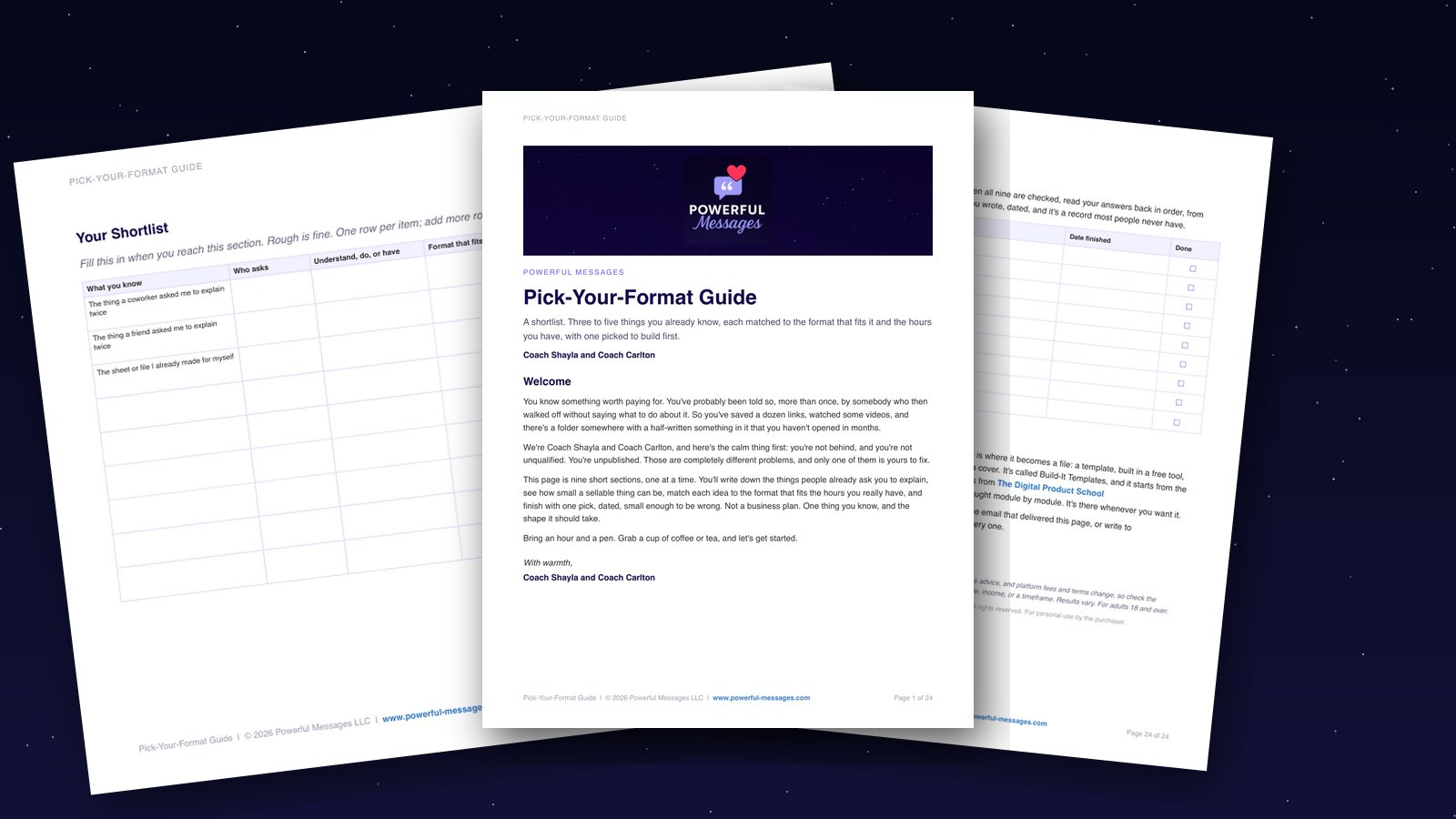
Pick-Your-Format Guide
helps you choose a simple shape for your idea, so you can start making it.
Get the Pick-Your-Format Guide