
The heart of it: Share your new printable first with a small, trusted circle of close friends and family. These are people who know you, want you to do well and will be honest without crushing your momentum. That first round builds your confidence, and it makes the printable better before more people see it.
The printer hums in the next room, and one warm page slides out into the tray. You carry it to the kitchen counter, and for a moment you feel proud, because the thing you made is finally real. Then you picture someone else reading it, and you tuck it into a drawer instead of sending it to anyone.
If that sounds like you, you're not alone, and nothing is wrong with you. We've watched smart, capable people sit on a finished printable for weeks because of one simple question. Who should you share your new printable with first?
We understand that pause, because we've felt it in our own work. The file is done and the idea is solid, yet that first share can feel heavier than the whole build.
The answer isn't to post it everywhere at once. Start with a small, trusted circle of people who know you, want you to win and will tell you the truth kindly. That first share isn't about going viral or making a sale. It's about building your confidence and gathering notes that make the printable better before more people see it.
Think of your first share like the soft opening of a new restaurant. The owners don't invite the whole city on day one. They invite a few friends, watch how they move through the room and fix the wobbly table before the big crowd arrives.
Your printable deserves that same care. A thoughtful first share lowers the pressure and shows you real ways to improve. It also gets you ready for a wider release with far less fear.
We spent years inside busy, high-pressure companies where feedback could make or break a project. The same idea works for your printable. Start small, listen well and let each round of sharing make the work stronger. By the end of this article, you'll know who to ask first and why that choice matters so much.
Key takeaways
- Start with a small, trusted circle so your first share builds confidence and brings you useful notes.
- Your first shares are for making the printable better, not for going viral or making sales.
- Choose people who know you and want you to win, like close friends and family.
- Ask specific questions about one small task, so you get notes you can act on instead of vague opinions.
- Fix anything that makes the page unclear or hard to use first, and save personal tastes for later.
- Widen your circle a little at a time, moving to online groups in your niche once the first fixes are done.
Why Your First Shares Matter So Much
When someone gives you an honest, caring reaction to something you made, you feel a quiet pull to keep going. That pull is the real reason your first shares matter.
Those first shares aren't a test of whether your printable is good. Think of them as the first deposit in a confidence account you'll draw from later.
One friend who tells you it's useful can do more for your momentum than a hundred strangers scrolling past. An early note like that builds your confidence before the product is polished.
It also helps you fix the printable while the stakes are still low. A confusing instruction caught by a friend costs you nothing.
If a paying customer finds that same mistake, it could cost you a refund and a bad review. Buyers do read reviews. Pew Research Center found 82% of U.S. adults at least sometimes read online reviews before buying something for the first time (Pew Research Center, 2016).
You may know the knot in your stomach that comes with opening your email when you don't know what's waiting. We'd love to spare you that feeling when it comes to your printable.
A thoughtful first share is a smart move, not a casual one. It protects you from the early burnout that can come from showing strangers your work too soon. Sharing that early can leave you alone with silence or harsh words.
Think about what this stage does for you. It turns a vague fear into a real talk with someone you trust. You stop asking whether it's any good, and you start asking what you should fix. That shift changes everything, because a simple to-do list takes the place of self-doubt.
Testing before you go wide is built right into the steps we teach in The Digital Product School. First you find your idea and test it, then you build it and list it, and then you read the numbers and repeat. It's our self-paced school for people who know something worth paying for but have never sold anything online. You'll use free tools all the way through, and you don't need an audience or design skills.
If you skip this stage, you hand your confidence straight to the open market. That's a hard lesson we'd never wish on any beginner.
Who Should You Share Your New Printable With First
Sharing with the wrong person first can flatten your momentum before it has a chance to build. Think of a coworker who barely knows you, a stranger in a Facebook group or a harsh online forum. They'll judge the product with no idea of the effort behind it. A cold reply like that feels like a verdict, not helpful feedback.
The right first audience is your closest friends and family, the people who know you and want you to succeed. With them, you've got a safe place where honest notes land gently.
The story below is an illustration, not a client case. Meet Grace Lim, a nurse who made a simple shift-tracking printable on her day off. She sent it to her friend Tasha Reed before anyone else, and Tasha did more than say it looked nice.
She pointed out that the medication log column was too narrow for real handwriting. She said it with warmth, because she's watched Grace work twelve-hour shifts. That's the kind of first response that makes a product better without bruising the person who made it.
Family can help in the same way. A sister or a parent will test your printable without needing it to be perfect. They'll click the link, print the page and tell you what confused them.
Their notes aren't market research, but they give you a safe place to test. We've seen beginners skip this step and hand their work to strangers who had no reason to be kind.
When that happens, what usually comes back is silence or a blunt comment that feels like failure.
How to Identify Your Inner Circle
Start with the people who already ask about your projects, because they care about your progress and not only your product. Look for the friend who texts back fast and the family member who asks what you're working on. Think of the coworker who gets excited right along with you. These are the people who'll give you notes without making you feel small.
- Someone who has seen you work on this idea and asked about it.
- A friend who gives you honest opinions in other parts of your life.
- A family member who'll actually print and use the page, not only glance at it.
- Someone who can tell you what's broken without making you want to quit.
Worth sharingWe'd rather see you share with two thoughtful people than twenty who don't care. The goal isn't a big number. It's a response you can use.
Tasha gave Grace one clear fix that made the printable better for real nurses. That single note was worth more than a hundred vague compliments from strangers.

Worth sharingYour inner circle isn't your final audience, but they're the right first one. They let you test the water before you swim.
Asking for Feedback From Your Trusted Circle
In 2026, the questions you ask before you launch can make the difference between a printable that flops and one that sells. So ask your trusted circle specific questions about one small task. Skip open questions like "What do you think?" because a vague question invites vague praise. A precise question gets a precise answer, and that's what helps your printable get better fast.
It's so common to hand a printable to a friend and ask them to tell you if anything looks wrong. That question is a trap, even though it feels polite. Your friend scans the page and says it looks great, so you learn nothing. But the problem isn't your friend.
The problem is the question. When you ask someone to judge a whole product at once, their mind slips into being polite.
When you ask them to do one small task, their mind switches to solving problems. Research supports this idea, too. A large review of feedback studies found feedback helped on average, but over a third of the time, it made performance worse. Feedback worked better when it pointed at the task, not the person (Kluger and DeNisi, Psychological Bulletin, 1996).
Grace learned this when she asked her coworker Ben Okafor to look at a meal-planning printable. Instead of asking for his general thoughts, she handed him one page. "Walk me through how you'd fill out Tuesday's dinner section," she said. Ben saw right away that the instruction box sat too low on the page. He had to flip back to understand the portion sizes. That one note saved Grace from printing a whole batch with a confusing layout.
How to Frame Questions That Get Real Answers
Try asking, "Can you finish this one task in under two minutes?" You can also ask, "Where did you pause or feel unsure?" Questions like these give your trusted circle a job to do, not a judgment to make. We suggest asking about clarity, flow and usefulness one at a time. Clarity means the words make sense.
Worth sharingFlow means the steps come in an order that makes sense. Usefulness means the person would truly want this in their life.
Make it easy for people to answer you. Send one page instead of the whole file, and ask one question instead of five.
Tell them their honesty helps you, because it truly does. Ben held back at first, so Grace told him, "I'd rather hear it from you now than from a paying customer later," and she meant it. That sentence changed the tone of the whole talk.
It gave Ben permission to be direct with her.
Many beginners overthink this step, and that's understandable. You don't need a formal feedback form or a rating scale. All you need is one clear task, one clear question and a person who wants you to succeed.
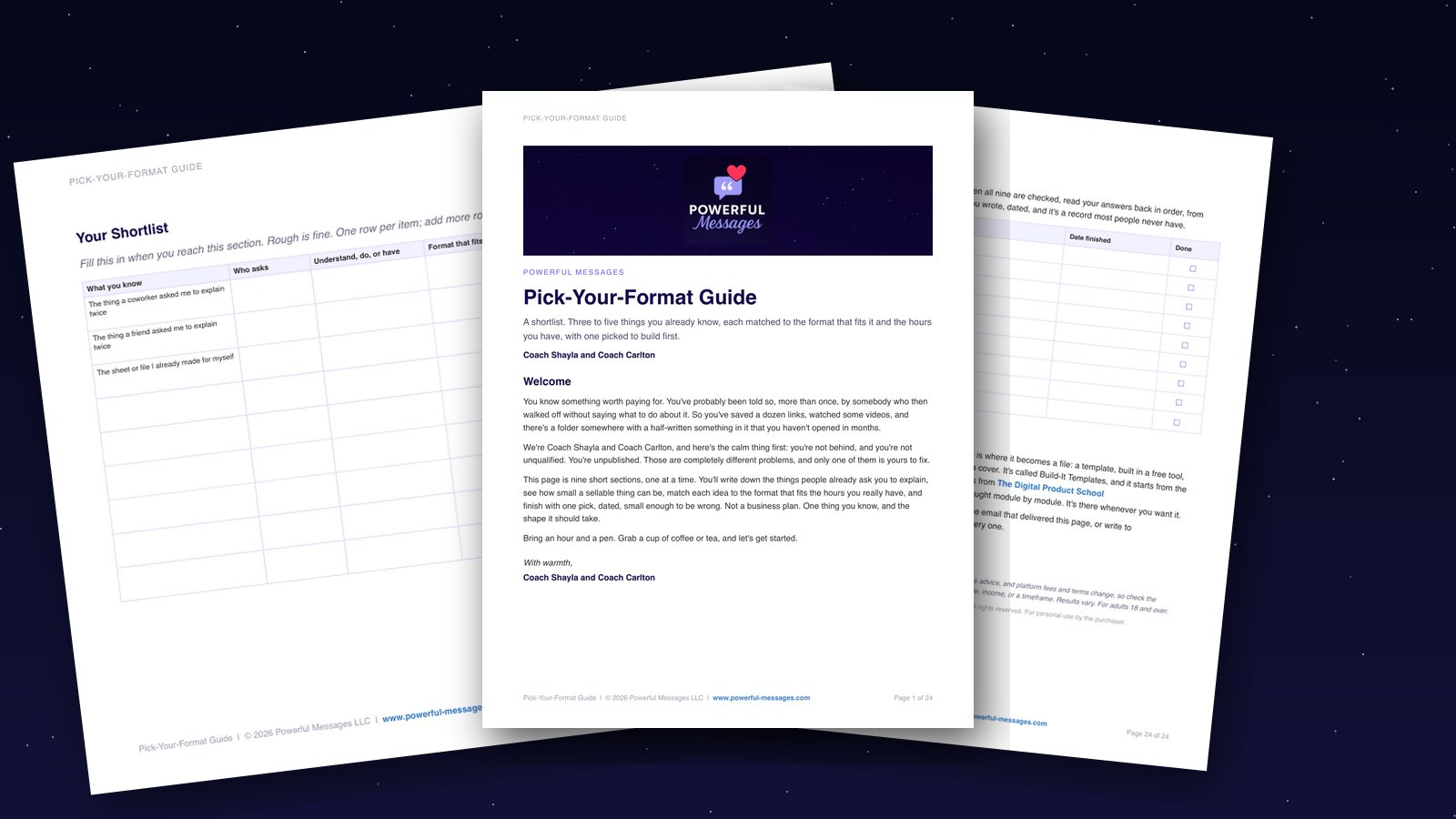
And if you're still deciding what your printable should be, our Pick-Your-Format Guide helps you make that call in one afternoon. You walk away with a short list of what you already know. Each row is matched to a format that fits your free hours, and one row is picked and dated.
Pick-Your-Format Guide
helps you pick a simple shape for your idea, so you can start making it.
Get the Pick-Your-Format GuideWhat to Do With the Feedback You Get
When the notes start coming in, your first move isn't to act on all of them. Your first move is to sort them, and we treat every response as raw material, not a command.
Some notes will make the printable sharper. Others will reflect one person's taste, which has nothing to do with your buyer.
So look for patterns across the responses, and fix whatever affects clarity and ease of use first. Everything else can wait.
Before we change anything, we ask one question. Does this suggestion remove friction for the person using the page? If a friend says the header feels crowded, that's a clarity problem.
If someone else says they'd like a different color, that's a preference. One of those moves the product forward.
The other one only moves it sideways. Chasing every comment can leave you with a printable that pleases no one, including you.
Patterns matter more than the number of notes. One person mentioning a confusing instruction is a single data point, but three people mentioning it is a clear signal. We sort feedback into three buckets:
- Clarity fixes: instructions, labels, spacing and anything else that gets in the way of understanding.
- Ease-of-use fixes: layout, print margins, font size and anything else that gets in the way of using it.
- Preference notes: color choices, wording style, extra sections and anything else that reflects taste.
The first two buckets come first, and the third bucket gets a pause. Your printable doesn't need to match every friend's style.
It needs to work for the person who buys it. Holding on to that keeps your vision whole while still honoring the notes you asked for.
We also suggest keeping a short note file where you write down what changed and why. Later, when you widen your circle, that record helps you explain your choices without second-guessing them. A printable that makes it through this sorting feels sturdier, and so does the person who made it.
If you'd like a second opinion on which notes to act on, book a Discovery call with us. It's a 30-minute talk with Coach Shayla and Coach Carlton about where you feel stuck and what to do next. It starts with a small deposit that's credited toward your next call or the 5-Day Challenge.

Expanding Your Circle After Initial Success
Waiting until your printable feels perfect is the wrong test. The right test is whether your first round of changes is done and the file no longer makes you wince. Once that's true, a wider audience becomes helpful instead of scary. We widen the circle one careful step at a time, not with a big public launch.
Large companies often work this way with new tools. A dashboard that works well for one team can confuse another, so it's wise not to ask everyone at once.
Instead, you gather a slightly bigger group, watch where they get stuck and improve the page again. Your printable can follow that same path.
Where to Find the Next Group
Online groups built around one clear interest work better than general social media. A teacher who made a lesson planner should look for teacher groups, not a random Facebook feed. A nurse who made a shift tracker should find nursing groups. Your audience is still focused, only a little bigger than your kitchen table.
- Look for groups where people talk about your topic every day.
- Join in as a helpful member first, not as a seller.
- Share your printable only when someone asks a question it answers.
- Ask for notes on one specific part, not the whole file.
Four steps to expand your sharing circle
- Look for groups where people talk about your topic every day.
- Join in as a helpful member first, not as a seller.
- Share your printable only when someone asks a question it answers.
- Ask for notes on one specific part, not the whole file.
Different groups give you different kinds of notes. Your friends caught typos and confusing labels, while strangers will notice whether the format fits the way they work.
That's exactly the point. Now you want notes from people who have no reason to protect your feelings.
Preparing for Rougher Notes
Strangers often say things bluntly. A comment like "this didn't print right on my printer" isn't a rejection of you. It's a clue about page size, margins or file type, and we treat it as a clue, not a verdict.
One helpful habit is to keep a short list of what you changed after the first round. When someone in a new group asks why a part works a certain way, you can share your reasons. That record turns a moment that could feel defensive into a confident one.

Your circle grows best in rings, not big leaps. The next ring is strangers who share your niche, and the ring after that is a wider market. Each ring teaches you something the last one couldn't.
When you're ready for those wider rings, our Creator's Path takes you there in order. It's four self-paced schools in one sequence, made for experts who already explain things for free. You'll turn that into a clear position and a finished product. Then you'll build a system that keeps selling it, even when you aren't there to explain it.
Conclusion
Sharing a new printable can feel so exposed. Many capable people sit on finished work for weeks because they don't know who should see it first. The answer isn't to post it everywhere. It's to start with a small circle of people who know you, want you to win and will tell you the truth.
That first share isn't about going viral. It's about building the confidence to keep creating. Inside large companies, we saw the same pattern with new dashboards and new products.
The teams that tested quietly with a few trusted coworkers fixed real problems before launch. The teams that spoke up too early spent their energy clearing up confusion instead of making the work better.
Here's what we hope you'll carry with you from this article:
- Choose your first sharers on purpose. Pick people who understand what you're trying to do, not only people who are easy to reach.
- Ask for specific notes, because a vague question like "what do you think" gets a vague answer. Ask what confused them, what they'd change and what they'd pay for.
- Act on what you hear, since notes only help when you use them to make the printable clearer or more useful.
- Widen your circle slowly, and share with a bigger group only after your trusted circle has helped you improve the printable.
Our own work taught us to care about testing. Coach Shayla spent years turning messy data into clear dashboards for senior leaders. Coach Carlton spent years selling software by listening to what buyers truly needed.
The same idea applies to your printable. Small, thoughtful sharing builds a stronger product and a calmer creator.
If you're still deciding what kind of printable to make, our Pick-Your-Format Guide helps you choose a format that fits your skills and your schedule. It's a low-risk first step, and you can work through it at your own pace.
Share it with one person you trust, listen closely and then make it better. That's the whole path, and you can start it this week.
Where to start this week
Start with the smallest step that feels doable. If you haven't picked your printable yet, the Pick-Your-Format Guide takes about two hours and ends with one idea picked and dated. When you're ready to build, test and sell it, join The Digital Product School and work at your own pace. If you want your position, your product and your selling system built in order, The Creator's Path takes you through four schools in sequence. And if you'd like a kind second pair of eyes first, book a Discovery call with Coach Shayla and Coach Carlton.
 Grace LimA nurse building something after hoursMeet Grace →
Frequently asked questions
Why is it important to choose carefully who you share your first printable with?
Choosing with care helps you get honest, kind notes without feeling crushed or discouraged. Your first sharers can show you how to improve your printable. They also help you feel more sure of yourself before you share it widely. It's about getting the right kind of input at the right time.
How can sharing with a small group help improve my printable?
A small group gives you focused notes on how clear, easy and useful your printable is. They can spot small problems or suggest changes that make it better for a bigger audience. Those early notes help you shape a product that meets real needs and is easy for anyone to use.
What kind of feedback should I look for when sharing my printable for the first time?
Look for notes on how clear the instructions are, how easy the page is to use and how useful it feels overall. Ask whether it solves a problem or makes a task easier. Also listen for feelings, like whether it feels good to use. Then you'll know both what it does and how it feels.
What if I don't know what printable to make yet?
Start with the Pick-Your-Format Guide. It walks you through nine short sections, about two hours in all. It helps you match what you already know to a format that fits your hours. It comes as a Notion page you copy, plus a printable PDF.
Where can I learn to list my printable for sale?
The Digital Product School is our self-paced school for people with a day job and a skill worth selling. You pick a format, build one product and list it for sale using free tools. You won't need a website or money for ads.
Can someone look at my printable with me?
Yes, and we'd be happy to. Book a Discovery call and talk it through with both of us.
Sources
- Kluger, A. N. and DeNisi, A., The Effects of Feedback Interventions on Performance, Psychological Bulletin, 1996
- Pew Research Center, Online Shopping and E-Commerce, December 19, 2016
Recommended for you
Pick-Your-Format Guide
helps you choose a simple shape for your idea, so you can start making it.
Get the Pick-Your-Format Guide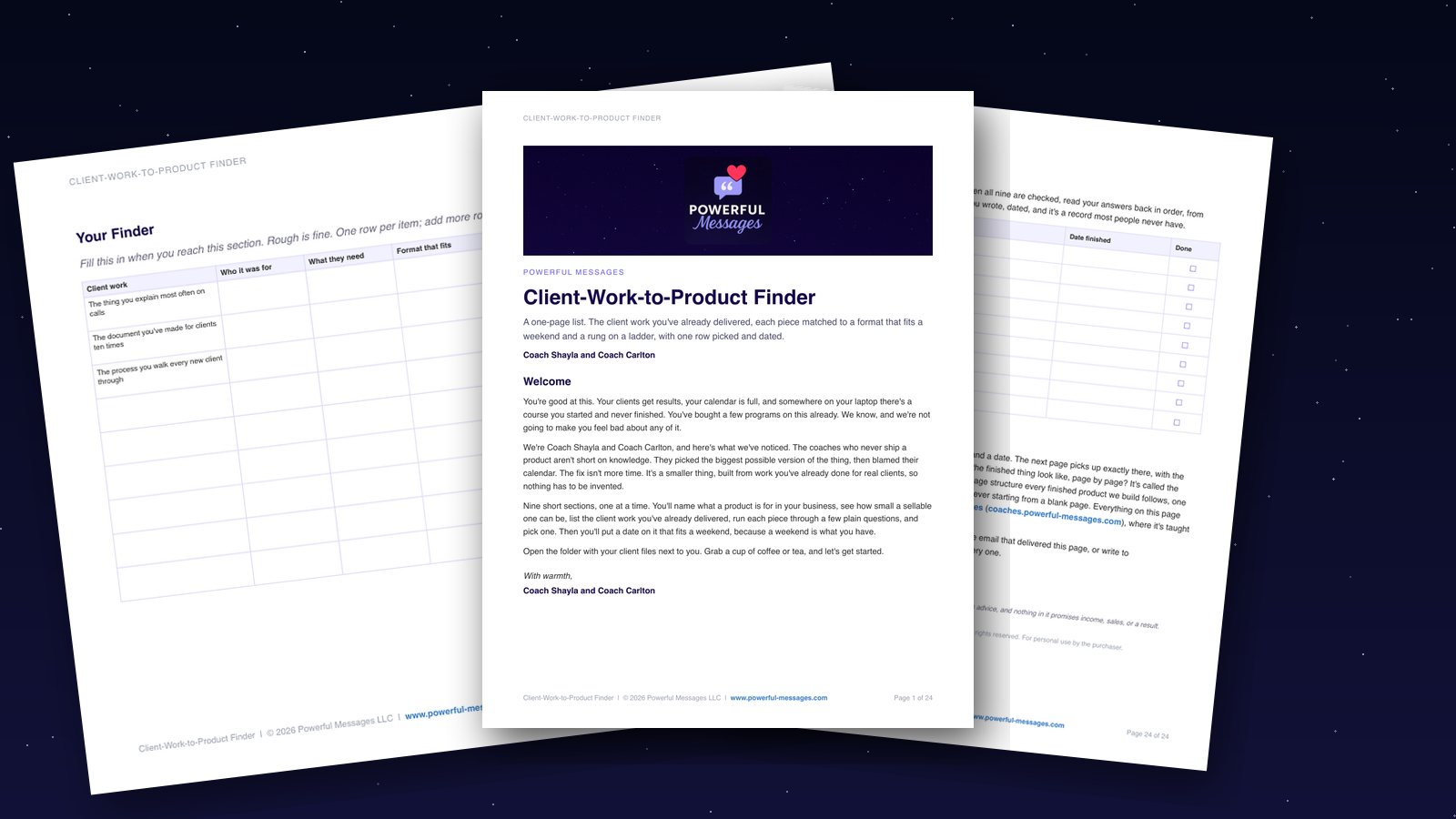
Client-Work-to-Product Finder
helps you turn an answer you give clients into a product you can sell.
Get the Client-Work-to-Product FinderThe Digital Product School
Build and sell your first product
Explore the school