
What matters most: Yes, templates and printables can solve one small problem for buyers. They give people a ready-made shape, so they don't face a blank page or a pile of tiny choices. Planning and tracking get easier to start, and every small start builds a little more confidence.
You walk in from a long shift, and next month's schedule is stuck to the fridge with a magnet. It's already covered in arrows, crossed-out days and a note you can't quite read. You stand there with your keys still in your hand, sure there has to be an easier way to hold all of this. If you've ever felt that, you might find a friend in Grace Lim.
The story in this article is an illustration, not a client case.
Grace is a nurse who works twelve-hour shifts. She comes home, sits down, and stares at a blank page. She'd love to build something small she could sell, but the first step feels foggy. So she keeps wondering if templates and printables can really solve one small problem for buyers. The answer is yes, and we'll show you exactly how.
We're Coach Shayla and Coach Carlton. We spent years inside Fortune 100, Fortune 500 and Fortune Global 500 companies and small and midsize private firms. There, we saw smart people drown in small tasks that should have been easy.
A nurse, a teacher and an office worker all hit the same wall. There are too many choices, too little time, and no clear place to start.
Templates and printables cut through that fog. They give buyers a ready-made path that turns a vague worry into a finished task.
This matters now, because extra income has become a quiet need for many working people. But the tech side can feel scary, and the design side can feel confusing.
A simple template removes both of those walls. You don't have to become a designer, because you're simply giving someone a tool that works in minutes, not hours.
You'll also meet Grace's coworker, Ben Okafor. Both of them are illustrations, not clients, and nobody is promising results. Their stories show how a simple tool can move a busy person from stuck to moving.
What you'll find here is calm, practical help for the small problem right in front of you.
Key takeaways
- A template gives you a ready-made shape you can reuse for tasks you do often.
- A printable brings quick clarity by turning a file into something you can hold.
- Ready-made tools save setup time and take away tech worries for beginners.
- Naming your exact problem helps you find the right, simple template.
- Templates turn vague projects into clear steps you can see and do.
- Small, steady wins from using templates build confidence for bigger tasks.
What Small Problems Can Templates And Printables Solve?
Winging it creates more stress than a simple structure ever will. Templates and printables solve the small planning and organizing tasks that keep coming back and quietly drain your energy. They give you a clear place to start when your brain is too tired to invent one.
We saw this in every office where we worked. Messy systems and unclear steps were the quiet cause of so much daily tension. People weren't failing because they lacked skill. They were struggling because they had no simple place to put the details.
Think about the last time you had to remember too many moving pieces at once. Maybe it was a new schedule, a list of appointments, or a small project with three steps. Your brain holds it all for a while, and then it drops something.
Memory research backs this up. Psychologist Nelson Cowan found that our short-term memory holds only about 3 to 5 meaningful items at once (Current Directions in Psychological Science, 2010). That one dropped detail can turn into a small crisis.
Grace knows this feeling well. A new shift rotation has landed in her lap, and her own appointments now bump into her changing work hours.
A printable weekly planner gives her one place to see the whole week at a glance. She writes in her shifts first, and then she fits her life around them.
That's the whole point. The problem isn't huge, but it's specific enough to cause friction every single day.
Here are the small problems templates and printables handle best:
- Keeping up with a new or changing schedule
- Tracking a simple project with a few moving parts
- Remembering key details like dates, contacts or steps
- Planning meals, errands or appointments around a day job
- Gathering scattered notes onto one clear page
None of these sound dramatic, and that's exactly why people ignore them until the stress piles up. It starts with a missed appointment here and a forgotten step there. Soon the small problem feels like a personal failure.
We'd gently argue the opposite. The problem was never your memory or your discipline. It was the lack of a simple structure. A template hands you that structure before you even have to think about it.
This isn't about becoming a productivity expert. It's about removing the daily friction that makes a busy life feel heavier than it is. When the structure exists, the load on your mind drops.
Once you see how a simple planner works for Grace, you start to notice how these tools are built. You notice the design choices, the layout and the logic behind the boxes, and that curiosity is where the next step begins.
Some readers notice something else here. If you're the person who already makes the checklist everyone at work borrows, that's a product idea. The Digital Product School is our self-paced school for people who know something worth paying for and have never sold anything online. It walks you through picking a format, building one digital product and listing it for sale. You'll use free tools, and you won't need any design skills.
Understanding What Templates Really Are
A template is a ready-made shape you can reuse for a task you do more than once. It isn't a finished product, but a frame you fill in. Its value comes from not having to build that frame yourself every single time.
You've probably seen this in meeting rooms. Picture someone who builds the same outline from scratch before every sales call.
One day, they make a one-page prep sheet with the same questions in the same order every time.
That sheet is a template. It can cut prep time in a big way, because the thinking is already done.
Think of a template as a container you can reuse. A budget tracker is a template, and so is a meeting agenda.
A project outline is a template too, and the container stays the same.
What you pour into it changes each week or each month.
Ben Okafor, Grace's coworker at her day job, uses a simple meeting agenda template. Before every team talk, he fills in three fields, which are the goal, the decisions needed and the time for each topic. His meetings end earlier now.
The template didn't do the work for him. It simply removed the guesswork about where to start.
That's the part beginners often miss. A template isn't a shortcut around effort, but it's a real shortcut around setup.
The effort still happens, of course. The blank page simply stops being the first thing in your way.
Templates usually come in three common forms. One is a ready-made document, like a resume or a proposal. Another is a spreadsheet with the columns and formulas already in place.
The third is a design file with the layout and spacing locked in. All three do the same job, because they ease decision fatigue by giving you a set format.
Decision fatigue is real, and every small choice you make drains a little energy. A template removes dozens of those choices at once.
You don't have to decide where the title goes or what order the sections follow.
All you do is fill in the blanks.
That's why templates feel like such a relief. They give you a clear starting point when your brain is too tired to invent one, because the structure is already there.
You bring the content, and that split of the work is the whole point.
Seeing How Printables Bring Immediate Clarity
Printables turn a digital file into something you can hold, mark and finish. A printable is simply a document you download and print at home. It might be a checklist, a planner page or a tracker. The moment it hits paper, it becomes a real tool you can use right away.
When a person feels scattered, a single sheet of paper can help the fog lift.
The tasks haven't changed, but now they have a place to live outside that person's head.
Grace knows this feeling, too. After a long shift, her brain still spins with patient follow-ups and errands. So she prints a daily checklist and keeps it on the kitchen counter, and each checked box releases a little pressure.
Checklists can help even the experts. When eight hospitals added a simple surgery checklist, deaths fell from 1.5% to 0.8% (New England Journal of Medicine, 2009).
Worth sharingThat's the quiet power of a printable. It doesn't need an app, a login or a learning curve, because all it needs is a printer and sixty seconds.
Writing by hand matters more than we often admit. Many people remember a task better after they write it down by hand. When Grace writes "call pharmacy" and later checks it off, the task lives in two places, on paper and in her head.
Printables also take the friction out of starting. A blank notebook page can feel scary. A printed layout with labeled sections seems to say, "Start here," and that's no small thing for a tired person.
We think of printables as the paper cousin of templates. Templates give you structure on a screen, while printables give you structure on a countertop, a fridge or a clipboard. Both share the same goal, which is clarity without having to invent anything.
Print a fresh checklist each morning, even if yesterday's is half done. The clean page resets your focus without carrying over any guilt.
Some people resist printables because they seem too simple, but that's exactly the point. A grocery list printed from a file works the same as one scribbled on a napkin. It's simply easier to read and harder to lose.
Grace doesn't need a fancy system. She needs her errands in one column and her patient calls in another. The printable gives her that in under a minute, and then she gets on with her evening.

The clarity comes fast because the format is familiar. We've all seen a checklist, and we all know what to do with one without any instructions.
Why Beginners Benefit From Ready-Made Solutions
As a beginner, you'll face a choice between building a tool from scratch and starting with a ready-made one. That choice matters more than most people expect. Ready-made templates and printables give you a faster, calmer way to solve a small problem without learning new software first.
Capable people freeze at a blank spreadsheet all the time. The cursor blinks, and the columns stay empty.
That freeze isn't a skill problem, but a starting problem.
A ready-made reading log melts the freeze, because the structure already exists.
Grace wants to track her reading. She could open a spreadsheet and build columns for the title, author, date and notes. But that means choosing column widths, names, and whether to add a rating scale.
None of that is reading, because it's all setup work.
Instead, she downloads a ready-made reading log template. The fields are already labeled, and the layout already makes sense.
She types in her first book title and moves on. Her setup time drops from an hour to about two minutes.
That's the real gift for beginners. Ready-made tools remove the tech wall that quietly stops people before they start. In big companies, it happens all the time. Smart, busy people avoid new tools because the first ten minutes feel like a test they didn't study for.
A template flips that feeling around. It tells you the hard part is already done, so you only bring the content.
Beginners also save time in ways that add up. Think about what a reading log really needs:
- Deciding what you want to track
- Building the whole layout yourself
- Formatting all of the columns
- Testing whether it really works
- Filling it in each week
A ready-made version skips the first four steps. That leaves only the last one, which is the part Grace wanted to do in the first place. The time you save isn't abstract. It's the difference between starting tonight and starting next month.
Beginners also tend to think they need to customize more than they do. A simple reading log with five fields works for most people. The urge to add color coding, formulas and a yearly chart is usually putting things off in disguise. Pick the plain template and start.
Choosing the right template still matters, of course. A reading log won't help someone who needs a meal planner. But a beginner's first job isn't to master the tool. It's to remove the friction between wanting to track something and actually tracking it.
Finding The Right Template Or Printable For Your Need
Start by naming the exact problem, and then match the tool to that problem. The right template does one specific task well. The wrong one only adds clutter and gives you another thing to ignore.
A big, general project tracker can look impressive until it asks for twenty fields you don't need. At that point, it isn't help anymore, but a second job.
Grace needs a way to catch her side project ideas before they slip away. She doesn't search for a "productivity planner." Instead, she searches for an idea brainstorming template. That difference matters a lot.
One is a broad category, while the other is an answer to her exact need.
Name The Problem Before You Browse
Vague problems attract vague tools. "I need to get organized" leads to a download folder full of unused PDFs. "I need to track meal ideas for the week" leads to a one-page printable that actually gets used.
We call this the problem statement step. Write one sentence that starts with "I need a way to," and then stop. That sentence becomes your search filter.
Here's the simple way to choose:
- Write the problem in one sentence. Be specific about what you need to catch, track or plan. If the sentence is vague, the tool will be vague too.
- List the three fields you really need. Most tasks only need a few pieces of information. If a template asks for more, it's solving someone else's problem.
- Check that the design is clear. Look at the layout before you download it. If you can't tell where to write within five seconds, move on.
- Test it on paper or screen for two minutes. Fill in one real example, and notice whether it feels natural or forced, because your gut usually knows.
Four steps to choose a useful template
- Write the problem in one sentence
- List the three fields you actually need
- Check that the design is clear
- Test it on paper or screen for two minutes
Worth sharingThat last step saves more time than any review. A two-minute test shows you whether the tool fits your brain or fights it.
Where Quality Templates Hide
We don't suggest chasing the most popular download, because popular often means generic. Instead, look for makers who solve one narrow problem and show the template in use.
A good listing shows the template filled in with sample details. That preview tells you more than the description does. You can see the logic, the spacing, and whether the fields match your one-sentence problem.
Grace skips the project trackers with timeline charts and color-coded tabs. She picks a simple brainstorming sheet with space for the idea, the first step and a date. Those three fields are her whole system.
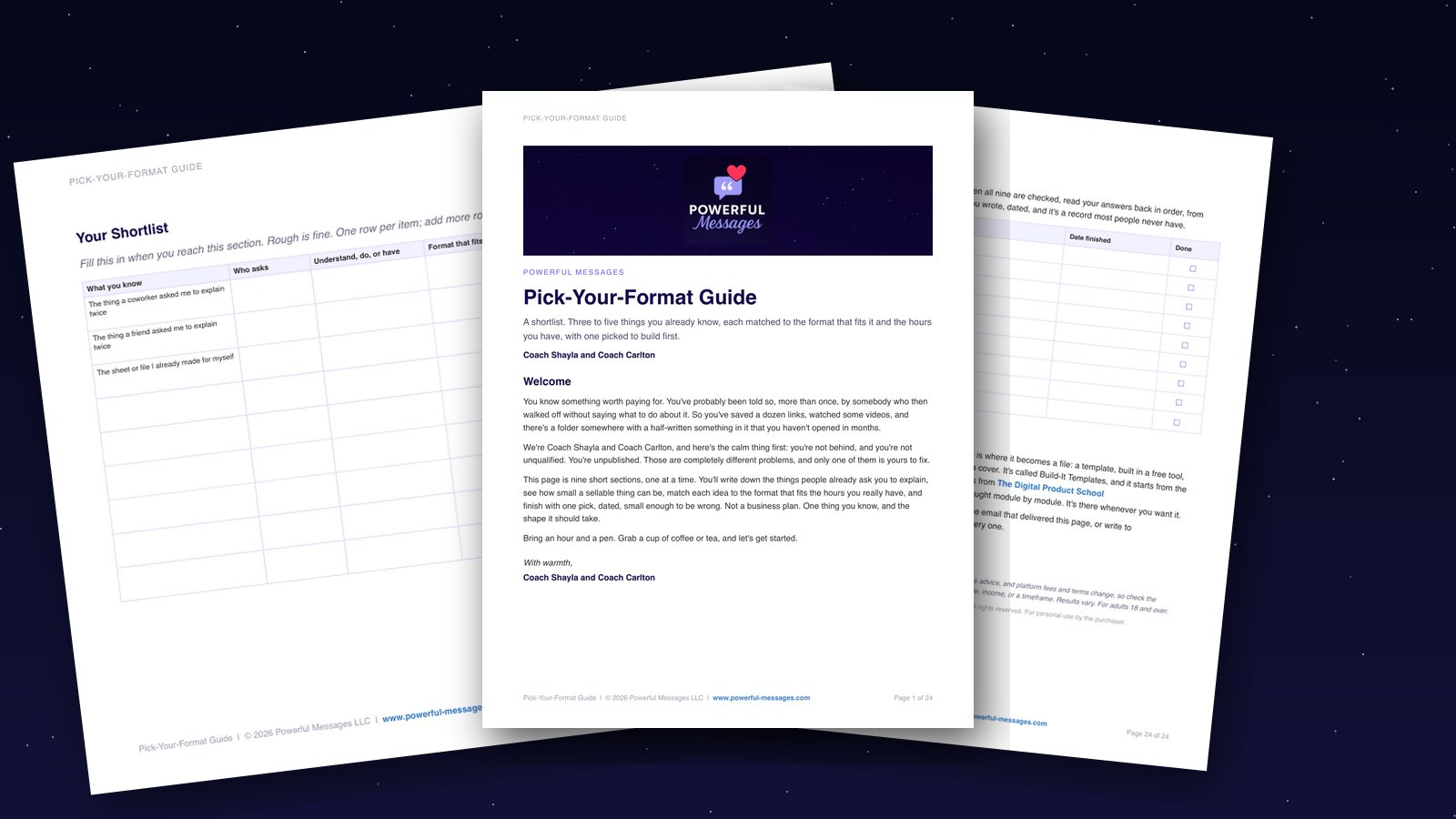
Maybe you're on the other side of this, and you'd rather make the simple tool than buy it. If so, start with our Pick-Your-Format Guide. In one afternoon, you list what you already know and match each idea to a format that fits the hours you have. Then you pick one and put a date on it.
Pick-Your-Format Guide
helps you choose a simple shape for your idea, so you can start making it.
Get the Pick-Your-Format GuidePeople often drop complicated tools and go back to something simpler. We saw the same pattern in the companies where we worked. People don't need more features. What they need is fewer features, arranged well.
The right printable feels almost too simple, and that's exactly the point.
How Templates And Printables Help You Get Started
The 5-minute rule applies here, because a template shrinks the first step until it feels too small to skip. Templates and printables help you start by removing the blank page. They give you a path that's already built, so your first action is filling in a box, not inventing a system. That's the whole trick.
Coach Shayla spent years running global employee surveys. In surveys like those, a clear first question makes it easier for people to begin. People don't freeze when the first question is already written for them.
The same is true in sales and in any project. A project stalls when the first step is vague, and it moves when the first step is obvious. A template is that obvious first step.
The Blank Page Is The Real Enemy
Most people don't put things off because they're lazy. They put things off because they don't know what the first move looks like. A blank page asks you to invent everything at once, and that's tiring before you even begin.
A template flips that around. It tells you to start here, then here, then here, so you don't have to decide the order.
You only have to follow it, and that small shift is what gets you moving.
Think about Tasha Reed, who wants to plan a small event for her church group. The idea feels big to her.
There's food, chairs, invitations and a schedule to think about. Where would she even start?
She prints an event planning checklist. Now her first step isn't to plan the whole event. It's to write the date at the top, which she can do in ten seconds. And once she does it, the next box is already waiting.
A template works because it turns a vague project into a next step you can see. Pick one that starts with something you can finish in under a minute.
Structure Creates Momentum
A format with a set structure has a real benefit for your mind, because our brains like order. When we see a list with empty boxes, we want to fill them, and that urge is free motivation.
Inside companies, people tend to lean in more when the path forward is clear. The same is true for a small side project.
Clarity isn't a luxury, but the engine that keeps you going.
Here's what a good starting template does:
- It names the first action in plain words.
- It breaks a big task into small steps you can see.
- It shows your progress as each box gets checked.
- It removes the need to design anything from scratch.
That last point matters most. Designing a system is one job, and starting a task is another. A template lets you skip the first job entirely.
You don't need to be clever, but you do need to be moving. A printable gives you that movement for the cost of a sheet of paper.
And here's the quiet part. Each small start builds a little confidence, and we'll come back to that soon. For now, the win is simply beginning.
Skip the urge to customize before you start, because that's only putting things off in a nicer outfit. Print the page and fill in the first box.
The rest will follow once you've begun.
Turning Small Wins Into Bigger Confidence
Small wins from templates and printables build the confidence to face bigger tasks. When a person solves one tiny problem with a simple tool, something shifts inside. The next challenge doesn't look quite so tall.
Grace knows this feeling now. For months, she used a simple budget template to track her spending.
It had a few rows, a few columns and a place to write the month at the top. She filled it in every Sunday night after her shift.
At first it felt like a chore, and then it felt like a habit. After a while, it felt like control.
She could see where her money went without doing math in her head. That small victory did something bigger than organize her bills.
It changed how she saw herself.
There's a name for this, which is self-efficacy. It's a fancy word for a simple idea, which is the belief that you can handle what comes next. Coach Shayla is a current student with the International Coaching Federation, and this idea sits at the heart of good coaching.
The path to that belief runs through small successes you repeat, not big leaps.
It's built from small steps that add up over time.
Later, Grace started thinking about a small personal investment. A year ago, that idea would have made her close the laptop, but now she opened a new spreadsheet.
She used the same logic from her budget template. She listed the options and compared the costs.
Then she wrote down what she didn't know yet.
The investment still felt serious, but it no longer felt impossible. That's the gentle strength of a printable or a template.
It doesn't only solve the problem in front of you. It teaches you that you're someone who solves problems.
The same pattern shows up in sales, where small, steady wins build momentum. A rep who closes one small deal starts to believe the next call will go better.
The belief comes after the action, not before it, and templates work the same way.
We're not saying a budget printable will turn anyone into a money wizard, because that would be silly. But we are saying the feeling of finishing one small task is real.
It's proof, and your brain stores it away.
Ben noticed the change in Grace at work. She offered to organize the shift schedule, which used to be the job nobody wanted.
Now she had a system, because she'd done it before on a smaller scale.
Her confidence had carried over.

Worth sharingThat's the part most people miss. Confidence isn't a mood. It's a record.
Every finished template adds a line to that record. And the record is what you reach for when the next big thing shows up.
If your next big thing is selling what you know, The Creator's Path takes you through four of our schools in order. You go from a clear position to a finished product and a way for buyers to find it. It's one login and one sequence, at your own pace inside each school.
Conclusion
Small problems feel big when you face them alone, but a simple template or printable gives you a place to start. Capable people freeze on a blank page every day. The blank page isn't really the enemy. The real enemy is the lack of structure.
Structure creates freedom, and that's a belief we hold close. A good template doesn't do the work for you. It removes the guesswork, so you can do the work faster.
Here's a quick look at what we covered:
- Templates give you a frame you can reuse for common tasks.
- Printables turn fuzzy ideas into clear steps you can see.
- Ready-made tools save time and ease the pressure to be perfect.
- Small wins build the confidence to try bigger things.
You don't need to solve everything today. Pick one small problem, like a weekly plan, a budget sheet or a simple checklist.
Find one template or printable that fits, and use it once.
Then notice what feels a little easier.
That's the real answer to whether templates and printables can solve one small problem for buyers. Yes, they can, because they solve the problem of starting.
Open a blank document or a notes app right now, and write down one small problem you'd like solved this week. Then go find one template that matches it.
One day soon, next month's schedule could hang on the fridge neat and clear, with every shift and errand in its place. That calm is closer than it looks, and it begins with one small page today.
Where to start this week
If you'd like one small step toward making your own template, pick your idea with the Pick-Your-Format Guide. It takes about two hours. If you're ready to build that first product and list it for sale, join The Digital Product School. If you want the full sequence, from your position to your product to buyers finding it, take The Creator's Path. And if you'd rather talk it through first, book a 30-minute Discovery call with Coach Shayla and Coach Carlton. Together, we'll find the small problem you're best placed to solve. It starts with a small deposit that's credited toward your next call or the 5-Day Challenge.
 Grace LimA nurse building something after hoursMeet Grace →
Frequently asked questions
What is a digital template?
A digital template is a ready-made file you can shape to fit your needs. It gives you a starting structure, like a prepared document or spreadsheet, that you fill in with your own details. It saves time and effort compared to making something from scratch.
How do printables help buyers?
Printables are ready-to-use documents, checklists or planners that buyers can download and print. They help people sort their thoughts, track progress or make tasks simpler. For example, a printable checklist can guide a buyer through a new process one step at a time.
Are templates and printables easy to use?
Yes, they're made to be easy, even for beginners. Most templates come with clear instructions, and printables are ready to use as soon as you print them. Their whole purpose is to make tasks simpler, so almost anyone can use them.
Could I make and sell my own templates or printables?
Very often, yes, you can. Our Pick-Your-Format Guide helps you find the one small thing you already know that's worth selling, along with the format that fits your time.
Do I need design skills or paid software to sell a template?
No, you don't. The Digital Product School uses free tools throughout, with no website and no ad spend, and you work through it at your own pace.
Can someone help me choose my first product idea?
Yes, and we'd be glad to help. Book a 30-minute Discovery call and talk it through with both of us. It starts with a small deposit that's credited toward your next call or the 5-Day Challenge.
Sources
- Cowan, N., The Magical Mystery Four: How Is Working Memory Capacity Limited, and Why?, Current Directions in Psychological Science, 2010 (PMC2864034)
- Haynes, A. B. et al., A Surgical Safety Checklist to Reduce Morbidity and Mortality in a Global Population, New England Journal of Medicine, 2009
Recommended for you
Pick-Your-Format Guide
helps you choose a simple shape for your idea, so you can start making it.
Get the Pick-Your-Format Guide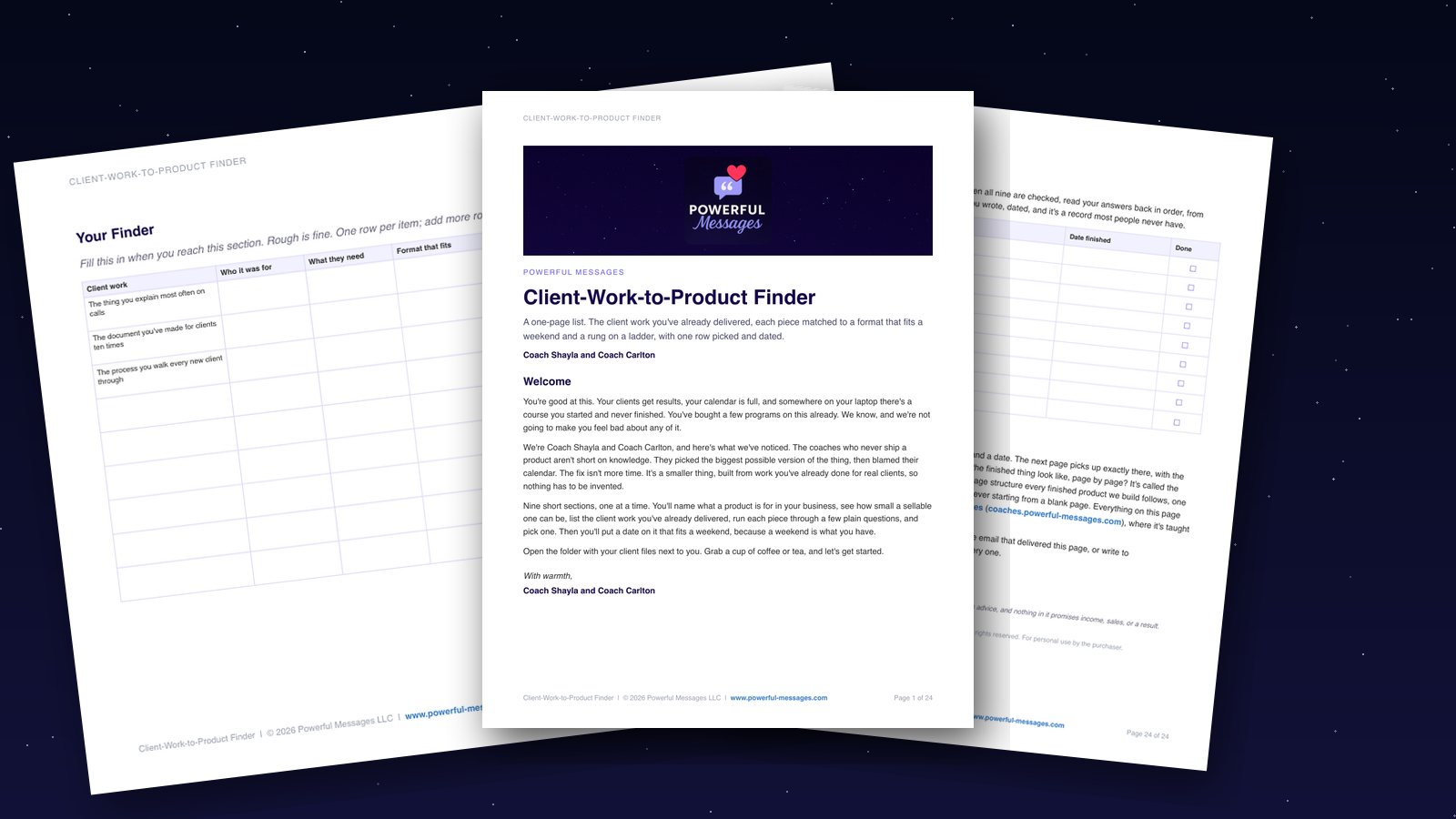
Client-Work-to-Product Finder
helps you turn an answer you give clients into a product you can sell.
Get the Client-Work-to-Product FinderThe Digital Product School
Build and sell your first product
Explore the school