
What matters most: Give people a small, honest yes before you ask them to book a call. Start with a quick free lead magnet and a clear opt-in page. Then send a short welcome series that builds trust, and finish with a simple booking page that asks a few good questions.
It's Sunday night, and you're curled up on the couch with your laptop. You open your website stats and see that people did come this week, even more than last week. Then you open your calendar, and next week doesn't have a single discovery call on it. A small, heavy thought settles in your chest, and you wonder if the problem is you.
We want to say this gently, because we know how much that thought weighs. Your work isn't the problem, and neither is your traffic. People are finding you, reading a little and nodding along. Then they close the tab, because the only next step you've given them is a big one.
What's missing is a smaller step in the middle. A sales path that books discovery calls is the clearest way we know to add that step. It's also kinder to your visitors than you might expect.
A sales path isn't a trick, and it isn't a machine. It's a simple, honest route. It gives an interested stranger a small way to say yes before anyone asks for a call.
Think about how you look for help yourself. You probably wouldn't call someone you'd never heard of. But you might download a useful checklist, read a short email and click a link when the time felt right. That quiet order of steps is what turns a browser into a real conversation.
We've spent decades inside Fortune 100, Fortune 500 and Fortune Global 500 companies and small and midsize private firms. Coach Shayla turned people data into clear answers for senior leaders, and Coach Carlton sold software to executive teams. In both jobs, we saw the same thing again and again: people move forward when the next step feels safe, clear and worth their time.
If the idea of a sales path feels a little pushy to you, we understand. Some people choose to add pressure, but pressure was never part of the structure itself.
That's why we built Sales Funnel Academy. It's for service business owners who are good at their work and tired of piecing together advice from a dozen places. You don't have to become a marketer. You can build one clear path, once, and let it keep working while you do the work you love.
Key takeaways
- A quiet inbox usually means a step is missing between a visit and a booked call, not that your offer is wrong.
- Offer one free thing that a person can use in under 15 minutes, in exchange for an email address.
- Keep your opt-in page simple, with a clear headline, a short subheadline, a picture, one email field and one button.
- Send a welcome series of five emails that deliver, connect, help, offer softly and then offer plainly.
- Add three to five sharp questions to your booking page, so the people who book are a good fit.
- Test your whole booking path as if you were a stranger, so the next steps are easy to see.
Why Your Website Gets Visits and Your Inbox Stays Quiet
In 2026, a service business can look busy online and still feel invisible. Your website gets visits while your inbox stays quiet for one reason. The only next step you offer is a phone call, and most people won't call a stranger. So they close the tab instead.
That isn't a no. It's more like nothing at all, and nothing can feel even lonelier than a no.
The story below is an illustration, not a client case. Meet Carmen Delgado, who runs a small service business and is wonderful at her work. Her website gets steady traffic, and people read her services page, look at her pricing and leave.
Her inbox stays quiet, so Carmen starts to wonder if her message or her offer is the problem. It isn't. Her website is asking a stranger to take a big, scary leap before any trust exists.
We saw this same pattern inside the companies we worked for. A visitor lands on a page, feels a flicker of interest and looks for a small, safe way to move forward. When the only option is a call, that flicker fades.
The visitor isn't saying no. They're saying not yet, and the website gives them nowhere to put that feeling.
When Nothing Happens
Most people who will someday buy from you haven't bought yet. They're curious, not committed, and a call feels like a big commitment. It means explaining yourself to someone new and maybe sitting through a sales talk. That's a lot to ask of a stranger this early. So they slip away without a trace.
Worth sharingCarmen's website isn't broken. It's quiet, and it waits for the visitor to be brave.
A clear path meets the visitor right where they're standing, with a small step that feels safe. That's the seed of the fix, and it starts with understanding what a quiet inbox is really telling you.
What a Quiet Inbox Is Really Telling You
A quiet inbox isn't a verdict on your work. It's a signal about your path, and these are the clues we look for when we see it:
- The visitor found you, so the way people discover you is working.
- The visitor stayed long enough to read, so your message is clear enough.
- The visitor left without acting, so the next step felt too big.
- Your inbox stays quiet, so the gap between interest and action is still open.
Tom Brennan is a good example. He asked about Carmen's service once and then went quiet. He was interested, but he wasn't ready to call.
Carmen had no smaller step to offer him, so his interest slowly faded away. That's the quiet inbox, seen in one person.
Maybe there's a Tom in your own life, someone whose name you still remember. The answer isn't more traffic. It's a smaller first step that turns a quiet visitor into someone you know. That's exactly what a well-built sales path creates. It's the most honest way we know to turn visits into conversations.
The Small 'Yes' That Leads to Discovery Calls
Carmen Delgado sat at her kitchen table with Juno Park, her part-time employee. She asked a question that changed how they saw their website. "What would make someone give us their email address without feeling pressured?" The answer wasn't a discount, a free consultation or a phone number.
It was a lead magnet, which is one small, useful thing a stranger can take in exchange for an email address. Before someone pays you, they need to say yes to something smaller first. Free things have a pull of their own, too. In one study, when an option became free, far more people chose it (Shampanier, Mazar and Ariely, Marketing Science, 2007).
That smaller yes matters because it takes away the risk. A visitor who isn't ready to book a discovery call will still download a checklist if it solves one problem right now. People will trade their email for something they can use in under fifteen minutes, so that's the line to aim for.
If the free thing takes an hour to read or needs a login, the trade feels uneven, and they leave.
A good lead magnet leaves the reader better off even if they never buy. That's the test we hold our own free things to.
What Really Works as a Lead Magnet
Carmen and Juno thought about a few formats. A video series felt too heavy, and a workbook felt like homework.
They picked a simple checklist called "Five Things to Check Before You Book a Corporate Event." Juno wrote it in one afternoon. Carmen read it over with her morning coffee. It was specific to their service and quick to use, and it left the reader with a clear next step.
That's the sweet spot. A lead magnet should be finishable this week, not a project that sits in a downloads folder.
We see so many service business owners make this step harder than it needs to be. They want to write a twenty-page guide or record a big class, because the version in their head is twenty pages long.
A checklist takes an afternoon, and that's plenty. The goal was never to impress anyone with size.
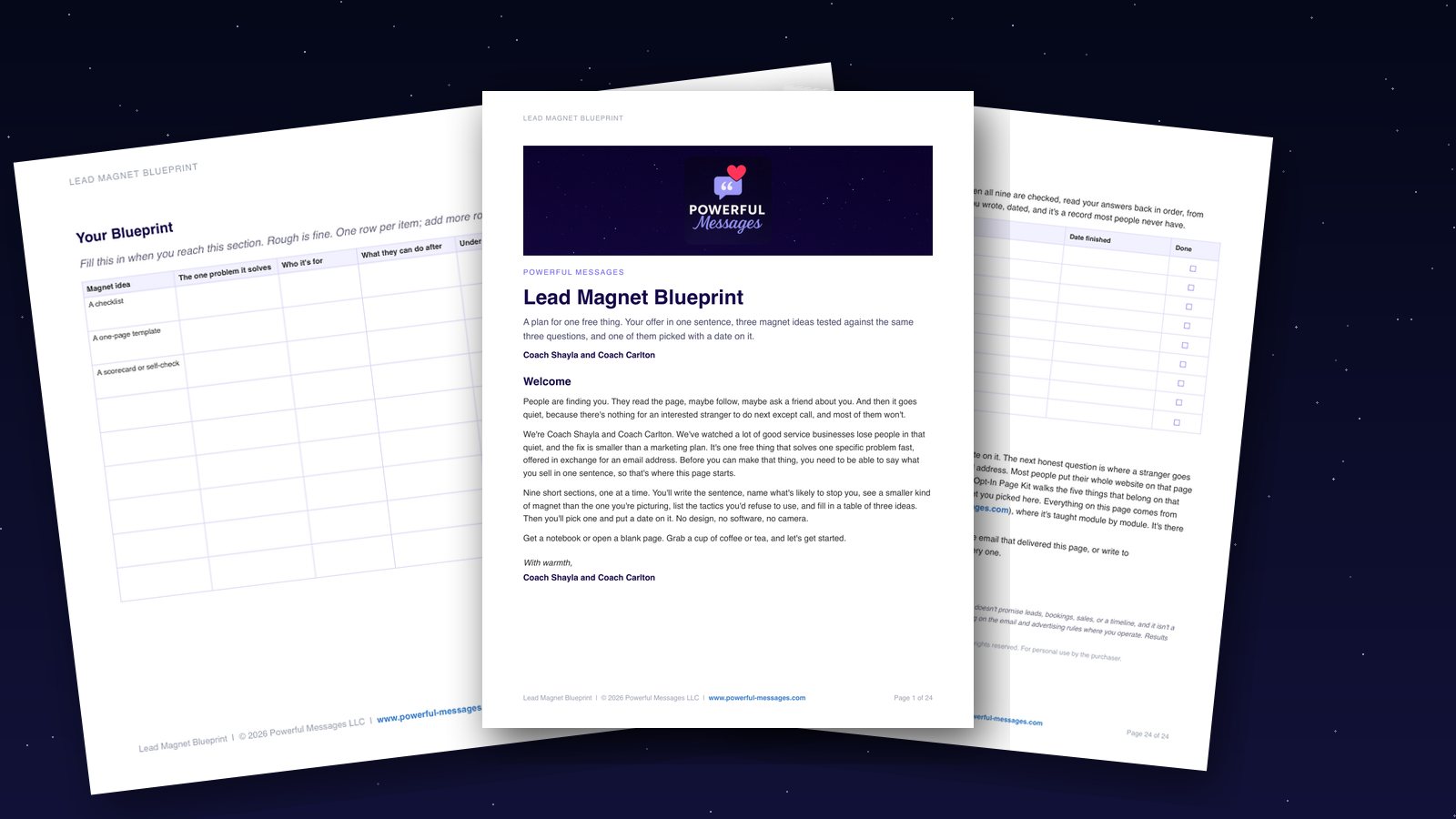
The goal is to start a conversation with someone who used to be a stranger. Our Lead Magnet Blueprint asks the same three questions about every idea. Can someone use it in under fifteen minutes? Does it leave the reader better off even if they never buy?
And can you finish it this week?
Juno's checklist passed all three, and that single page became the bridge between a quiet visit and a booked call. Next comes the page that shares it and collects the email address, but the checklist itself is what earns the yes.
If you'd like to plan your own free thing the same way, start with our Lead Magnet Blueprint. In one afternoon, you'll write your offer in one sentence and test three ideas. Then you'll pick one and put a date next to it. You won't need design skills, software or a camera.

How to Build an Opt-In Page That Works
A page can't be clearer than the sentence behind it. That's the rule we follow before we touch a headline, a button or any design at all. Your opt-in page has one job, which is to help a visitor who wants your free thing share their email address. If the sentence behind the page is fuzzy, the page will be fuzzy too, and the visitor will drift away.
We learned this from years of watching people read dashboards. Coach Shayla spent two decades turning people analytics into clear answers for senior leaders. A dashboard with twelve charts and no clear answer made leaders lean back and ask for another meeting.
A dashboard with one number and one suggestion made them act, and an opt-in page works the same way.
It isn't a brochure. It's a moment of choice, and a choice needs focus.
Five parts decide whether the page works, and we keep them in a simple order:
- Headline: one sentence that names the result or the problem.
- Subheadline: one sentence that lowers the risk or adds a helpful detail.
- Visual: a simple picture of the free thing, not a stock photo of a handshake.
- Form: one field for the email address and nothing more.
- Button: a clear action like "Send My Checklist," never "Submit."
That list is the whole page. There's no menu, no sidebar and no video that plays on its own. Every extra piece is a small exit door. Google found that as a page grows from 400 to 6,000 elements, the chance of a conversion drops 95% (Google/SOASTA Research, 2017). We'd rather have a plain page that works than a fancy page that confuses people.
Carmen Delgado's opt-in page shows how this looks. Her headline asks one question: "Do you know the five things event buyers check before they book?" Under it, she offers the checklist and says it takes ten minutes to read. The picture shows the first half of it.
The form has one field, and the button says "Send My Checklist." There's nothing else on the page.
A visitor either wants the checklist or doesn't, and the page makes that choice easy to see. That matters because people often leave a web page in 10 to 20 seconds unless its value is clear (Nielsen Norman Group, 2011).
We see business owners worry over this step. They add a long story, three testimonials, a countdown timer and a menu bar, because they're afraid the page looks too bare. We understand that fear, but the fear is what gets in the way.
Worth sharingA bare page isn't a broken page. It's a clear one.
Inside Sales Funnel Academy, the opt-in page lessons keep you to that same plan. Your page gets one job, and you write a headline a stranger could repeat back to you. If a stranger can't repeat your offer back after reading the headline, you rewrite the headline.
Your welcome emails begin the moment an email address arrives. That's a different job, though, and it only works if this page did its job first. A clear opt-in page makes the next step feel natural instead of forced.
If the sentence behind your page still feels fuzzy, start there. Our Positioning Statement Builder helps you write who you're for, what you do and why someone would pick you. It all fits in one clear line. Every headline gets easier once that line exists.

From Opt-In to Discovery Call: Your Welcome Series
Five emails someone is glad to get will do more than fifty they put up with. That's the heart of a welcome series. It's how a new reader moves from a downloaded checklist to a booked discovery call. You don't need a long, complicated campaign. You need a short, warm series that gives value first and asks for the call only after trust has grown.
Tom Brennan downloaded Carmen Delgado's checklist and then went quiet. That silence wasn't a rejection. People are busy, not uninterested, so a kind follow-up isn't nagging.
Carmen's welcome series sent Tom five emails, and each one had one clear job. The first email delivered the checklist and connected it to his situation.
The second and third were useful on their own, with no offer attached. The fourth email offered the discovery call softly, and the fifth offered it plainly.
By the time Tom read that fifth email, the call felt like a natural next step instead of a sales trap.
We see business owners make this part harder than it needs to be. Some write twenty emails, and others write one long email that tries to do everything. Either way, people end up deleting them or ignoring them.
Worth sharingA welcome series isn't a newsletter. It's a bridge.
Each email should have one job: deliver, connect, be useful, offer softly and offer plainly. When you write them in your own voice, the reader hears a real person instead of a machine. That voice builds trust faster than any clever subject line.
That's why the welcome sequence lessons in Sales Funnel Academy walk you through all five emails, one job at a time, so the words stay yours. You fill in the details of your offer in your own voice.
The structure carries the heavy part for you. We'd rather you send five honest emails than fifty polished ones that sound like everyone else.
The booking path comes next, and its questions will help decide who lands on your calendar. Still, the welcome series is what makes that booking feel earned instead of requested.
If you want to build each of these pieces in order, that's what Sales Funnel Academy is for. It's our self-paced school for service businesses. In the first three modules, you build one free thing, a live opt-in page, a five-email welcome series and a booking page. You finish one piece at a time.
Sales Funnel Academy
Build a sales path that books clients, one step at a time.
Explore the schoolSimplify Your Booking Path for Better Discovery Calls
A booking page with three sharp questions sorts people better than a twenty-minute phone screen. A simpler booking path means fewer calls, but better ones, because you trade volume for fit. Everyone who lands on your calendar has already cleared a small step. So you stop spending discovery calls explaining what you do. You spend them deciding together if you're a good match.
We learned this from years of watching sales teams chase the wrong meetings. Coach Carlton spent two decades selling software to senior leaders, and the worst weeks were never the ones with few calls. They were the weeks with full calendars and almost no real buyers.
A booked call on its own isn't a win. A booked call with someone who can buy, has the problem you solve and arrives ready to talk is a win.
The booking path is where that difference gets made.
Carmen Delgado learned this after a few frustrating months. Her business was getting questions, but too many discovery calls ended with polite nods and no follow-up. So she rebuilt her booking form around three questions.
First, what result are you hoping to create? Second, what have you already tried?
Third, what made you reach out now? Those questions didn't add friction. They gently kept the wrong people off her calendar before they ever booked.
The way it works is simple. A booking page with no questions treats every visitor as equally ready. A page with smart questions asks for a small bit of effort first.
The person has to type a sentence or two about their situation. That alone sorts out people who are curious but not serious.
Then their answers tell you whether the call is a good use of everyone's time. We'd rather have three calls a week with people who wrote kind, careful answers. That beats ten calls with people who clicked a link and hoped for the best.
Your intake questions should do three jobs, and only three:
- Confirm the person has the problem you solve
- Show whether they have the authority or budget to act
- Bring out their urgency or their reason for reaching out now
Three jobs for your intake questions
- Confirm the person has the problem you solve
- Show whether they have the authority or budget to act
- Bring out their urgency or reason for reaching out now
Anything more than that turns into an interview you're doing for free. We see business owners add seven, eight or nine questions because they want to be thorough, and we understand that instinct.
Every extra field gives someone another reason to close the tab. For most service businesses, three clear questions with a purpose is the sweet spot.
Then test the whole path yourself. Book a call on your own page, and then read the confirmation email.
Check what the calendar invite says, too. Coach Carlton calls this the stranger test: if a stranger landed on your booking page right now, would they know what happens next?
Most booking paths fail that test. The confirmation email is generic, the calendar invite says nothing useful, and nobody tells the person what to prepare. When you fix those three things, the call itself starts warmer.

Good calls can still go sideways when nobody prepared for them. The booking path isn't only a door. It's the first instruction your future client gets about what working with you feels like.
Send a short note that says what to bring, what to expect and how long the call will last. It changes the whole tone of the talk. That isn't a sales trick.
It's simple respect for everyone's time.
We hold ourselves to the same rule. When you book a Discovery call with us, the page tells you up front what the 30 minutes are for. It's a real talk with both of us about where your business feels stuck and what to do next. It starts with a small deposit that is credited toward your next call or the 5-Day Challenge.
Make the Small Yes Possible
A quiet inbox isn't a verdict on your work. It's a sign that the path from stranger to booked call is missing a step. When we build a sales path that books discovery calls, we aren't adding technology or pressure. We're giving interested people a small, honest way to raise their hand.
That path has four parts, and each one does one job:
- A lead magnet that solves a real problem in under fifteen minutes, so saying yes feels easy.
- An opt-in page with one clear promise and one clear action, so nobody has to guess what happens next.
- A welcome series of five emails that gives value, builds trust and makes the offer plainly.
- A booking path with questions that check for fit, so the calls you take are worth taking.
You don't need more traffic first. You need the visitors you already have to land somewhere that respects their time and yours. Picture opening your calendar on a Sunday night and seeing a booked call. It's from someone who has read your emails, knows your work and already feels at ease with you.
You can start today by writing your offer in one sentence a stranger could repeat back. Then pick one lead magnet idea you can finish this week, and you've truly begun.
Maybe you'd like the whole structure without piecing it together yourself. Sales Funnel Academy walks you through every piece at your own pace, from the lead magnet to the booking path. Either way, the first step is the same, and it's making the small yes possible.
An honest sales path brings interested people to your door. When you build it with care, the calls tend to follow.
Where to start this week
Start with one clear sentence about your work. The Positioning Statement Builder helps you say who you help and why your work matters. Then plan your one free thing with the Lead Magnet Blueprint, which takes about two hours. When you want the whole path, from first download to booked call, join Sales Funnel Academy. You'll build it step by step at your own pace. And if you'd rather talk it through first, book a Discovery call with Coach Shayla and Coach Carlton. It's 30 minutes with both of us. It starts with a small deposit that is credited toward your next call or the 5-Day Challenge.
 Carmen DelgadoA service business ownerMeet Carmen →
Frequently asked questions
What's the most important part of a sales path that books calls?
The lead magnet matters most. It's one small thing an interested stranger can take, and it solves a small problem quickly. It lets them say yes to something smaller first, so trust can grow before a discovery call. A clear, one-sentence offer matters a lot, too.
How can I tell if my sales path has a leak?
A leak means people are finding you but not booking or buying. Look at the numbers at each step to see where people drop off. That shows you whether the problem is getting enough visitors or what happens on your pages and calls.
Can I build a sales path without being a tech expert?
Yes, you can. What matters most is a clear plan and clear words, not complex software, so you don't need to be a developer. Pick tools that fit your comfort and your budget. The goal is a clear path, not mastering every new platform.
What should I do if people sign up but don't book calls?
This often means your free thing and your paid offer solve different problems. Your welcome emails can build a bridge from one to the other. It's also worth looking at your intake questions, so the right people land on your calls.
Is there a simple way to plan my lead magnet?
Yes, there is. Our Lead Magnet Blueprint walks you through nine short sections. You write your offer in one sentence, test three ideas the same way and pick one with a date. It comes as a Notion page you copy, plus a printable PDF.
Where can I learn to build the whole path, step by step?
Sales Funnel Academy is our self-paced school for coaches, consultants and other service businesses. You'll build your lead magnet, opt-in page, welcome emails and booking page. Then you'll learn to read your numbers and fix the step that loses people.
Can someone look at my booking path with me?
Yes, we'd be glad to. Book a Discovery call and talk it through with both of us. It starts with a small deposit that is credited toward your next call or the 5-Day Challenge.
Sources
- Shampanier, K., Mazar, N. and Ariely, D., Zero as a Special Price: The True Value of Free Products, Marketing Science, 2007
- Daniel An, Find Out How You Stack Up to New Industry Benchmarks for Mobile Page Speed, Think with Google, February 2017
- Jakob Nielsen, How Long Do Users Stay on Web Pages?, Nielsen Norman Group, September 11, 2011
Recommended for you
Sales Funnel Academy
Build a sales path that books clients
Explore the schoolLead Magnet Blueprint
helps you share a useful first step that brings the right buyers closer.
Get the Lead Magnet Blueprint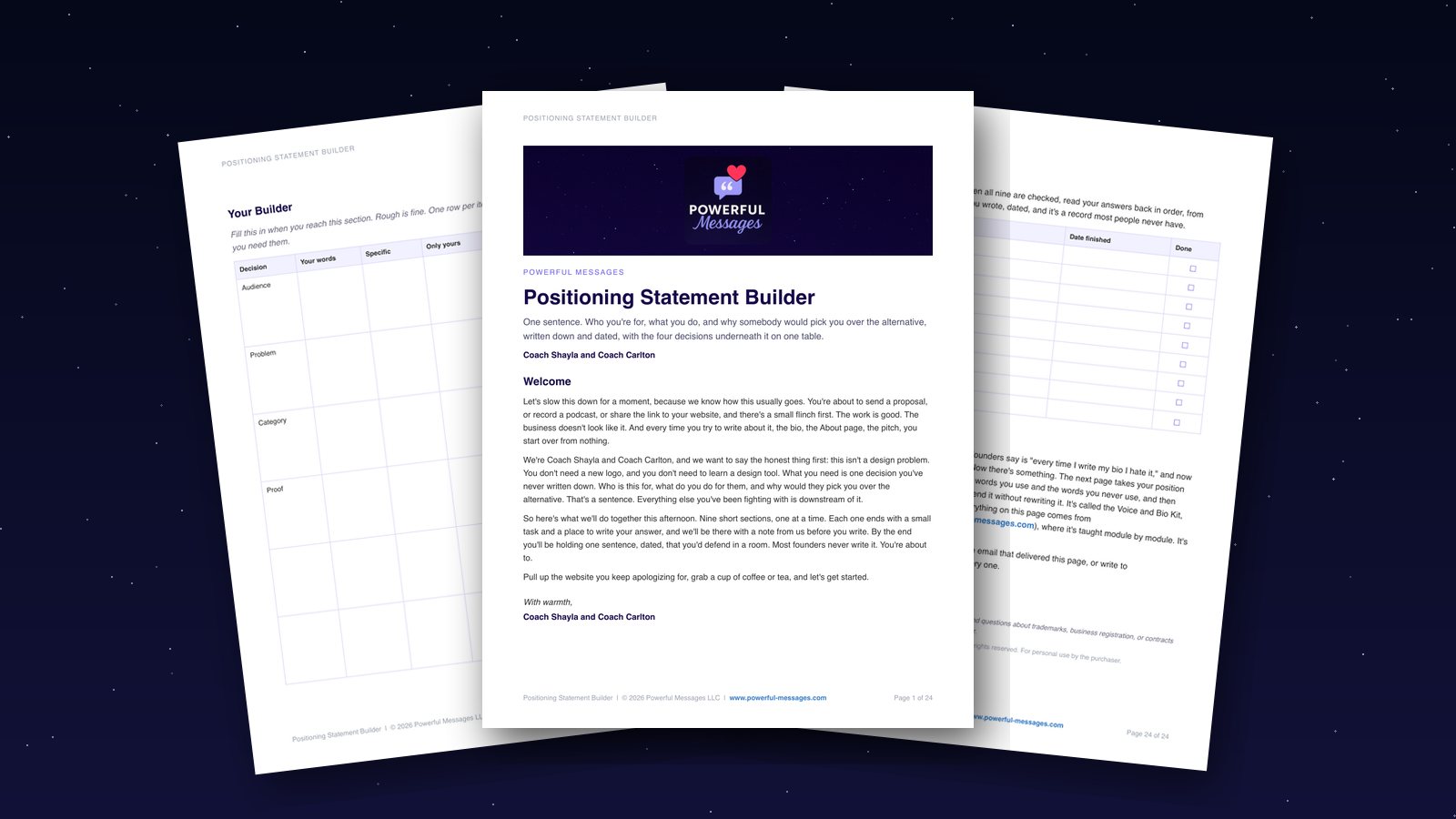
Positioning Statement Builder
helps you say who you help and why your work matters in one clear line.
Get the Positioning Statement Builder