The heart of it: Your freebie should solve one small, urgent problem really well, so your paid service feels like the natural next step. It should draw in the clients you want most and build trust quickly. It gives a taste of your paid work without handing over the whole answer.
You're halfway through writing your free guide at the kitchen table when you stop and stare at the page. A worried question slips in. If you put all of this in here, why would anyone ever hire you? So you delete a whole section, sit with it for a minute and then paste it right back in.
If that back-and-forth sounds familiar, you're not doing anything wrong. You're standing at the exact spot where most free offers quietly go off track. Too often they draw in people who are only browsing, and then they get downloaded, skimmed and forgotten.
We've watched this happen inside large companies and small coaching practices alike. Coach Shayla spent years leading people analytics. She turned piles of data into the one clear answer a leader could act on. Coach Carlton spent years selling software to executive teams. He knows that a free trial with no clear next step ends up as a favor you do for a stranger.
Your freebie isn't a giveaway. It's a promise about the work you sell.
Your freebie should solve one small, urgent problem really well. Then the person who uses it thinks, "If this is the free part, the paid part is worth a look." That's its whole job. It should draw in the right people, build trust fast and make your paid offer feel like the obvious next step. That way, it opens the door to your paid service instead of competing with it.
Content can bring in leads, but a general PDF called "Free Marketing Guide" barely scratches the surface. The right freebie is narrow and useful, and someone can finish it in minutes. That matters because people decide fast. Nielsen Norman Group found people often leave a web page in 10 to 20 seconds unless its value is clear (Nielsen Norman Group, 2011).
In this article, we'll walk through what your freebie should say about your paid service. We'll look at the true goal of a free offer and how to draw in your best clients. We'll also find where the line sits between helpful and too much. Then we'll cover the formats that work for service businesses and how to make your paid offer the clear next step.
You won't find hype here, only the structure we use and the patterns we've seen work. You'll also meet Carmen Delgado, a web designer who learns all of this one step at a time.
The story below is an illustration, not a client case.
Key takeaways
- A freebie is a tool with a job, not a giveaway, and that job is building trust.
- Solve one narrow problem all the way, and leave the bigger problem for your paid service.
- Draw in your ideal clients by naming the exact worries they already have.
- Build the bridge to your paid service right into the freebie itself.
- Choose a freebie format that matches how you deliver value when someone pays you.
- Share your freebie everywhere your clients already look, so more of the right people find it.
Why Your Freebie Is More Than a Giveaway
A freebie is a tool with a purpose, not a gift you hand out and forget. It's there to build trust and draw in people who are ready to hear about your paid work. When we treat it like a giveaway, we get giveaway results, like casual browsers, dusty downloads and no real conversations. When we treat it like a tool, it does a job for us.
The pull of "free" is real, and researchers have measured it. The zero-price effect shows that the gap between one cent and zero feels huge to the mind. That's why people stop comparing carefully when something is free. A team of behavioral economists tested this idea. When one option became free, far more people chose it (Shampanier, Mazar and Ariely, Marketing Science, 2007). That's a powerful pull, but it cuts both ways.
Free gets attention, yet attention alone doesn't pay your invoices. Free content turns into paying clients when it draws people in and builds trust. Then it gently guides them toward your paid work, so the order really matters.
Worth sharingAttention comes first, trust comes second and the paid offer comes third. If you skip the middle step, your freebie turns into noise.
Let's go back to Carmen, who runs a small service business. She used to offer a general "marketing tips" PDF. It gathered dust because it had nothing to do with her paid service of custom web design.
The PDF was free, but it didn't have a clear job.
It drew in people who wanted marketing tips, not people who needed a website built. That's the difference between a giveaway and a tool, because a tool has a job to do.
A giveaway simply sits there.
Here's what a freebie with a clear job can do that a giveaway can't:
- It sorts for the right people by naming a specific problem your paid service solves.
- It gives a small win fast, so the reader trusts you before any sales conversation.
- It sets up your paid offer as the natural next step instead of a big leap.
- It gives you permission to follow up, because the reader raised their hand.
Knowing the purpose is everything. Many businesses make freebies without a clear reason, simply because they feel they should. We saw this in the companies where we worked.
A team builds a checklist because a competitor has one, and then nobody tracks what that checklist is supposed to do.
That isn't a plan. It's only a way of staying busy.
We'd love for you to think of your freebie as the first rung of a ladder. The reader steps onto it, feels steady and looks up, and what they see next should be your paid service.
It shouldn't be a random pile of tips or a PDF that could belong to any business in your field.
Your freebie should give a preview of the value you deliver when someone pays you. That's what makes it worth their email address.

Worth sharingYour freebie isn't the product. It's the proof that you can help.
What Your Freebie Should Say About Your Paid Service
A smallest viable solution is a free resource that solves one narrow problem all the way and leaves the bigger problem alone. Your freebie should say, "I can fix this one thing for you right now. I can help with the rest when you hire me." Every strong freebie carries that message, even if you never say it out loud. The best ones solve a clear, urgent problem and give value fast. They show what you know without giving it all away, and they lead naturally to your paid work.
Corporate data work teaches this same pattern. Coach Shayla spent years turning messy workforce data into one clear chart a CEO could act on. That chart never tried to answer every question.
It answered the one question that mattered most that week, and a freebie works the same way.
It should be the smallest real answer to your client's biggest worry. It needs to be worth an email address. It shouldn't be so complete that they no longer need your paid service.
Show the Win, Not the Whole System
Think about what your paid service really delivers. If you coach leaders through burnout, your paid work might include weeks of two-on-one coaching, new routines and some hard conversations. Your freebie shouldn't try to squeeze all of that into a PDF.
Instead, it might offer one small tool, like a five-minute exercise to name the exact moment the day starts to feel heavy. That tool gives a quick win.
It also hints at the deeper work you do, so your paid offer starts to feel like the obvious next step.
Here's what that can look like:
- An accountant offers a tax deduction checklist instead of a full tax course.
- A web designer offers a homepage layout review instead of a whole new site.
- A sales coach offers a cold email opener template instead of a full sales system.
Each one solves a real problem in minutes, and each one leaves the person wanting the bigger answer. If your freebie solves the whole problem, there's no reason for anyone to hire you.
The Bridge Is Built Into the Design
We don't believe in freebies that end with a vague "contact me" line. The bridge to your paid service should be built right into the freebie. For services that cost more, a free consultation or review often works best. It gives real, useful insight, and it opens the door to a deeper talk. The person gets to see how you think. They notice the gap between where they stand now and where they could be, and they ask what comes next.
That gap is the whole point. Your freebie shouldn't close it, because its job is to make the gap easy to see.
If you'd like help finding that gap for your own offer, our Lead Magnet Blueprint walks you through it in one afternoon. You write your offer in one sentence and test three freebie ideas against the same three questions. Then you pick one and put a date on it. You'll stop second-guessing what to give away, because you'll know exactly what your freebie is for.
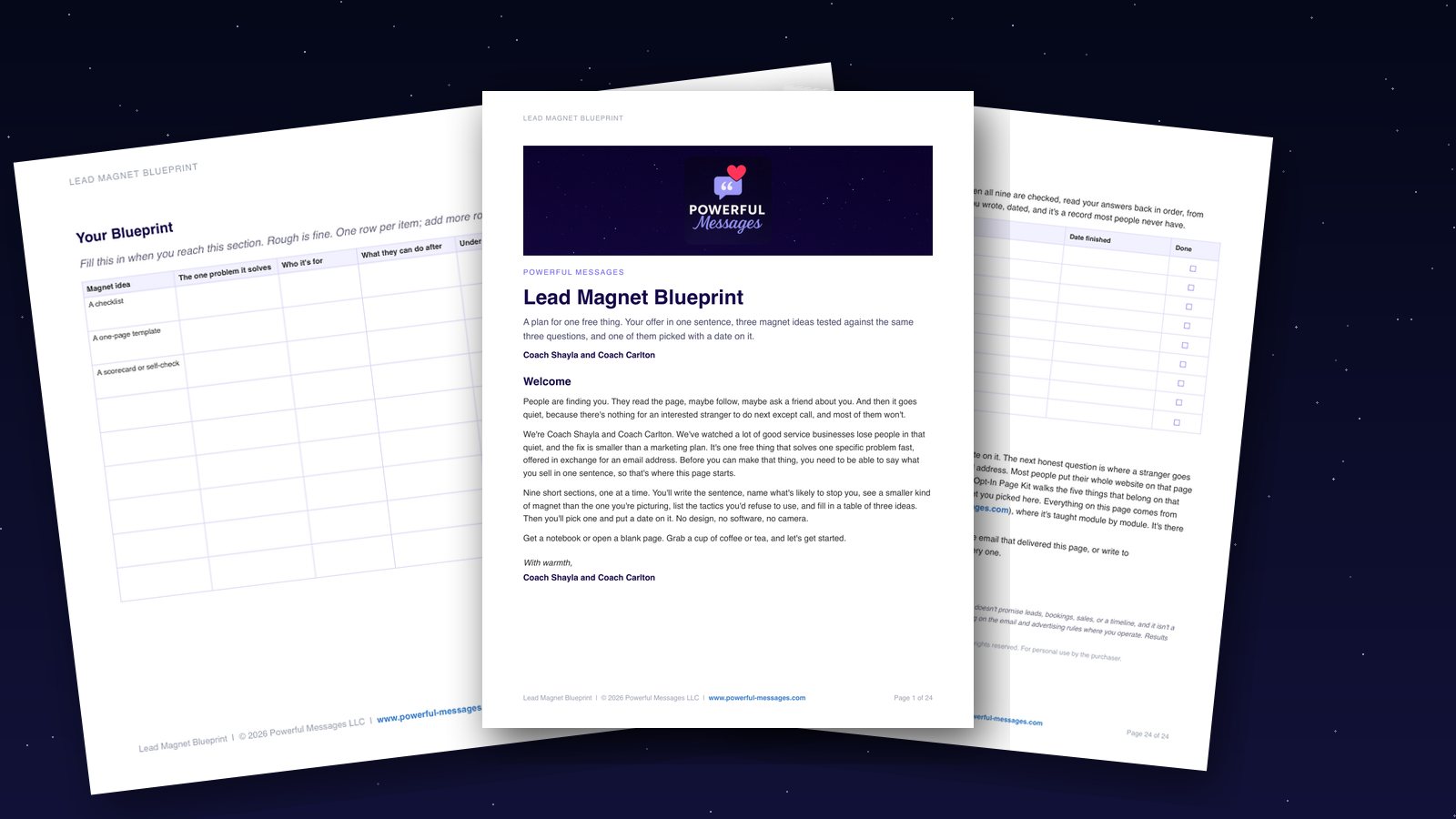
Lead Magnet Blueprint
Helps you share a useful first step that brings the right buyers closer to you.
Get the Lead Magnet BlueprintAttracting Your Ideal Client with the Right Freebie
A broad freebie casts a wide net, but a narrow one catches the fish you actually want to cook. The right freebie draws in your ideal client by naming a worry so specific that only the right person stops scrolling. It should speak right to the pain, wish or goal your best clients already have. That means it isn't a sample of everything you do. It's a signal that says, "This is for you, not for everyone."
This is one of the most common mistakes we see. A web designer offers a general marketing tips PDF and wonders why the leads feel so scattered. A web design business needs a freebie about websites. The fix is simple to say and a little scary to do. That's because you have to narrow the promise until it leaves out the wrong people.
Think about what your ideal client is already worried about at 9 p.m. on a Tuesday, because that worry is your freebie.
- Name the exact problem your ideal client wants solved this week.
- Use the words they already use, not the industry terms you prefer.
- Make the title specific enough that the wrong person scrolls past.
- Give one quick win that proves you understand their situation.
Four steps for a focused freebie
- Name the exact problem your ideal client wants solved this week.
- Use the words they already use, not the industry terms you prefer.
- Make the title specific enough that the wrong person scrolls past.
- Give one quick win that proves you understand their situation.
Carmen runs a small web design service, and for months she offered a general guide about growing a business online. The downloads came in, but the follow-up calls didn't.
Then she switched to a Quick Website Health Check checklist, which asked five questions about load speed, mobile layout and broken links.
The people who downloaded it were already thinking about their websites. One of them was Tom Brennan, who had asked about her services months earlier and then gone quiet. The checklist gave him a reason to come back. Carmen never had to chase him, since the checklist matched the exact problem he was still carrying.

In 2026, we think quizzes and reviews that ask a few questions about the person's own situation make some of the strongest freebies. For service businesses, we prefer them over plain PDFs. That's because the person does a little work and then sees their own situation reflected back. That reflection is the bridge, and the main idea still holds: a freebie that speaks to everyone convinces no one.
Try not to hedge. A title like "Business Tips for Busy Owners" is a shrug. A title like "The 10-Minute Website Health Check for Service Businesses" is a decision.
A specific title is much easier to write once you know exactly who you're for. Our Positioning Statement Builder helps you write that one sentence. It names who you're for, what you do and why someone would choose you over other options. Every freebie title you write after that can grow from that one line.
A title that clear will lose some people, and that's exactly the point.
Choosing the Best Freebie Format for Your Services
When a service business picks the wrong format, the freebie gets attention, but not from the right people. The best format for your business is the one that gives value right away and leads naturally to your paid offer. A free consultation or review works for services that cost more, because it gives real, useful insight in one conversation. A template works for a designer or copywriter, because the person can use it the same day.
The format alone isn't the plan. What matters is how well the format fits your paid service.
Coach Carlton spent years selling software to senior leaders and executive teams, and he's seen how a clear, useful guide can open a door that a vague checklist can't.
Picture a freebie called 5-Step Plan to Align Your Team's AI Use. It's the kind of idea the Lead Magnet Blueprint helps you shape. That guide promises a specific result in a short time, and it eases the fear of falling behind.
That's what a strong format can do.
- Free consultation or review: best for services that cost more, where trust grows through conversation and personal insight.
- Template they can fill in: often a strong choice. The person can use it right away, like a proposal or social caption template.
- Quiz or assessment: engaging because it feels personal, gives tailored results and tells you more about each person.
- Short email course or challenge: usually around five days. It warms people up over time and builds the habit of opening your emails.
We don't suggest picking a format because it's easy to make. Pick it because it matches how you deliver value when someone pays you. A coach who sells clarity through conversation probably shouldn't lead with a 40-page ebook.
A bookkeeper who sells order probably shouldn't lead with a personality quiz either. Your freebie is a small sample of what it's like to work with you, not a random gift.
That's why the format question always comes back to one test. Does this freebie let the person feel the exact kind of win your paid service gives? If the answer is yes, the format is right, and if the answer is maybe, the format is only decoration.
Every format choice carries one gentle warning, because some freebies go too far. A template that solves too much, a review that fixes the whole problem or a course that teaches your whole method all cross that line. The format should give a quick win, not the whole system.
The Line Not to Cross: When a Freebie Gives Too Much Away
A freebie that solves the whole problem takes away the reason to hire you, and that's the line. When your free resource does the entire job, people start to feel it has no value. They see your paid service as something they don't need. We watched this happen in the companies where we worked.
A team gives away the full method, the complete template and the entire system, and then the phone stops ringing.
Juno Park, Carmen's part-time employee, once suggested giving away a complete website template. Carmen realized that clients wouldn't need her paid custom web design service anymore, so the freebie would quietly erase her business. That moment of clarity is the line every service owner needs to draw.
Where Over-Giving Starts
Over-giving rarely starts as a choice. It usually starts with a fear that a small freebie will look cheap.
So we add more, like the full checklist, the complete walkthrough and the entire framework.
Each addition feels generous, but each one moves the freebie closer to replacing the paid offer.
- If your freebie solves the whole problem, there's no reason for anyone to hire you.
- Giving your services away for free can make people see your expertise as worth less.
- Putting too much into a freebie can take away the need for your paid service.
We see this pattern in service businesses that struggle to turn interest into sales. They give away the farm, then wonder why nobody buys the land. The answer isn't to give less value. It's to give a different kind of value, a result that proves you're good at this without finishing the whole job.
The Long-Term Cost
Over-giving builds on itself over time. The first big freebie teaches your audience to expect everything for free, and the second one confirms it.
By the third, your paid offer feels like an extra sales push instead of the natural next step. That's a hard name to shake once you've got it.
Worth sharingWe'd rather give someone one sharp, specific win than a complete answer. The win proves we can help, and the gap between that win and the full result is what makes the paid service worth it.
That gap isn't a flaw. It's the heart of your business.

Making Your Freebie Work Harder for Your Business
Picture two business owners with the same freebie. One posts it once and waits, while the other weaves it into every place a client already looks. The second one gives it a far better chance.
A great page only matters if people actually find it, and a freebie sitting quietly in a website footer isn't a plan.
It's really only a hope.
We saw this in the companies where we worked. The freebie itself was often fine, and the missing piece was getting it in front of people.
Carmen decided to share her Quick Website Health Check in her blog posts, her email signature and a simple pop-up on her website. That helped her reach more of the right people, and quiet leads like Tom Brennan started to lean back in.
She didn't make a new freebie. She made the one she already had work harder.
Where Your Freebie Belongs
Share your freebie everywhere it makes sense. That can mean sign-up boxes on your site, pop-ups that show when someone starts to leave, LinkedIn, your email signature and offers inside your blog posts. Each place reaches a different moment in a person's day. Your email signature reaches someone who's already talking with you, and a leaving pop-up reaches someone who's about to go.
An offer inside a blog post reaches someone who's already reading your thinking. None of these needs a bigger audience.
All they need is the audience you already have.
Email quietly does a lot of the heavy lifting here. A free lesson from a paid program builds trust and shows your value. So does a small sample of a paid resource, and both gently move people toward the full offer. That's how the freebie becomes a doorway instead of a dead end.
- Add your freebie link to your email signature with one clear line of text.
- Turn one blog post each month into a post that offers the freebie halfway through.
- Set up a pop-up that shows only when a visitor starts to leave.
- Share the freebie on LinkedIn with a short story about the problem it solves.
Simple tools can make all of this easier. A free booking tool lets clients pick a time without a long chain of emails. A free design tool helps you make a clean-looking freebie without hiring a designer. These aren't luxuries. They're often the difference between sharing your freebie and putting it off.
If you'd like the rest of the path built around your freebie, that's what Sales Funnel Academy is for. In the first three modules, you build the free thing, the sign-up page, a welcome email series and a booking page. You finish one piece at a time, at your own pace. You'll finally have a clear road from "someone downloaded it" to "someone booked a call."
Many websites struggle to collect email addresses. The pages that do it well have a narrow promise and a clear next step, so the gap usually isn't talent. It's where you put the freebie.
Bringing It Together
Your freebie is a promise. It shows a possible client what working with you feels like, how you think and whether you can really solve their problem. When that promise is right, the freebie starts building trust before you ever get on a call.
The best freebie makes your paid offer feel like the obvious next step. That means it solves a small, urgent problem without solving the whole thing. It's the smallest real answer to your client's biggest worry. Give them the quick win and show them the door. Then let them decide whether they'd like to walk through it with you.
Here's what we hope you'll remember:
- A freebie isn't a giveaway. It's a sample of your paid service, built to draw in the right people and gently turn away the wrong ones.
- Aiming well matters more than getting lots of downloads. A narrow, specific freebie brings better leads than a broad one that tries to please everyone.
- Balance is everything. Solve one small problem well, because if you solve the whole problem, no one has a reason to hire you.
- Your freebie should lead naturally to the next step. Every free resource needs a clear path toward your paid work.
So here's what we'd love for you to try today. Open the freebie you offer now, or the one you're planning. Ask yourself one question: does this make my paid service feel like the obvious next step? If the answer is no, tighten it until it's smaller, more specific and more connected to what you sell.
If you'd like help building that bridge, our Lead Magnet Blueprint walks you through it at your own pace. It helps you land on one clear freebie, one clear path and one clear next step. That's really all your freebie needs.
Where to start this week
If you're not sure yet who your freebie is for, begin with the Positioning Statement Builder. After that, plan the free thing itself with the Lead Magnet Blueprint in about two hours, with no design work and no software. When you want the whole path from download to booked call, join Sales Funnel Academy and build it at your own pace. And if you'd like two fresh sets of eyes on your freebie first, book a Discovery call with Coach Shayla and Coach Carlton.
 Carmen DelgadoA service business ownerMeet Carmen →
Frequently asked questions
What's the main purpose of a good freebie?
A good freebie solves a small, urgent problem for your ideal client, gives value quickly and shows what you know. It works like a stepping stone, so your paid service feels like the natural next step without you giving away the whole answer. That builds trust and draws in the right people.
How can I make sure my freebie attracts the right people?
Your freebie needs to speak to a specific worry, wish or goal that your ideal clients already have. Try to stay away from broad, general topics. Instead, choose a freebie that connects straight to the problem your paid service solves. That way, it draws in the people who truly need your main offer.
Why shouldn't a freebie solve the entire problem?
If your freebie solves the whole problem, people no longer have a reason to invest in your paid service. Your freebie should give a quick win or a helpful insight and leave the bigger, deeper answer for your paid offer. That way, it gives real value now and still makes the need for more support clear.
What kinds of freebies work best for service businesses?
For service businesses, good freebies include free consultations or reviews, templates people can fill in, checklists, quizzes and short email courses. Each one gives people something useful right away. It shows what you know, and it starts a real connection.
Is there a simple way to plan a freebie that leads to my paid service?
Yes, and we made a tool for exactly this. Our Lead Magnet Blueprint walks you through nine short sections and ends with one freebie idea picked and dated. It comes as a Notion page you copy, plus a printable PDF.
What if my freebie keeps attracting the wrong people?
That usually starts with an audience that isn't clear yet. The Positioning Statement Builder helps you decide who you're for in one plain, dated sentence.
Can someone look at my freebie and offer with me?
Yes, and we'd be glad to. Book a Discovery call and spend 30 minutes talking it through with both of us. It starts with a small deposit that is credited toward your next call or the 5-Day Challenge.
Sources
- Jakob Nielsen, How Long Do Users Stay on Web Pages?, Nielsen Norman Group, September 11, 2011
- Shampanier, K., Mazar, N. and Ariely, D., Zero as a Special Price: The True Value of Free Products, Marketing Science, 2007
Recommended for you
Lead Magnet Blueprint
helps you share a useful first step that brings the right buyers closer.
Get the Lead Magnet Blueprint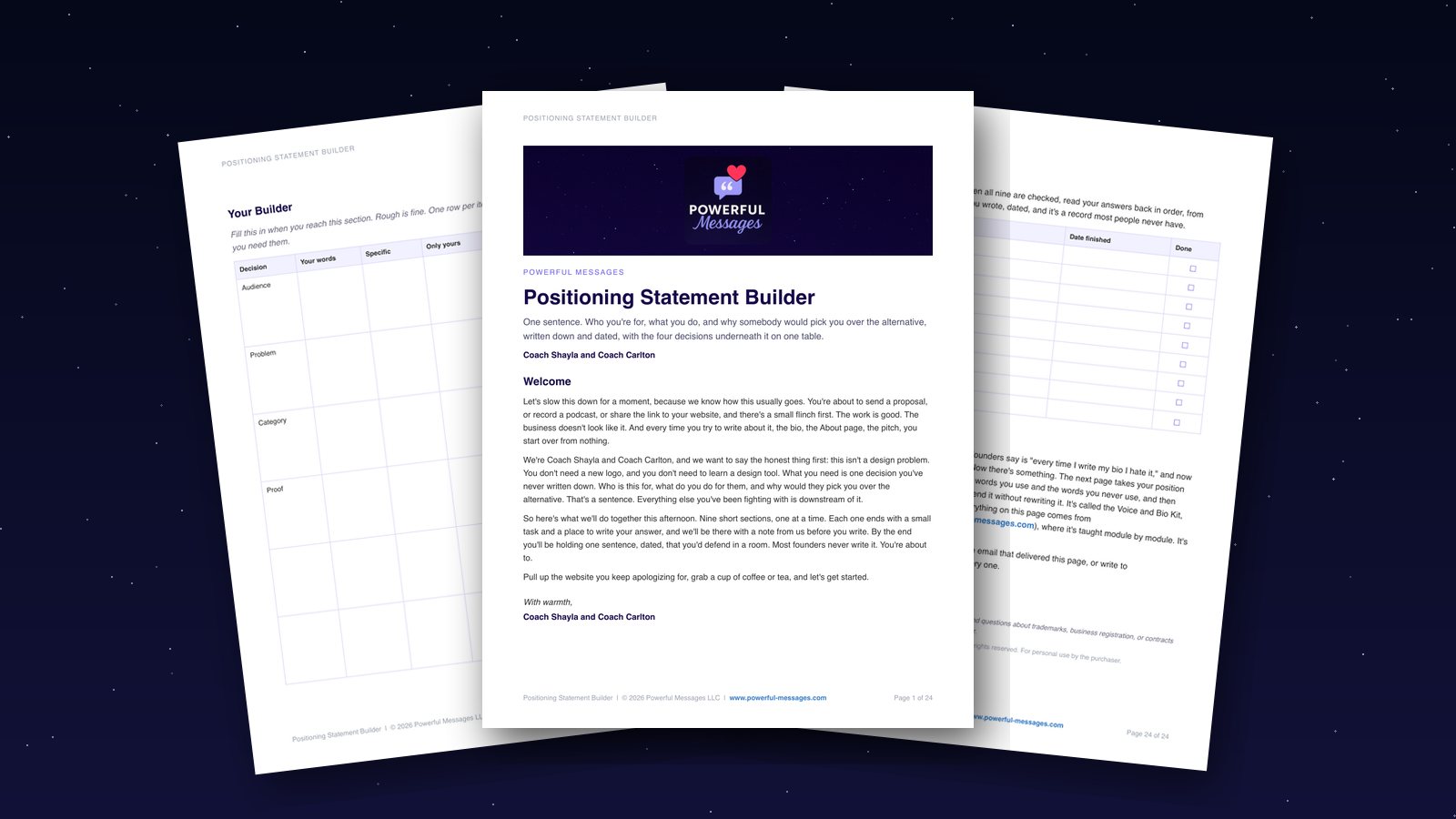
Positioning Statement Builder
helps you say who you help and why your work matters in one clear line.
Get the Positioning Statement BuilderSales Funnel Academy
Build a sales path that books clients
Explore the school