
The big idea: Decisions still run through you because being the one who decides became part of how you see yourself. That habit formed when you built the business alone, and it served you well. But your business never learned to decide without you. So now you're the bottleneck, guarding a role your company has outgrown.
You step out of a forty-minute dentist appointment and turn your phone back on. There are eleven new messages waiting. Most of them ask the same small question in different words: is this okay? Your shoulders rise before you've even reached the car.
Maybe you've told yourself it's simply what being a founder costs. You built a team so you could breathe, and yet you've quietly become the only person who can say yes. A manager asks you to approve something she already knows how to do. A vendor waits on a call that could have been an email.
The business keeps growing, but your days keep shrinking around a role nobody asked you to fill. You've become the human bottleneck, and it's exhausting.
If you've ever wondered why does every decision in my business still run through me, please hear this first. It isn't because you're bad at delegating. It's because your business never learned how to make decisions without you.
This pattern is common, and it's something you can change. We saw it in the companies we worked in, and we've felt it in our own work, too. Working harder won't fix it, and neither will checking your phone less. What helps is building clear structures that let your team move with confidence. Then you get to focus on the work only you can do.
In this article, you'll meet Omar Haddad, a founder who faced this exact struggle, and his story may feel very familiar. We're not here to shame you for holding on. We're here to show you a gentle path back to leading instead of approving.
The story below is an illustration, not a client case.
Key takeaways
- Being the only one who decides helped you early on, but now it holds your business back.
- When you keep every decision, your team can't learn or take the lead.
- Write small, clear decision boundaries, and hand off one choice at a time.
- Build trust by coaching people through mistakes instead of fixing the work yourself.
- Create simple written systems so your team can act without asking you every time.
- Move your energy from daily approvals to growth and to helping your people grow.
Why Every Decision Still Runs Through You
You built this business with your own hands, so your brain learned that every choice is yours to make. That habit served you well when you were alone, but now it works against you. Decisions still run through you because being the one who decides has become part of how you see yourself.
You aren't failing at delegating. You're protecting a role that no longer fits the company you built.
This pattern forms so quietly that most founders never see it happen. A founder starts alone, makes every call and wins, so the wins feel personal.
The mistakes feel personal, too. So the brain writes a simple rule: if I decide, it goes well.
If I don't decide, it might not. Over time, that rule becomes invisible, and it starts to feel like the truth instead of a habit.
Meet Omar Haddad, a founder in his early forties who carries every decision. He has a marketing manager and an operations lead. Yet he still reviews every social media post and even small vendor contracts.
His team has the skills they need, but they don't have his permission.

Omar isn't a control freak. He's a founder whose early success taught him that his touch is the magic ingredient. He also has plenty of company. Gallup found that 75% of the business owners it studied have limited or low talent for delegating (Gallup, 2015).
That belief is the trap, because it whispers that no one can do it like you. In the beginning, that was often true.
You knew the customers, the product and the stakes better than anyone.
But the business grew, and the decisions multiplied. The belief simply never caught up.
The Real Cost of Being the Decider
Every decision you keep is one your team doesn't learn to make. So they wait, and they check with you.
Slowly, they stop thinking it through, because thinking has stopped being their job. You become the answer key instead of the leader.
That's exhausting, and it can feel very lonely.
We saw this in the companies we worked in. Coach Shayla led people analytics at large global companies, and she shared what people really felt with top leaders and the board. The pattern showed up again and again.
Teams whose leaders held every decision reported lower confidence, and they stopped bringing ideas.
Instead of ideas, they brought their leaders more and more questions.
Coach Carlton spent years selling software to senior leaders and executive teams, so he saw the same thing from the outside. A founder would delay a purchase for weeks. The product wasn't wrong, but no one else could say yes.
The business slowed down while the founder stayed busy.
Nothing could move without them.
Write down the last five decisions you made that someone else on your team could have made. If the list is longer than two, the trap is already working on you.
This isn't about a lack of effort. It's a deep pattern, and it takes care and attention to loosen. The belief that only you can make the right call is a trap you built without meaning to.
It limits your growth, and it wears you out.
It also quietly teaches your team to stop trying.
We're not sharing Omar's story to make you feel bad for holding on. We're sharing it so you can see the pattern clearly enough to loosen your grip.
The next cost doesn't land on you alone, because it lands on the people waiting for your answer.
When Your Team Waits for Your Answer
A team that waits for your answer is a team that has stopped thinking for itself. Keeping every decision doesn't only slow the business down. It makes your team go quiet. People stop bringing ideas, because they know each idea will sit in your inbox until you approve it.
We saw this inside the companies we worked in. A capable manager would draft a plan and then pause, because the plan needed a sign-off.
That sign-off sat behind three other sign-offs. By the time the answer arrived, the energy behind the plan had faded away.
Omar's team lived this every morning. They checked his inbox before they checked their own work. A simple task, one they could handle with clear guidelines, waited half a day for his approval. That half-day delay, repeated across five people, became two and a half lost days of progress.

The bottleneck isn't the only cost. Delayed decisions quietly teach people to stop deciding. Each time someone waits, they learn that their judgment isn't enough. Over time, they stop offering it at all.
First, they bring you options instead of advice. Then they bring you problems instead of options.
You can see the hidden cost in project timelines, too. A decision that takes three days to reach you doesn't only delay the project by three days. It delays every task that depended on that decision.
So the work stacks up while the team works around the gap. Then they have to redo work when the answer finally lands.
These are the signs we'd gently watch for:
- Team members ask for approval on choices they used to make alone.
- Meetings end with "I'll check with you" instead of "here's what I'll do."
- Simple tasks sit in line behind hard ones, because everything goes through one person.
- New hires start out confident, then grow quieter within a few months.
That last sign can really sting. Sharp, capable people can shrink inside a system that treats their judgment like a rough draft. The founder never means for it to happen, but the pattern does it anyway.
Coach Carlton knows the feeling from the other side. "I know what it's like to wake up with a heavy feeling in your gut," he says. "The worry would build before I got out of bed." That weight doesn't stay with the founder. It spreads to the team waiting for a reply.
The good news is that this can change. Small decision boundaries, which we'll explore next, give people room to act without waiting. But first, it helps to name the cost clearly. Every answer that must pass through you is an answer your team didn't get to own.
Often the real block is a quiet belief, something like "if I don't check it, it will go wrong." Did that sentence make you wince a little? Our Invisible Limits Finder can help. It helps you name that belief with three short questions. Then it gives you a matched way to work through it, so you can take one different action this week.
Why Omar is out of energy by 7 PM
Omar is a high performer. He's good at what he does, so he takes everything on himself. Every question his team brings him costs a little energy. By 7 PM, there's nothing left, not for his family and not for the work that matters most.
Handing off decisions is how he gets that energy back, and the first step is seeing where it goes.
That's the job we're building ClarityPilot to do. It's a private coaching app for high-performing professionals and founders, starting with the Transform Your Energy pathway. Join the waitlist to hear first when it opens, and you'll get our guide, Make Smarter Decisions in 30 Days.

ClarityPilot
A private coaching app that helps you see what drains your energy, starting with the Transform Your Energy pathway. Join the waitlist and get our free guide, Make Smarter Decisions in 30 Days.
Join the ClarityPilot waitlistStart Small With Decision Boundaries
Pick one decision you can hand off this week, and then write down the exact limits around it. That's the whole method. A decision boundary is a simple rule that tells someone what they can approve on their own and what still needs you. It works because it shrinks the risk while it builds the habit.
Trying to hand off everything at once can feel like dropping a stack of plates. The safer move is to hand over one small, low-stakes choice with a clear fence around it.
Omar started with social media captions. He told his marketing manager she could approve any caption under 100 words. It only had to match the brand voice guide he'd already written. Longer posts, or anything with a product claim, still came to him. That one boundary took a daily line of tiny approvals off his plate.
The key is that the boundary is written down, not assumed. A spoken rule fades by Thursday, but a short note in your project tool or a shared document stays visible. Your team can check it without asking you to repeat yourself.
Handing off one or two small decisions a week lightens the load faster than most founders expect. It isn't a dramatic overhaul. It's a quiet shift that keeps adding up.
A clear decision matrix helps your team act without checking with you first. A matrix sounds fancy, but it's really a simple grid. One side lists the type of decision.
The other side lists who decides. Fill in the boxes once, and your team stops guessing.
This is the order we suggest.
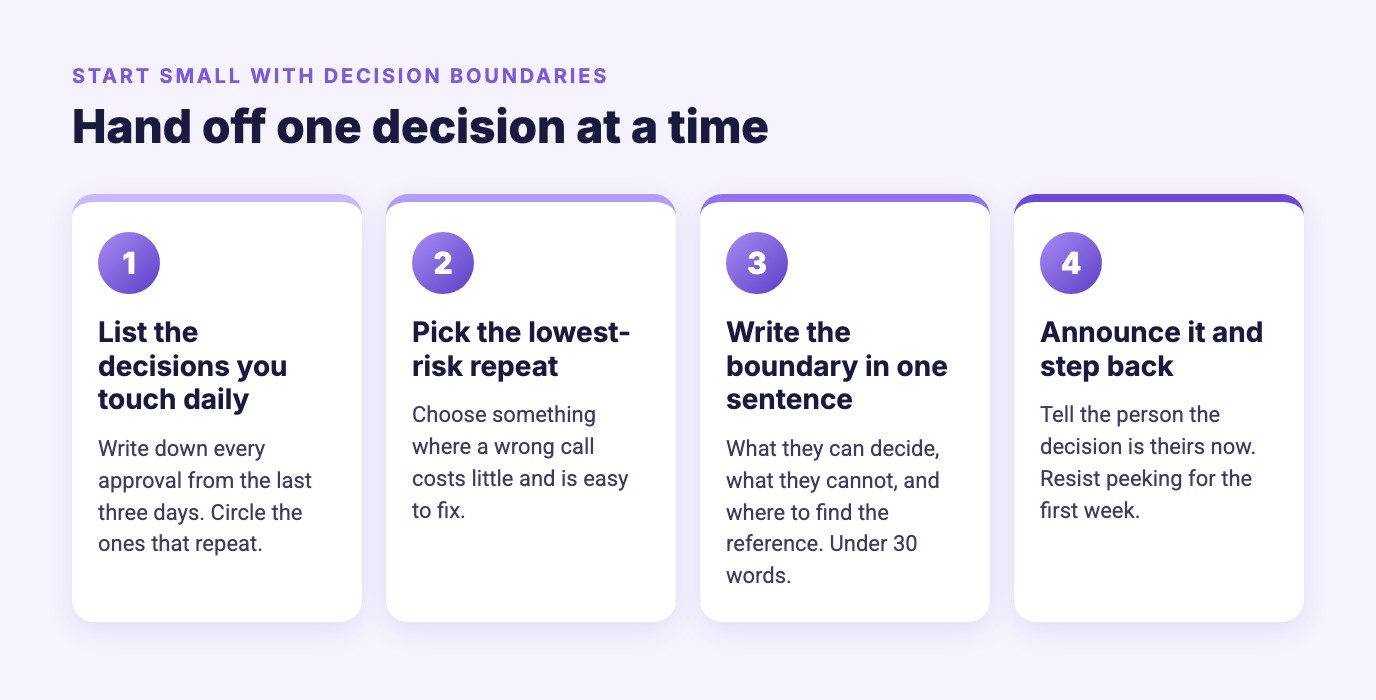
- List the decisions you touch every day. Write down every approval, review or sign-off you handled in the last three days, and circle the ones that repeat.
- Pick the repeat with the lowest risk. Choose something where a wrong call costs little and is easy to fix. Social captions, meeting agendas or internal email replies are good choices.
- Write the boundary in one sentence. Say what the person can decide, what they can't and where to find the guide they need. Keep it under 30 words.
- Announce it, and then step back. Tell the person the decision is theirs now. Try not to peek at every choice during the first week.
Coach Carlton has a motto we come back to often: You can't get clear without taking action. This is all about action. Clarity doesn't arrive before you hand something off. It arrives because you handed it off and watched what happened.
Omar's first boundary felt small, but it taught his marketing manager to think about brand voice instead of waiting for a yes.
So start with one boundary this week, and write it down before you hand it over. Then watch what the person does with the room you gave them, because you may be pleasantly surprised.
Build Trust in Your Team's Choices
Trust isn't a feeling you wait for. It's a practice you build through how you respond when someone gets it wrong. Your team will only make confident decisions when they know a mistake will lead to coaching, not correction. Handing over a task is easy, but handing over your judgment is the real work.
It's so common to hand off a decision and then hover. You ask for updates every few hours, or you rewrite the email before it goes out. Your team reads that clearly: you still don't trust us.
That's what quietly undoes the work. A decision boundary on paper means nothing if your reaction to a small miss teaches people to stop deciding.
Feedback Builds More Confidence Than Redoing the Work
When Omar's marketing manager made a small mistake in a social media campaign, his first instinct was to fix it himself. It would have taken five minutes. Instead, he asked one question: "Walk me through what you were thinking."
She explained her thinking, and Omar listened. Then he talked through the why behind the brand guidelines. He didn't redo the post, because he wanted her to revise it herself.

That talk took longer than fixing the mistake would have. But it built something a quick fix never could, which is a person who now understands the standard and not only the rule.
When someone makes a small mistake, ask what they were thinking before you correct the work. The conversation teaches more than the fix ever will.
In Paul Zak's research on trust at work, people at high-trust companies reported 74% less stress and 50% higher productivity than people at low-trust companies (Harvard Business Review, 2017). Those numbers don't come from perfect work. They come from knowing a mistake won't cost people their standing.
Coach Shayla's motto fits here: emotions are not problems, they are messages. When someone on your team hesitates before acting, that pause is a message. It says the safe path is to wait for you.
Open, honest talk is the bridge. Ask what would help them feel ready to decide, and then listen without interrupting. The systems that support this trust come next.
Worth sharingWe'd rather see a team make ten small decisions and get two wrong than make no decisions and get nothing done.
Create Clear Decision-Making Systems
A few clear systems can remove most of your daily decision requests. A decision system is a written rule that tells your team what to do without asking you. It turns your judgment into a simple process anyone can follow.
Many founders resist this step, because they worry that written rules will make their team robotic. The opposite tends to happen. Clear rules free people to act with confidence, because they know where the edges are.
When the rules are written down, decisions move faster and fewer mistakes slip through. That matters, because every delay lands back on your desk.
Turn Your Judgment Into an If-Then Guide
Omar created a simple if-then guide for customer service questions. It read: "If a customer requests a refund for a damaged product, then process it right away if it's a small amount. If it's a large amount, then pass it to the team lead."
That one sheet of paper removed a dozen questions a day. His team knew exactly when to act and when to pause. The guide didn't replace their judgment, because it gave their judgment a frame.
We call this a decision tree, and it isn't complicated. You write down the common situations your team faces.
Then you write the action for each one. The key is to make the trigger specific and the action clear.
Try to skip vague rules like "use your best judgment." That phrase creates more questions than it answers. A good rule names the exact situation and the exact response.
This is what a simple decision tree can look like:
- If a client asks for a deadline extension under three days, approve it.
- If the extension request is over three days, check the project calendar first.
- If the client mentions leaving, bring it to the founder right away.
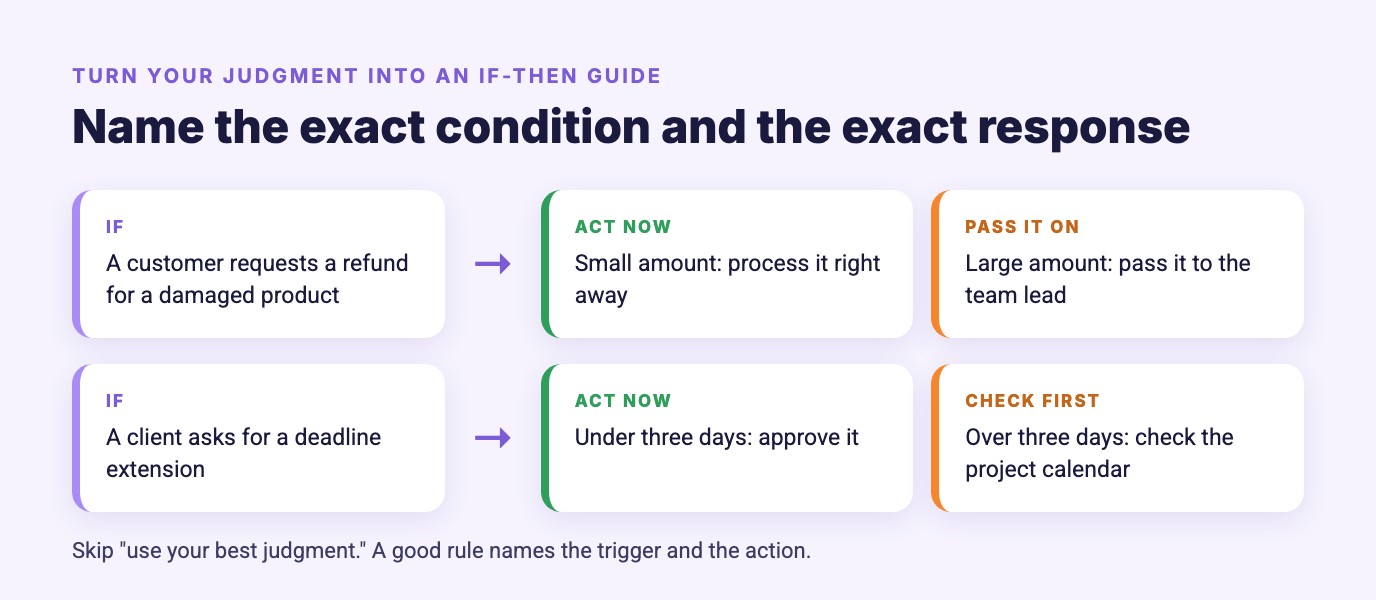
Each line removes one interruption, and ten lines remove ten. Over time, the system keeps adding up.
Worth sharingWe'd rather see a team follow a written rule imperfectly than wait for a perfect answer. The rule can be revised. The waiting can't be recovered.
Keep the rule where everyone can find it, because a shared document beats a spoken instruction every time. Your team shouldn't have to remember what you said in a meeting three months ago.
Before you write the rules, it helps to see where the week really goes. Our Team Workload Snapshot gives you one dated page of your team's week in tasks and hours. It adds one sentence about where that time should go. Most people finish it in one afternoon, and it shows you which decisions to hand off first.

Team Workload Snapshot
helps you see where your team needs support and where AI could save time.
Get the Team Workload SnapshotStep Back and Let Your Team Lead
Stepping back isn't abandoning your team, because you're giving them room to grow. Once you've turned daily decisions into systems, you can choose to let them go. Let your team run the process while you move into the role of mentor.
It's easy to hand off a task and then hover. You might ask for updates every hour or reopen decisions that were already made. That habit tells your team one thing, which is that you don't really trust them yet.
Omar caught himself doing this. He'd written the rules, and he'd handed over the refund decisions.
But he still opened the shared document each morning to check what his team had done while he slept. To him, it felt responsible.
Worth sharingIt was really fear wearing a manager's jacket.
Checking work you already handed off feels careful, but it quietly pulls the decision back to you. Set review points ahead of time, and then stay out of the space between them.
Let Mistakes Become Lessons
Your team will make a wrong call sometimes. That isn't a failure of the system. It's the cost of growing good judgment in someone else. When we fix every small error before it happens, we teach people to wait for us.
Omar's marketing manager once wrote a caption that missed the mark. He could have rewritten it, but instead he asked her one question: what would you change next time?
Her next caption was sharper, and the lesson stuck because she owned it.
Founders who hand off well get their focus back, and that makes sense. Every hour you spend reviewing someone else's work is an hour you don't spend on the next product, the next partnership or the next market.
Shift From Doer to Mentor
Your job changes when you step back. You stop being the person who decides everything, and you become the person who helps others decide well. That's a different skill, and it takes practice.
Coach Shayla knows this tension personally. For years, she looked the part while underneath she was running on racing thoughts and morning dread. She'd grab her phone before her eyes were fully open. The shift came when she stopped treating every team decision as a reflection of her own worth.
Omar set two review points each week, and between them, his team ran without him. He used the time he got back to think about growth instead of watching the dashboard. That's the real reward waiting on the other side of this step.
Focus Your Energy on Growth
Handing off decisions isn't the end of your work. It's the beginning of your real work. When daily decisions leave your desk, your mind has room for the work only you can do, and that work is growth.
Some founders reach this point and freeze, because they don't know what to do with the quiet. The answer is to point that energy at the future of your company.
Omar reached this point after months of building trust and handing over small decisions. Then something shifted inside him. He stopped starting his day in the weeds, and he started asking bigger questions.
- Market research: What do our customers need next?
- Strategic planning: Where should we be in three years?
- Team development: Who's ready for more responsibility?
- Personal well-being: What does a full day off feel like?
That last question matters more than most founders admit. A founder who never rests tends to make worse decisions, while a founder who rests comes back sharper.
What Growth Actually Looks Like
For Omar, growth looked like a quiet Tuesday morning. He opened a blank document and mapped out a new market he'd been too busy to explore. For the first time in years, he wasn't putting out fires. He was lighting one on purpose.

Coach Carlton often says, "The battle isn't always outside of you. A lot of the time, it's the pattern running inside." Here, that pattern is the habit of treating every small decision like an emergency. Breaking it frees up something bigger than your calendar.
Gallup found that teams in the top quarter for engagement are 21% more profitable than teams in the bottom quarter (Gallup, Q12 meta-analysis, 2016). That number isn't magic. It's what can happen when the founder stops being the bottleneck and starts being the leader.
Handing off decisions is linked to growth, too. Gallup studied 143 CEOs of fast-growing companies. Those with strong delegation talent earned 33% more revenue than those without it (Gallup, 2015).
We're not asking you to do less. We're asking you to do what only you can do. The conclusion of this series will show you how to hold on to that.
If you're like Omar and running on empty by 7 PM, a kind place to start is measuring it. In the From Fried to Focused 5-Day Challenge, you say your real energy number out loud. Then "everything is draining me" becomes five specific things, ranked. It's five live days, 45 minutes a day, two-on-one with both of us.
Conclusion
Asking "why does every decision in my business still run through me" isn't a sign that you're failing. It's a sign that your business grew faster than your systems did. We saw this pattern in the companies we worked in, and we've felt it ourselves. The weight you carry is real, and it's also something you can set down, one decision at a time.
These are the ideas we'd love for you to keep close:
- Keeping every decision is a habit, not a law. You built it one choice at a time, and you can unbuild it the same way.
- Decision boundaries always come first. Pick one type of decision, set a dollar or scope limit and hand it over in writing.
- Trust grows through small tests. Let your team make a low-stakes call, review it together and then widen the lane.
- Systems will outlast your willpower. A simple checklist or a few approval levels will do more than a pep talk ever could.
- Your role shifts from operator to coach. That may be the promotion you've been putting off for a while.
Picture stepping out of your next appointment to a quiet phone, because your team already knew what to do. Start today with one decision you made this week that someone else could have made. Write down who should own it next time, what the boundary is and when you'll check the result. Then go and tell that person, because that's the whole first step, and it's enough for today.
Worth sharingYou're allowed to have both: a business that runs well and a mind that rests well.
Where to start this week
The next time your phone fills up with questions, open the Team Workload Snapshot and see where your team's week goes, on one page. If a belief keeps pulling every decision back to you, use the Invisible Limits Finder to name it gently. Join the ClarityPilot waitlist to hear first when our private coaching app opens. And if your energy is gone by 7 PM, join the From Fried to Focused 5-Day Challenge. You'll work on it live with Coach Shayla and Coach Carlton, so you don't have to carry it alone.
 Omar HaddadFounder learning to hand off decisionsMeet Omar →
 Andre WhitfieldFounder, same founder circle as OmarMeet Andre →
 Jasmine HollowayOmar's marketing managerMeet Jasmine →
 Daniel ChoOmar's operations leadMeet Daniel →
Recommended for you
ClarityPilot
A private coaching app that helps you see what drains your energy, starting with the Transform Your Energy pathway. Join the waitlist and get our free guide, Make Smarter Decisions in 30 Days.
Join the ClarityPilot waitlistTeam Workload Snapshot
helps you see where your team needs support and where AI could save time.
Get the Team Workload Snapshot
Invisible Limits Finder™
helps you find the hidden rule holding you back, so you can move forward.
Get the Invisible Limits Finder™Workplace AI Academy
Get your team using AI
Explore the schoolFrequently asked questions
Why do I feel like I have to approve every small business decision?
Many founders feel this way because they started out doing everything themselves. As the business grows, that habit can lead to bottlenecks and burnout. It often comes from a lack of clear systems or trust in your team, and then nothing moves without you.
How can I stop being the only decision-maker in my business?
Start by finding the decisions you can hand off. Then create clear guidelines for your team, and give them the information and the authority to choose within those limits. Over time, your role moves from constant approvals to guiding and supporting.
What happens if I don't hand off decisions well?
Your business can slow down, and your team may feel they have no say. You risk burnout, slower growth and becoming a bottleneck for everything. It can also keep you from the big-picture thinking your company needs in order to grow.
Is it possible to trust my team with important choices?
Yes, and trust is built step by step. It grows through clear talk, clear expectations and the training and support people need. Start with smaller decisions, and widen the scope as your team gains experience and confidence. Mistakes along the way are part of how everyone learns.
How do I know which decisions to hand off first?
Start by seeing where the week goes. The Team Workload Snapshot walks you through nine short sections and leaves you with one dated page of tasks and hours. It comes as a Notion page you copy, plus a printable PDF.
What if I know I should let go but I still can't?
That's often a belief at work, not a missing skill, and it's nothing to be ashamed of. The Invisible Limits Finder gives you a workbook, a guided audio and a 7-day tracker to name the belief and work through it. It's educational, not therapy.
Can I get coached on my energy and decisions?
Yes, and we'd love to work with you. The From Fried to Focused 5-Day Challenge is five live days, two-on-one with both of us. You track your energy number, find your pattern and make a decision based on real information by day five.
Sources
- Paul J. Zak, The Neuroscience of Trust, Harvard Business Review, January-February 2017
- Jim Harter and Annamarie Mann, The Right Culture: Not Just About Employee Satisfaction, Gallup Business Journal, April 12, 2017 (reporting the 2016 Q12 meta-analysis)
- Sangeeta Bharadwaj Badal and Bryant Ott, Delegating: A Huge Management Challenge for Entrepreneurs, Gallup Business Journal, April 14, 2015