
The heart of it: To replace morning scrolling, choose one calm task. It might be three deep breaths, one written thought, a moment of thanks, a short plan on paper or a quick tidy of your space. Each one helps your body settle, and it turns your focus inward before the day starts asking things of you.
The coffee maker is still gurgling when you notice you've been standing at the kitchen counter for ten minutes, reading work emails you can't answer yet. Your shoulders are already up near your ears, and the day hasn't even started. We know that feeling well. Coach Shayla lived this pattern for years, looking the part on the outside while racing thoughts and morning dread ran underneath. Coach Carlton knows the heavy feeling in the gut that builds before getting out of bed.
So the question we'd love to answer with you is a simple one: what calm task can replace scrolling in your morning routine? A calm task is any small, chosen action that settles your body instead of stirring it up. It helps you start the day on purpose, instead of reacting to whatever lands on your screen first.
When the day starts with a phone in your hand, it starts in reaction mode. Work emails, news alerts and social feeds pull your attention outward before you've had a chance to feel your own feet on the floor. So the morning feels behind from the very first minute, even when nothing is truly on fire.
In this article, we'll walk through gentle, practical swaps. You'll see why the phone steals your morning peace and how three deep breaths can reset your body. You'll also see how small tasks, like writing one thought or planning on paper, can help. Each idea is something you can do at your own pace, without adding one more chore to your plate.
Here's what we'll cover together:
- Why reaching for your phone first thing stirs up worry before your feet hit the floor
- How a calm task helps you move from reacting to choosing
- Simple swaps like breathing, writing, gratitude and planning
- Why showing up beats doing it perfectly, so the habit really sticks
You don't need a complicated morning routine. You need one small action that tells your body the day can start from calm instead of chaos, and we'll help you find yours.
Key takeaways
- Reaching for your phone first thing stirs up worry, because it puts other people's needs ahead of yours.
- Three deep breaths can help your body move from tense to calm.
- Writing down one thought or feeling gives your worries a safe place to land.
- Gratitude moves your focus from what's missing to what's already here.
- Planning with pen and paper gives you clear priorities without screen noise.
- Tidying your space helps your mind settle and sets a peaceful tone.
Why Your Phone Steals Your Morning Peace
Your phone doesn't wake you up gently. It wakes you up into everyone else's emergencies. The moment you reach for that screen, you hand the first minutes of your day to whatever an app decides you need to see. Your own plans get pushed aside by other people's needs before you've even had a thought of your own.
We've lived this pattern too. Coach Shayla knows the racing thoughts that start before her feet hit the floor. Coach Carlton knows the heavy feeling that builds while he's still under the covers. The phone makes both of those worse, every single time.
Here's what happens in your body. A steady stream of alerts can keep your body's stress response switched on. It's the same fight or flight response our ancestors used to escape danger.
But there's no tiger in the room with you. There's only a news alert, a work email or a comment on a post.
Your body still reacts as if something urgent needs you right now. In a 2015 University of British Columbia study, 124 adults checked email only three times a day for a week. They felt less daily stress that week (Kushlev and Dunn).
Checking a news app is a good example. You open it for a quick update, and instead you get a wave of worry about the world.
That worry doesn't stay inside the app. It follows you into breakfast, into the shower and into your first meeting.
It makes it so hard to focus on your own plans for the day.
We saw this pattern again and again in the places where we worked: Fortune 100, Fortune 500 and Fortune Global 500 companies and small and midsize private firms. Smart, capable people started their days already behind. It wasn't because their workload was heavier than anyone else's, but because they gave their first hour to a device that's built to keep them reacting.
Try leaving your phone in another room tonight. A little distance makes the habit easier to break than willpower can on its own.
Your phone isn't neutral. It's designed to pull you in and keep you scrolling, and every app is competing for your attention. One of the easiest ways to win that contest is to make you feel a little anxious.
Worry keeps you checking, and calm doesn't.
That's the real cost of the morning scroll. You don't only lose time to the phone. You also lose the chance to start from a settled place you chose.
The calm swaps are real, and they work. But first, it helps to see clearly what the phone is taking from you.
It takes your peace before you've had a chance to claim it.
The Simple Power of Three Deep Breaths
Three slow breaths can take the place of the scroll. Before your hand reaches for the phone, you can give your body a different signal. While you're lying in bed with your eyes closed, breathe in through your nose for a count of four. Hold it for four, and then breathe out through your mouth for six. Do that three times, and that's the whole task.
It's a simple tool for mornings when the pressure hits before your feet touch the floor. It may be the shortest reset there is, and it costs nothing and takes under a minute.
Here's the step-by-step version we recommend:
- Breathe in for four counts. Breathe in slowly through your nose, and let your belly rise, not only your chest. This is called diaphragmatic breathing, which means the muscle under your lungs does the work.
- Hold your breath for four counts. Pause with the air still inside, so your heart has a moment to settle into a slower rhythm.
- Breathe out for six counts. Let the air out through your mouth, a little longer than you breathed in. A longer breath out tells your body it's safe to relax.
Three steps before the scroll
- Breathe in for four counts
- Hold your breath for four counts
- Breathe out for six counts
Repeat that pattern three times, and keep your eyes closed. Stay lying down if you can, because the phone can wait ninety seconds.
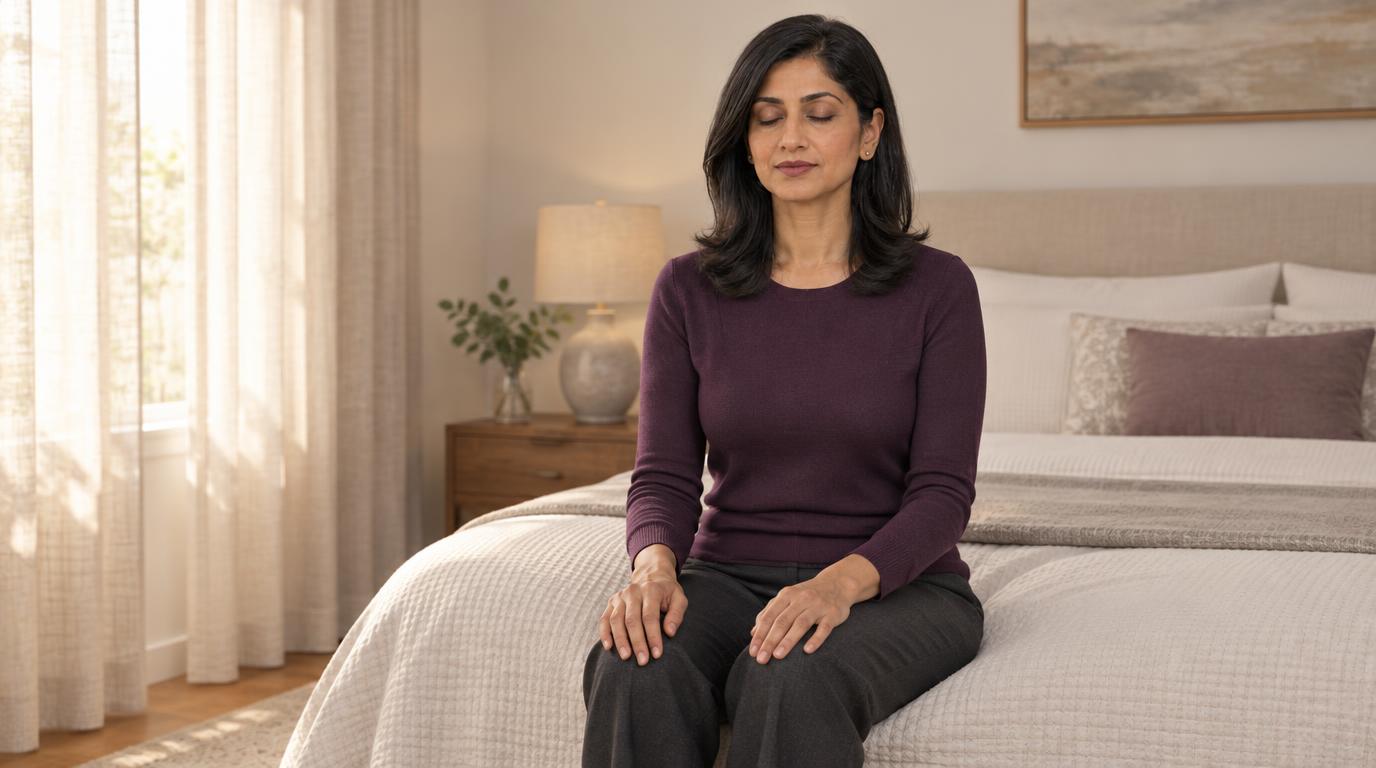
Why does this work so well? A slow breath out turns on the parasympathetic nervous system, which is the part of your body that handles rest and recovery. It's the opposite of the alert state your phone sets off.
You're not fighting stress with willpower. You're giving your body a clear, physical cue to slow down. A 2023 Stanford study backs this up. People who did five minutes a day of breathing that focused on the breath out had a bigger lift in mood than people who meditated (Cell Reports Medicine).
We like to think of it as a handoff. The alarm wakes you, and your body is already bracing for demands, so three breaths pass the baton from that tense state to a calmer one. You don't need an app to do it.
Worth sharingThis isn't a full morning routine. It's the first domino, and every small task that follows starts from the same place: a body that isn't already in overdrive.
Coach Carlton keeps a simple motto on this: Calm is a skill. Protecting your peace today protects your future self. Three breaths are the smallest way to practice that skill.
Let go of the urge to do it perfectly. Some mornings your breath in will feel shallow, and that's okay, because the pattern matters more than the performance.
What Calm Task Can Replace Scrolling In Your Morning Routine
A warm mug in your hands can do what a cold screen can't. Make a cup of herbal tea and sit quietly with it for five minutes. When you notice the warmth of the mug, your mind gets a gentle place to land. That simple act is one of several screen-free tasks that can replace the morning scroll.
We've tried this in our own mornings. The phone pulls your attention outward, toward demands, alerts and other people's needs. A calm task turns that attention inward, toward what you can feel and control right now.
Light stretching works the same way. Reach your arms overhead and roll your shoulders back, and then bend forward slowly.
Each movement gives your body a job that has nothing to do with a notification.
Your muscles let go of tension, and your mind stops chasing the next alert.
Quiet music offers another path. Choose something slow without words, and let the sound fill the room while you sit still. The music becomes something to focus on, a lot like the warmth of a mug or the stretch in your back.
Looking out a window costs nothing and asks nothing of you. Watch the light change, notice a tree moving in the wind or count the cars passing by.
This isn't meditation, and it doesn't need to be.
It's a simple way to give your eyes a rest from the small, bright rectangle that usually owns them.
These tasks all have one thing in common. They're screen-free, which means they don't set off the stress response your phone is built to create, and they move at your own pace.
There's no timer, and there's no streak to keep up.
No app is tracking how you're doing, so you can simply be there.
Coach Shayla often says, "Emotions are not problems. They are messages." A calm task helps you read those messages before the outside world starts shouting over them. Coach Carlton adds, "You can't get clear without taking action." Even a small action counts.
Here are a few gentle options to try:
- Make herbal tea and hold the warm mug for five quiet minutes
- Stretch your arms, neck and back before you touch any device
- Play soft music without words while you sit still
- Stand at a window and notice what moves outside
- Make your bed slowly, smoothing the blanket with both hands
None of these need special skill or gear. They only ask you to decide to start the day from inside yourself instead of from a feed. When you make that choice again and again, it becomes the calm skill you're already building.
Some mornings, you may pair a warm drink with one thankful thought. That's a natural next step toward gratitude, but you don't need it today. The task itself is enough.

Worth sharingA phone rewards speed, and a calm task rewards slowness. That's the whole difference, and it's why the swap works.
If you'd like a calm task that's already written for you, that's the job of our 7-Minute Morning Reset. It's a short guided audio and a written script in three parts, which are grounding, calm thoughts and one clear intention. You play it right after you wake up, before you touch your phone, and a 7-day tracker helps you keep showing up for yourself.
7-Minute Morning Reset™
It helps you start the day with a calm mind and one clear step.
Get the 7-Minute Morning ResetA racing mind isn't a broken mind. It's a mind holding too many open tabs. Writing down one thought or feeling closes one of those tabs, and that's the whole practice.
We don't mean a long diary entry. We mean one sentence, written by hand, before the phone lights up, and it's fine if it's messy.
It can even be half a thought. The point is to name what's there, so it stops running the show.
Coach Shayla calls this naming the charge. When a worry stays unnamed, it feels huge and shapeless, but once it lands on paper, it has edges. It becomes something you can look at, instead of something that's looking at you.
How to Do It in Under Two Minutes
Keep a small notepad and a pen on your nightstand. Before you reach for the phone, write one line, which can be a feeling, a fear or even a single word. Then close the notepad and set it down.
Here's the simple order we use:
- Open the notepad to a blank page.
- Write one sentence that starts with I feel or I notice.
- Close the notepad, and let that be your release.
Writing I feel worried about today's presentation and then closing the notepad does something quiet but real. The thought isn't circling inside you anymore, because it has a place to wait. Research backs this up, too. In a 2011 University of Chicago study, students who wrote about their worries before a big exam scored higher (Science).
Write one sentence, and then close the page. Closing it matters as much as writing it.
Coach Carlton brings the structure here. He says the path from an idea to getting it done starts with a single step you can see, and one written line is that step. It turns a foggy morning into a clear place to start.
We've both tried the long journaling habit, and it faded for us. The one-sentence version sticks because it asks almost nothing of you and gives back a little space.
This isn't about solving the worry. It's about seeing it, and once you see it, you get to choose what comes next. That choice often leads toward gratitude, which is the next step.
Some mornings, the same worried sentence lands on the page again and again. When a thought keeps coming back like that, it's a pattern, not a fact. Our Rewrite Your Reality workbook helps you work with it in four steps. You catch the thought and name it as a pattern. Then you replace it with a stronger thought you can believe, and you repeat it until it becomes your new normal.
Connecting With Gratitude for a Better Start
When you pause to name one good thing before reaching for the phone, your morning moves from "not enough" to "enough." Gratitude isn't an empty saying. It's a small, chosen act that changes what your brain notices first, and you can do it before your feet touch the floor.
Coach Shayla keeps a simple motto close: Be thankful for today. Don't wait for tomorrow. That line isn't about ignoring hard things. It's about refusing to let the hard things be the only things you see at 6:47 a.m.
Most mornings begin with a scan for problems, like the unread messages, the missed call and the calendar that already looks too full.
Gratitude flips that scan around.
It asks a different first question: what's already here that I didn't have to earn this morning?
Start Before You Sit Up
The easiest place to practice gratitude is while you're still in bed. You don't need a journal, a pen or a phone. All you need is one quiet moment and one honest thing you notice.
Think of the warmth of the blanket, the sound of birds outside or a kind word from yesterday that's still with you.
These aren't small things at all. They're proof that the day didn't start empty.
Naming three of them takes less than a minute, and you can say them silently or out loud. The point isn't to build a list. The point is to feel the shift from what's missing to what's already here.
That shift is real. In classic studies, people who listed what they were grateful for showed more positive mood than the comparison groups (Emmons and McCullough, 2003). Gratitude doesn't add anything new to your morning. It shows you what was already there, waiting to be noticed.
Why Gratitude Works Faster Than Scrolling
A phone feeds you other people's urgent needs, while gratitude feeds you a sense of your own steady ground. One makes the morning feel borrowed, and the other makes it feel like yours.
We've seen this in high-pressure roles. The first act of the day sets the lens you see through. If that first act is scanning for threats, everything starts to look like one. If it's naming what's good, your brain keeps looking for more of it.
This isn't forced cheerfulness, and we're not asking you to ignore the hard parts. They'll still be there after you take ninety seconds to stand on what's steady.
Here's a simple practice we come back to often:
- Before you sit up, name one comfort you can feel in your body right now.
- Name one sound you can hear that isn't a notification.
- Name one person who said or did something kind yesterday.
- Let those three things sit with you for one full breath before you move.
That's the whole practice. There's no app, there's no streak to keep and there's no perfect wording you have to find.
We like this better than morning affirmations that feel forced. Gratitude works because it's rooted in something real, so you're not telling yourself a story about who you wish you were. You're noticing what's already true.
That noticing gets you ready for the day with purpose. A mind that starts from "enough" makes calmer choices about what deserves its attention next.
Writing your top three priorities on paper gives you a clearer head than any app can. The phone shows you everyone else's demands, but a sticky note shows you only what matters before noon.
We've spent decades inside high-pressure workplaces: Fortune 100, Fortune 500 and Fortune Global 500 companies and small and midsize private firms. Strategy was the job, and yet the most useful planning tool we know fits in a pocket and costs less than a cup of coffee.
Paper planning works because it's slow, and that slowness is the point. Your hand has to form each letter, which gives your brain time to decide what truly belongs on the list.
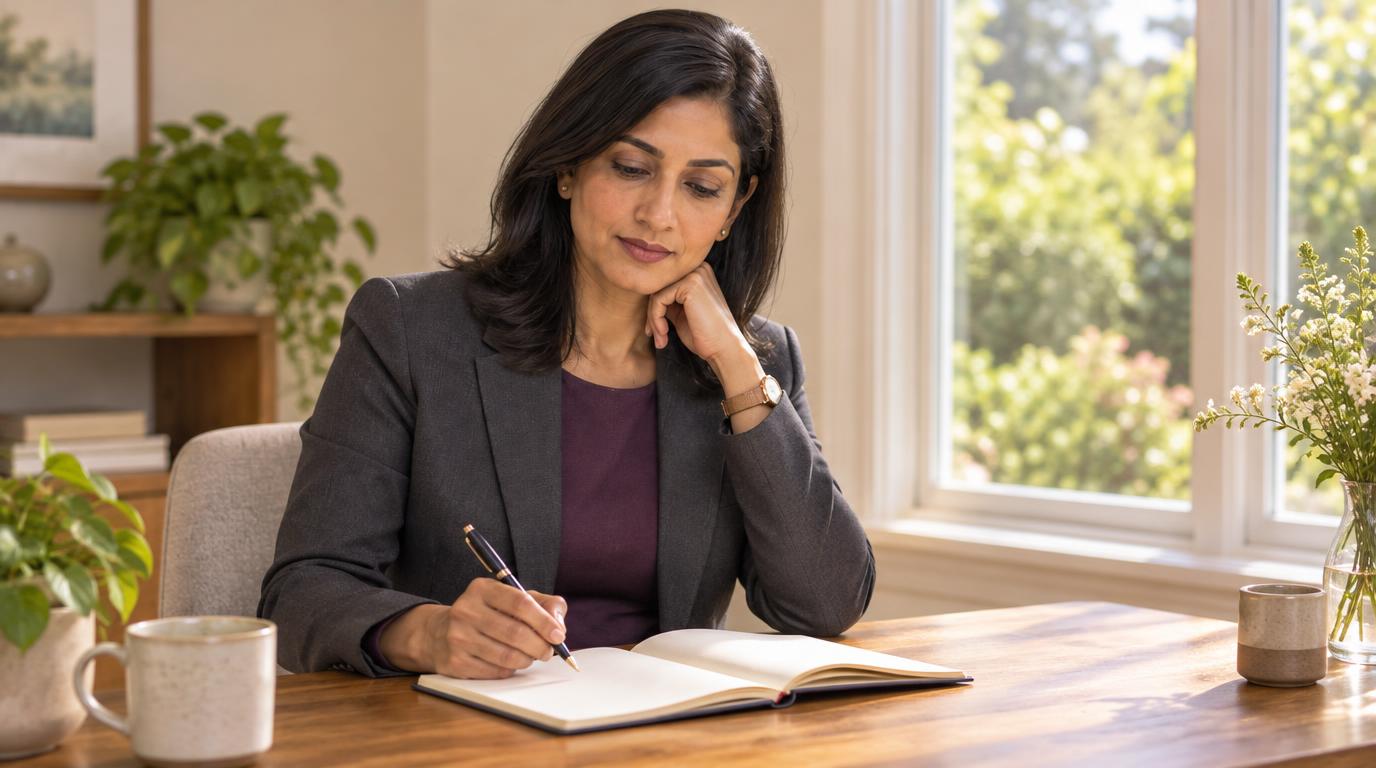
A to-do app lets you type faster than you can think. That's how lists grow to thirty items and feel useless by 9 a.m.
How to Plan on Paper Without Overthinking It
Start with a small sticky note instead of a notebook. A big page invites a big list, while a small square gently makes you choose.
Write down three things, not ten, because three is plenty for one morning.
They can be as ordinary as finish report, call client and walk dog. Writing them down while you sip your coffee tells your brain that the day has edges.
It isn't an endless scroll of other people's emergencies.
Coach Carlton's background in strategy taught us one thing that carries straight over to mornings: a plan is a path from idea to execution. Without that path, the idea keeps circling in your head. Writing it down is the first step of getting it done, not a separate chore before it.
Try not to copy the list onto your phone after you write it on paper, because that undoes the whole point. The paper version is your real plan.
Keep the note where you'll see it during your first hour. A corner of your desk works, and so does the kitchen counter. That paper becomes a quiet anchor while the screens start asking for your attention.
Some people like a full page with a few lines for what needs to happen before noon, and that works too. What matters is the pen touching paper, not the format.
You can skip the fancy planner. A sticky note and a pen you like are enough, and the feel of writing by hand slows your breathing in a way typing never does.
Your space matters here too. A messy desk makes a paper list feel like one more thing in the pile, while a clear surface gives the note room to work. We'll look at that more closely next.
Paper doesn't refresh, ping or add a red badge. It quietly holds what you chose, and that's why it still wins.
Preparing Your Space for a Calm Morning
A few minutes spent tidying the space right around you can clear the clutter in your mind and set a peaceful tone for the whole day. We don't mean a deep clean. We mean small acts of order you can see, which tell your brain the day has started on your terms.
There are two ways to wake up. One is to reach for the phone and let the outside world flood in before your feet touch the floor. The other is to shape the space around you first. We'll gently vote for the second one every time.
Coach Carlton puts it plainly: "The battle isn't always outside of you. A lot of the time, it's the pattern running inside." When you change your space, you interrupt that pattern before it takes hold.
Start With One Visible Act of Order
Making your bed right after you get up is the simplest place to begin. It takes under two minutes, and it gives you a quick sense of order and a small win. You've already finished something before the day has asked anything of you.
That small win matters more than it seems. A tidy bed makes the whole room feel calmer, and it also takes away the quiet invitation to climb back in and hide from the morning.
We saw this in the companies we worked in. Leaders who took charge of their first few minutes often felt more in charge of their whole day, and the same idea works at home.
Clear the Nightstand, Open the Curtains
Your nightstand is a little command center. If it holds yesterday's water glass, loose receipts and a tangle of chargers, it's sending you a message that unfinished business lives here. Clearing it takes seconds, and the calm it brings can last for hours.
Then open the curtains or raise the blinds. Natural light tells your body that the day has started, and that's a physical cue no app can copy.
Here's a simple order we recommend:
- Make the bed first, before anything else.
- Clear the nightstand of everything except what belongs there.
- Open the curtains or blinds to let the light in.
- Put yesterday's clothes in one place, instead of leaving them scattered.
None of these steps need motivation. They only need you to start moving, and moving builds momentum.
We're not suggesting a spotless home. We're suggesting a prepared space, and that difference is about being practical, not perfect.
A cluttered room keeps a low hum of unfinished tasks running in the background, and a cleared space quiets that hum. That's why tidying works so well as a calm task to replace scrolling in your morning routine.
Small, steady actions like these add up to lasting change. One made bed won't transform your life, but a hundred of them, done without drama, will change how your mornings feel.
Choosing Consistency Over Perfection
A calm morning is built on showing up, not on getting it exactly right. It's so easy to give up on a good habit because one morning went sideways, but that's the wrong measure. What you're after is progress, not a flawless routine.
Burnout is a pattern, not a personality. We say that often, because it changes how you see the whole problem. You're not broken because you grabbed your phone at 6:12 a.m. on a Tuesday. You're human, and the pattern can shift.
Showing up steadily beats pushing hard every time. A single deep breath taken every day will outlast a perfect thirty-minute routine done twice a month. The brain changes through repetition, not through big bursts of effort.
Show Up Imperfectly
Promising yourself three deep breaths every morning works because the bar is low. Some days you'll forget, and that isn't failure.
It's useful information, and you can simply come back the next morning and start again.
We saw this in the companies we worked in. The teams that got better weren't the ones with the fanciest plans, but the ones who kept showing up after a bad quarter.
Worth sharingMissing a day doesn't erase the days before it, because the habit is still there, waiting for you.
Progress Over a Rigid Schedule
A rigid schedule breaks the first time life gets in the way, but a flexible promise bends and holds. We'd much rather you do one calm task for sixty seconds than skip it because you can't do the full version.
We believe in real practices and no hype, and that's the standard we hold ourselves to. The power to replace scrolling comes from small choices you make again and again, not from one perfect fix.
Some mornings your breath in will feel shallow. Do it anyway, because the pattern is what counts.
If the tiredness follows you all day, not only at 6 a.m., take a look at our From Fried to Focused 5-Day Challenge. It's five live days with both of us, two-on-one, for 45 minutes a day. Day one starts with one honest number, which is how much energy you really have left at 7pm.
Your Morning Belongs to You
Your morning doesn't belong to your phone. It belongs to you and the life you want. When you reach for a screen before your feet touch the floor, you hand your first clear thoughts to someone else's plans. A calm task flips that order and puts you back in charge before the day begins.
We've walked through this ourselves. Coach Shayla knows what it feels like to grab the phone with her eyes half open and let morning dread set the tone. Coach Carlton knows the heavy feeling that builds before getting out of bed. We built these practices because we needed them too.
Here's what we hope you carry with you from this article:
- Three deep breaths slow your body down before your mind starts racing.
- One written thought gives a worried mind somewhere safe to land.
- A moment of gratitude turns your attention from what's missing to what's already here.
- Planning with pen and paper turns a foggy morning into a clear first step.
- A prepared space clears away small snags before they turn into frustration.
Showing up matters more than doing it perfectly. You don't need a full routine tomorrow, because one small action is enough.
Pick a single calm task and do it before you touch your phone, and that's your whole assignment.
We believe you can feel as good on the inside as you look on the outside. Success on paper and peace inside aren't a trade, and you're allowed to have both.
The question of what calm task can replace scrolling in your morning routine isn't really about the task. It's about the life you build, one morning at a time.
Now picture how tomorrow morning could feel. The coffee maker is gurgling, and you're standing at the window with a warm mug while your phone stays face down in the other room. Stretch once, breathe three times and write one line.
Then walk into your day as if it belongs to you, because it does.
Where to start this week
Start tomorrow morning with the 7-Minute Morning Reset, before you open your phone. When the same worried thought keeps showing up, catch it and rewrite it with Rewrite Your Reality. If you'd like both of us beside you while you track your energy for five days, join the From Fried to Focused 5-Day Challenge. And if you'd rather talk it through first, book a Discovery call with Coach Shayla and Coach Carlton.
 Anjali MehtaA finance leader reclaiming her morningsMeet Anjali →
Frequently asked questions
Why isn't scrolling first thing in the morning helpful?
Grabbing your phone as soon as you wake up pulls you straight into other people's demands. That puts your brain in reaction mode, which makes it harder to focus and feel calm later. When the day starts with everyone else's needs, you can feel behind before you've even begun.
How long does it take to change a morning routine?
Building a new morning habit takes steady effort and patience. A 2010 University College London study found that new daily habits took 18 to 254 days to feel automatic. The average was 66 days (Lally and colleagues). Start small, be patient with yourself and focus on progress, not perfection, because every calm choice helps.
Can a calm morning routine help my focus at work?
Yes, it can. When you start your day with purpose and peace, you're practicing being present. That can lead to clearer thinking, better choices and less mental tiredness during your workday.
What if I feel too tired to do a calm morning task?
Feeling too tired is a message from your body, and it deserves to be heard. Start with a very small task, like three deep breaths, because even a tiny step can shift your energy. Aim for gentle, steady practice instead of perfection, and listen to what your body tells you about rest.
Is there a guided version of a calm morning routine?
Yes, there's one ready for you. The 7-Minute Morning Reset gives you a guided audio, a written script in the workbook and a 7-day tracker. It takes about seven minutes, right after you wake up.
What if the same anxious thought comes back every morning?
That's a pattern you can work with, and it doesn't mean anything is wrong with you. Rewrite Your Reality walks you through catching the thought, naming it as a pattern and replacing it with a stronger one you can believe. It's educational and self-guided, not therapy.
Can I get support if I feel tired all day, not only in the morning?
Yes, and we'd love to help. The From Fried to Focused 5-Day Challenge gives you five live days with both of us. If you'd rather talk first, book a Discovery call. It starts with a small deposit that is credited toward your next call or the 5-Day Challenge.
Sources
- Kushlev K, Dunn EW. Checking email less frequently reduces stress. Computers in Human Behavior, 2015
- Balban MY et al. Brief structured respiration practices enhance mood and reduce physiological arousal. Cell Reports Medicine, 2023 (Stanford; NIH PMC9873947)
- Ramirez G, Beilock SL. Writing about testing worries boosts exam performance in the classroom. Science, 2011 (PubMed 21233387)
- Emmons RA, McCullough ME. Counting blessings versus burdens. Journal of Personality and Social Psychology, 2003 (PubMed 12585811)
- Lally P, van Jaarsveld CHM, Potts HWW, Wardle J. How are habits formed. European Journal of Social Psychology, 2010 (UCL); summary by BPS Research Digest
Recommended for you
7-Minute Morning Reset™
helps you start the day with a calm mind and one clear step.
Get the 7-Minute Morning ResetRewrite Your Reality™
helps you catch a harsh thought and choose a kinder, truer one.
Get Rewrite Your RealityFrom Fried to Focused
Ten weeks of live coaching, two-on-one, with both of us the whole way.
Explore coaching with both of us